
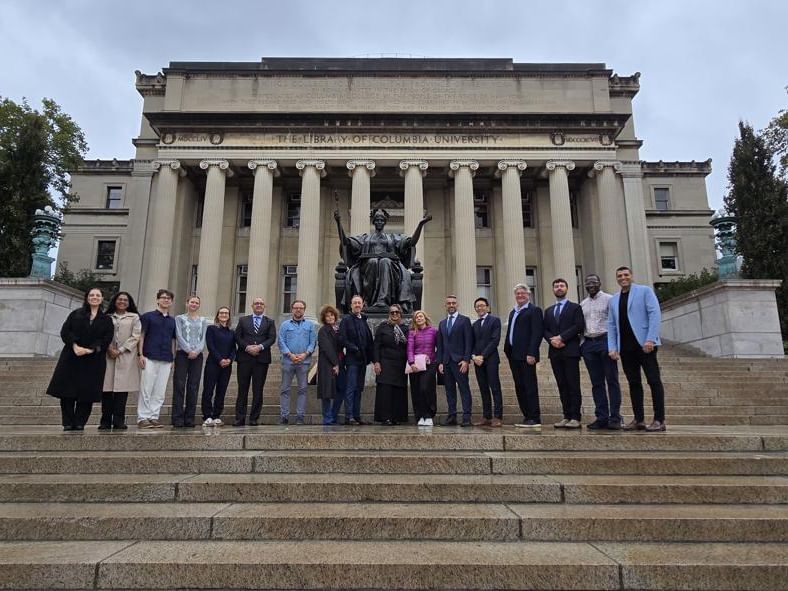
ABU DHABI, 30th September, 2026 (WAM) -- Khalifa University of Science and Technology participated in a series of high-level engagements in New York during the 81st United Nations General Assembly High-Level Meetings and Climate Week NYC 2026, contributing academic and technological expertise to global discussions on water security and preparations for the 2026 United Nations Water Conference which the UAE will co-host with Senegal in Abu Dhabi from 8th to 10th December 2026.
Across engagements involving government, academia, international organizations, technology leaders and water experts, Khalifa University highlighted the importance of translating scientific knowledge, artificial intelligence and emerging technologies into practical and scalable solutions for water resilience.
Professor Shadi W. Hasan, Director of Khalifa University's Centre for Membranes and Advanced Water Technology (CMAT) and Chairholder of the UNESCO Chair on Global Water Resilience, Innovation and Sustainable Solutions, contributed to discussions spanning AI-enabled water intelligence, technology deployment, sustainable water treatment and urban water resilience. Professor Hasan also chairs the UNESCO-IHP Youth4Water Initiative Advisory Board and the Khalifa University-UNESCO Global Water Hackathon 2026.
Professor Ebrahim Al Hajri, President of Khalifa University, said, “The UAE’s preparations for the 2026 UN Water Conference provide an important opportunity to translate scientific knowledge and innovation into solutions with meaningful and lasting impact. Khalifa University is contributing its research capabilities, expertise and international partnerships to this effort, connecting knowledge with policy, technology and implementation to advance water security and resilience.”
Artificial intelligence and water intelligence featured prominently across Professor Hasan's engagements in New York. At the UAE Permanent Mission to the United Nations, he participated in the high-level consultation on 'Advancing AI-Powered Hydrology for Water Resilience', exploring how AI, Earth observation, data and advanced hydrological modelling can help governments better understand water systems, anticipate vulnerabilities and strengthen integrated planning and resilient infrastructure.
Professor Hasan emphasised the need to move from reactive approaches toward predictive and preventive water management. He also contributed to the Water Cycle Intelligence Coalition Workshop, convened by the World Resources Institute, bringing a technology-deployment perspective focused on connecting Earth observation, AI and hydrological intelligence with engineering interventions and deployable solutions.
At Goals House, Professor Hasan joined the 'AI-Water-Energy Nexus: Innovation, Resource, and Responsibility' discussion, hosted by Abdulla Balalaa, Assistant Minister of Foreign Affairs for Energy and Sustainability and the UAE's Head of the 2026 UN Water Conference. The discussion examined how AI can support water management, desalination and resource efficiency, while also addressing the water and energy requirements of expanding AI infrastructure.
Across these discussions, a common message emerged: the value of water intelligence lies in the decisions and interventions it enables. Converting better prediction into engineering, operational and policy action is critical to delivering measurable improvements in water resilience.
At the UAE Water Academic Carnival, a national academic initiative organised under the UAE Ministry of Foreign Affairs and held at the UAE Permanent Mission to the United Nations, Professor Hasan represented Khalifa University and CMAT alongside leading UAE universities and research institutions.
His presentation, 'Next Generation and Sustainable Biodegradable Membranes for High-Efficiency Water Reuse: From Lab to Market', showcased Khalifa University research on next-generation sustainable membrane technologies and their progression from fundamental materials research through membrane fabrication, module development and validation toward deployment.
Professor Hasan also served as Co-Chair of the inaugural Water Cities Dialogue at Columbia University, convened by UrbanWaterSECURITY during Climate Week NYC. The dialogue brought together universities, cities and water experts to examine how urban environments can become more water-secure and resilient under changing climatic conditions.
Discussions covered water supply and diversification, reuse, desalination, urban flooding, climate resilience and emerging technologies, while exploring how cities facing different water challenges can exchange knowledge and practical solutions.
The New York meeting marked the first stage of an international dialogue connecting New York, Abu Dhabi, Naples and Venice. The second dialogue is planned for Abu Dhabi alongside the 2026 UN Water Conference, carrying the international conversation from New York to the UAE and strengthening collaboration among universities, cities, governments and water experts around practical approaches to urban water resilience.
Professor Hasan said, “Water innovation must ultimately be measured by its ability to deliver impact. AI and advanced water intelligence can help us anticipate scarcity, floods and emerging risks, but intelligence alone is not enough. We need to connect prediction with engineering, policy and deployable technologies.
“As the global water community moves toward Abu Dhabi in December, the opportunity is to move from dialogue and commitments toward demonstrable and scalable solutions that strengthen water resilience.”