
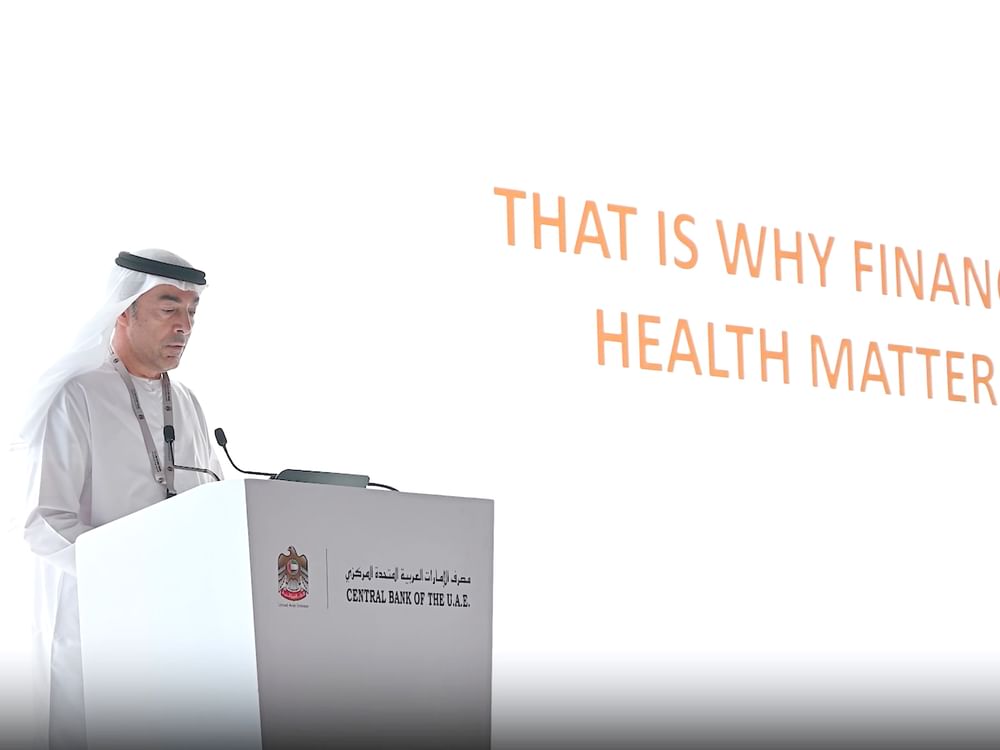
ABU DHABI, 30th September, 2026 (WAM) -- Under the patronage of His Highness Sheikh Mansour bin Zayed Al Nahyan, Vice President, Deputy Prime Minister, Chairman of the Presidential Court, and Chairman of the Board of Directors of the Central Bank of the UAE (CBUAE), the CBUAE is organising the MENA Leaders’ Summit on Financial Health.
The Summit is being held in partnership with the Office of the United Nations Secretary-General’s Special Advocate for Financial Health, the World Bank, the Arab Monetary Fund, the Consultative Group to Assist the Poor (CGAP) and the Centre for Financial Inclusion (CFI), under the theme “Building on Financial Inclusion: Advancing Financial Health for Resilience in MENA”, on 30 September and 1 October 2026 in Abu Dhabi.
The Summit aims to support a regional shift from focusing on the number of accounts and transactions as indicators of financial inclusion to focusing on tangible impact on financial health, including the ability to cope with shocks, long-term savings, responsible borrowing and informed financial behaviour.
The Summit also seeks to strengthen the evidence base on the impact of regulatory frameworks, consumer protection and digital public infrastructure on financial health outcomes, and to develop a shared approach to measuring financial health from a supervisory perspective.
The Summit is attended by central bank governors and heads of financial regulatory and supervisory authorities from the region and beyond. They are joined by senior representatives of international organisations, international standard-setting bodies and development institutions, CEOs of banks and fintech companies, as well as a distinguished group of innovators, academics and experts.
The programme of the first day, titled “From Inclusion to Financial Health: Building the Foundations”, includes high-level discussions on financial health as a new frontier for financial inclusion, financial literacy, digital public infrastructure, the role of the private sector, and women’s financial health.
The second day, titled “Financial Health in Action”, will focus on the financial sector and innovation, addressing behavioural science, gamified financial education, and emerging risks that may undermine financial health, such as fraud, AI-enabled scams and over-indebtedness.
The first day of the Summit saw a number of prominent national and international announcements and initiatives, most notably:
• The launch of the National Financial Literacy Strategy 2027–2031, a national roadmap to equip individuals at every stage of life, as well as micro, small and medium enterprises (MSMEs), with the knowledge and skills needed to make financial decisions confidently, responsibly and safely.
• The announcement of the CBUAE joining the CGAP Council of Governors, making the UAE the first country from the region to join the Council. This strengthens the UAE’s participation in global dialogue, knowledge exchange and the development of innovative approaches in financial inclusion and financial health, and supports its efforts to develop financial health policies at the regional and global levels.
• The announcement of the signing of a Letter of Intent with the United Nations Capital Development Fund (UNCDF) to cooperate on exchanging knowledge and expertise and building institutional capacity in the areas of financial health, financial sector development and digital public infrastructure governance, helping to translate regulatory and supervisory expertise into practical applications that strengthen financial systems and improve financial health outcomes.
• The presentation of the financial health measurement framework developed by CGAP, alongside new findings on the uses of artificial intelligence in financial services in the region, in partnership with Financial Innovation for Impact, and findings on women’s financial health based on the World Bank Group’s Global Findex Database.
On its second day, the Summit will see the launch of the Financial Health Innovation Challenge, an open global call for practical solutions that help improve the financial health of individuals and MSMEs in the UAE, to be tested in collaboration with licensed financial institutions in the country. Selected solution providers will receive support, grants and partnerships to help put their solutions into practice, with applications open until 30 November 2026.
The Arab Monetary Fund’s Financial Inclusion Task Force will also hold its 31st meeting on the sidelines of the second day of the Summit.
In a related development, on the sidelines of the 81st session of the United Nations General Assembly (UNGA 81), the United Arab Emirates officially joined the Group of Friends for Financial Health, a step that reflects the country’s commitment to supporting international efforts to enhance financial health for individuals and communities. The CBUAE extended its thanks and appreciation to the Office of the United Nations Secretary-General’s Special Advocate for Financial Health for its continued support and partnership.
On this occasion, Khaled Mohamed Balama, Governor of the Central Bank of the UAE, said, “Organising the MENA Leaders’ Summit on Financial Health reflects the vision of the UAE’s wise leadership to build a stable, innovative, inclusive and responsible financial sector that contributes to improving the quality of life of individuals. Last year, we launched the National Financial Inclusion Strategy to enhance inclusive and sustainable participation in the financial system, and today we are taking the next step by strengthening the financial literacy that individuals need to use financial services safely and confidently.”
He added, “Financial health is an investment in the long-term resilience and competitiveness of the national economy. Through this Summit, we seek to share the UAE’s experience, learn from our peers, and support countries in the region in developing financial health approaches that suit their national contexts. We also seek to consolidate the UAE’s position as a leading global financial hub.”