
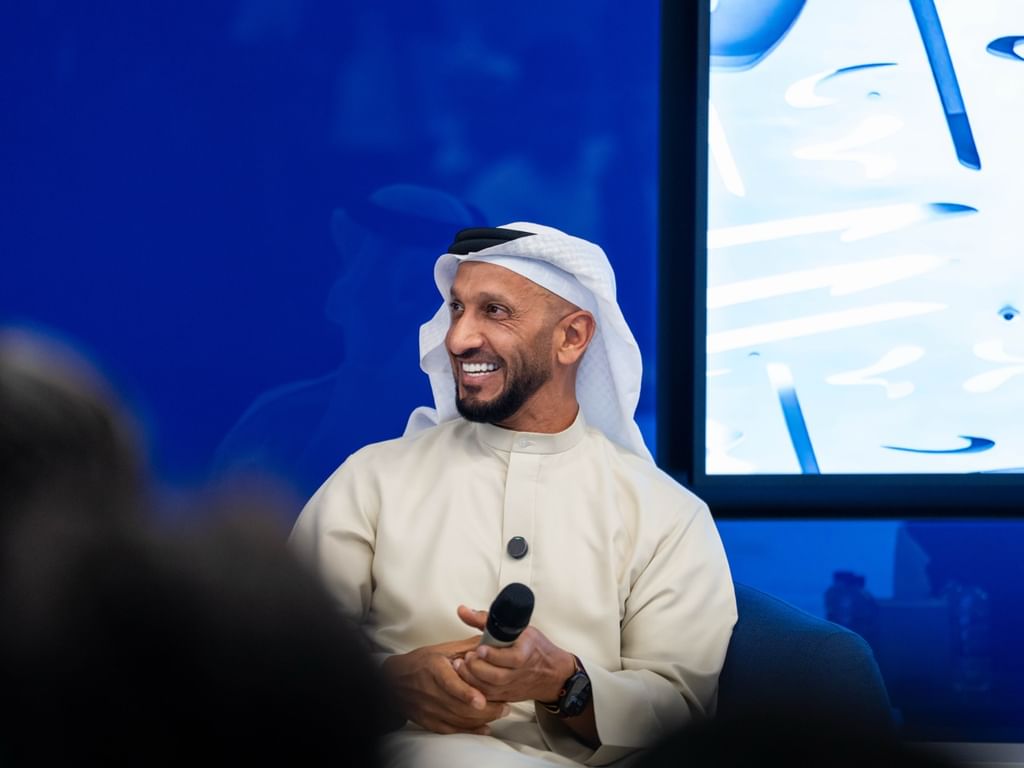
DUBAI, 2nd October, 2026 (WAM) -- Abdulla bin Mohammed bin Butti Al Hamed, Chairman of the National Media Authority, said the UAE’s leadership has made investing in young people a national priority, creating opportunities to develop their talents and turn ambition into achievement.
Speaking during the eighth Young Arab Media Leaders Programme, Al Hamed said investing in young people’s knowledge and capabilities is essential to the country’s strength and continued progress. The UAE’s approach, he added, has helped develop a generation equipped with the skills and ambition to shape its future and build on its achievements.
The session was attended by Dr. Sultan bin Saif Al Neyadi, Minister of State for Youth Affairs and Vice Chairman of the Arab Youth Centre (AYC).
Titled “Behind the Scenes: How Media Systems Are Built from Scratch,” the session explored media responsibility, public trust, decision-making and the changes reshaping the industry. It formed part of AYC’s efforts to connect participants with experienced media leaders and equip them to address issues affecting their communities professionally and responsibly.
Trust is the most valuable asset of any media organisation, media professional or content creator, Al Hamed said. It is earned through accuracy, verification, transparency and respect for the audience’s intelligence, rather than the speed at which content spreads.
Combating fabricated news, he added, goes beyond refusing to share it. Media professionals should report false content to the platforms where it appears and provide evidence demonstrating its inaccuracy. Repeated circulation increases its visibility online and can eventually make it appear credible.
Describing young people as a strategic asset for Arab media, Al Hamed said building media institutions that can endure begins with investing in people, establishing a clear vision and using technology to strengthen their message.
He also addressed the growing influence of artificial intelligence, which enables content to be produced and distributed at unprecedented speed and scale. These capabilities, he said, increase media professionals’ responsibilities, as AI cannot assume ethical accountability for published content or its impact.
Al Hamed urged young Arab media professionals to verify information before publishing, consider its consequences before algorithms amplify it, and recognise that every piece of content helps shape perceptions of their societies and countries.
He described the current moment as a historic opportunity for young Arabs to build a more influential, trusted and competitive media sector, one that shares knowledge, respects diversity, preserves human judgement and gives Arab stories a confident voice worldwide.
“Let us tell our own stories, in our own way, through our customs and traditions,” he said.
He encouraged participants to reach audiences unfamiliar with their countries and cultures, tailor their content to different ages and backgrounds, and explore new ways of telling those stories as the media landscape evolves.
Turning to the UAE’s media sector, Al Hamed said it has developed into an integrated economy where technology, innovation and creativity create new opportunities for young people.
He cited projections showing that the sector’s contribution to the UAE’s GDP will rise from AED18.8 billion in 2025 to AED27.2 billion by 2031, supporting more than 209,500 jobs.
Gaming and interactive content are among the leading areas of growth, with an annual growth rate of 12.1 per cent projected through 2031 and a contribution that has reached AED3.4 billion. These figures, he said, reflect the expansion of the content economy and the growing economic value of media and technology skills.
Concluding his remarks, Al Hamed urged young media professionals, “Make truth your reference, verification your habit and responsibility your measure. Keep learning, ask questions before publishing, and do not let the speed of technology outpace the maturity of your ideas.”
“Remember that fame is fleeting, but trust is a legacy. The words you write and the content you create today will remain part of how Arab media is seen. Be worthy of the responsibility you carry, the opportunities you have been given and the future you aspire to,” he said.
At the close of the session, Al Hamed launched the Smart Media Agents Challenge in collaboration with AYC, in the presence of Dr. Sultan bin Saif Al Neyadi.
The challenge invites participants to develop AI agents that address practical needs in media, improving efficiency, content quality and credibility while helping combat disinformation and save time.
Participants will turn their ideas into prototypes that can be further developed and put into use. The three best projects will receive prizes and support to help take them from concept to implementation, turning young people’s innovations into practical media solutions.
The eighth Young Arab Media Leaders Programme, organised by AYC, brings together 50 young men and women from 18 Arab countries and runs from September 27 to October 15, 2026.
The programme combines practical training, meetings with media leaders and experts, and visits to media organisations. Participants will also develop final media projects to present to an evaluation panel.