
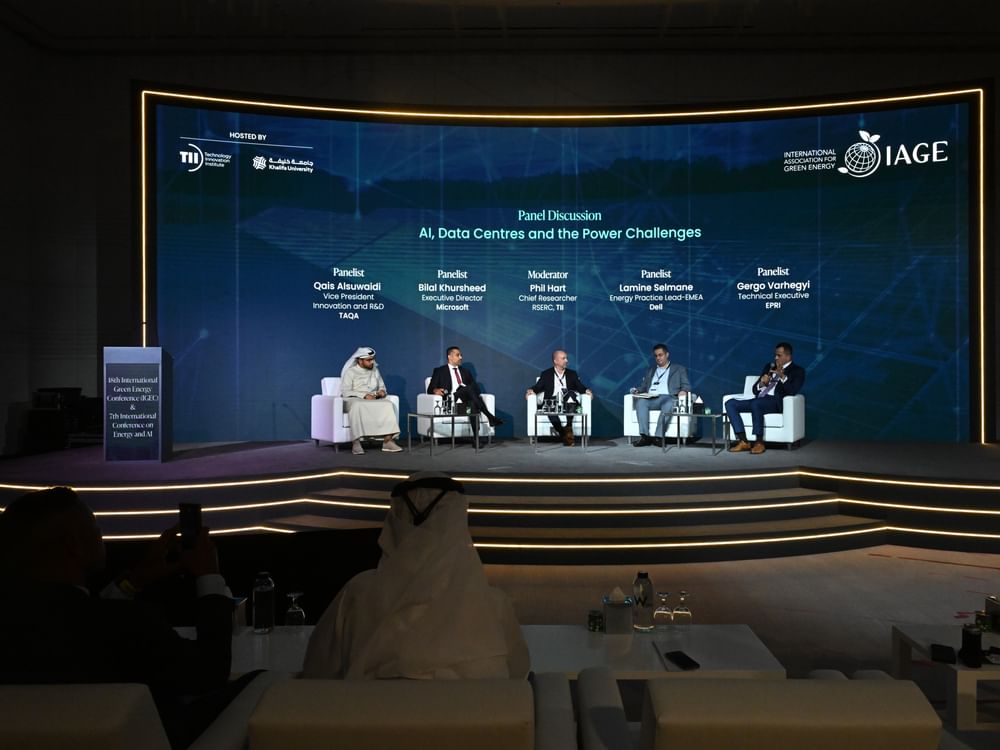
ABU DHABI, 5th October, 2026 (WAM) -- Khalifa University of Science and Technology and the Technology Innovation Institute (TII), the applied research arm of Abu Dhabi’s Advanced Technology Research Council (ATRC), co-hosted the 18th International Green Energy Conference and the 7th International Conference on Energy and AI.
The events bring global expertise to Abu Dhabi to advance research and practical solutions for cleaner, more efficient and resilient energy systems, while reinforcing the emirate’s growing role as a global hub for advanced technology, research and innovation.
The two international conferences are taking place from 4 to 8 October 2026 at W Abu Dhabi, Yas Island, with more than 140 research papers accepted for presentation.
The multidisciplinary forum brings together researchers, industry specialists, policymakers, educators and students from fields spanning clean energy, artificial intelligence, water, economics and policy, supporting new research partnerships, knowledge exchange and applied projects.
Professor Ebrahim Al Hajri, President, Khalifa University, said: “The future of energy will be shaped by our ability to connect scientific discovery with emerging technologies and real-world needs. Co-hosting these conferences with TII brings together global expertise across energy, artificial intelligence, engineering, water and policy to accelerate that translation.
By convening this community in Abu Dhabi, we aim to strengthen international research collaboration, create new opportunities for our faculty and students, and contribute solutions that support the UAE’s priorities in energy security, sustainability and technological leadership.”
Dr. Najwa Aaraj, Chief Executive Officer, Technology Innovation Institute, said: “The convergence of energy and artificial intelligence is opening new possibilities for how we design, operate and optimize the systems that underpin our future. At TII, we are focused on translating advanced research into practical technologies that can address complex real-world challenges. This forum creates an important opportunity to connect frontier research with real-world applications, accelerate the development of new solutions and help build more efficient, resilient and sustainable energy systems.”
The programme covers renewable and clean energy technologies, hydrogen energy and fuel cells, energy conversion and storage, green power production, cogeneration and distributed generation. It also examines the use of artificial intelligence to design, control and optimize energy and chemical systems, alongside broader areas including the relationship between the environment, water and energy; energy economics, policy and planning; life-cycle analysis; and education and capacity building in energy and AI.
The inclusion of the water-energy nexus reflects the growing importance of integrated approaches to resource security and resilience.