
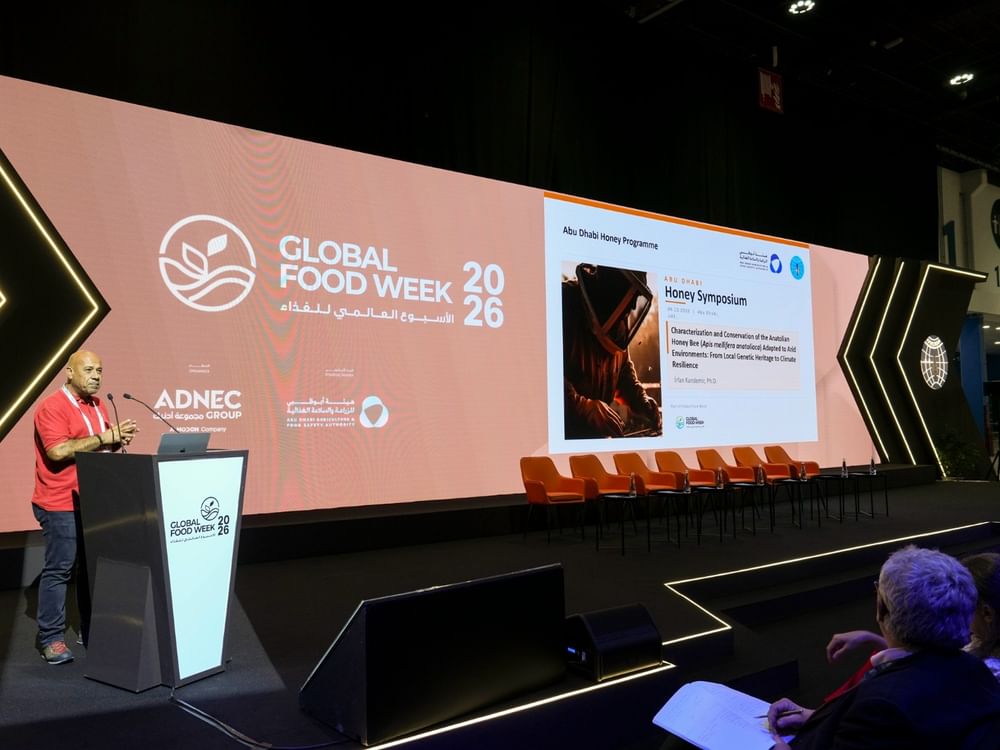
ABU DHABI, 6th October, 2026 (WAM) -- The inaugural Abu Dhabi Honey Symposium and Exhibition, organised by the Abu Dhabi Agriculture and Food Safety Authority (ADAFSA) in collaboration with Apimondia, the International Federation of Beekeepers' Associations, opened today as part of Global Food Week 2026.
The symposium brings together international experts, researchers, policymakers, beekeepers and industry leaders to exchange knowledge and explore the future of sustainable beekeeping and honey production in arid environments.
As the largest scientific gathering dedicated to beekeeping and honey production in the Middle East and North Africa region, the symposium's opening day featured a series of specialised presentations and discussions examining biodiversity, pollinator protection, sustainable apiary management and the contribution of beekeeping to resilient and sustainable food systems.
The opening ceremony featured a keynote address by Prof. Dr Peter Kozmus, Acting President of Apimondia, who highlighted the importance of strengthening cooperation among beekeeping organisations, researchers and industry stakeholders to support sustainable sector development worldwide.
In his welcome remarks, he said, “I would like to congratulate the organisers on delivering such a magnificent event. It is a pleasure to return to Abu Dhabi for the third time, and I am increasingly impressed by the quality, scale and impact of this gathering, which continues to provide an outstanding platform for advancing the global beekeeping sector.”
He added that beekeeping is far more than a niche agricultural activity. While honey production is an important contribution, the true value of bees lies in their essential role in pollination, biodiversity and sustainable food production. As beekeepers around the world face growing challenges, from climate change and habitat loss to disease and pesticide exposure, strong cooperation through local, national and international associations has never been more important.
He added that by bringing together knowledge, science and practical experience, we can create the conditions that enable beekeepers to thrive and safeguard the future of this vital sector. ''I commend the organisers of this outstanding event for providing a valuable platform that unites experts, policymakers and industry leaders to advance the global beekeeping community,'' he noted.
The Abu Dhabi Honey Symposium outlined key measures to strengthen sustainable beekeeping in the UAE, including improving water and food resource availability, breeding resilient local bee populations, using advanced genomic tools and AI-based monitoring systems, protecting pollinators and biodiversity, enhancing beekeeper education, and developing a coordinated national programme for beekeeping in arid environments through collaboration between researchers, institutions and conservation organisations.
The symposium programme included a number of high-level technical sessions and expert presentations, including a session titled Characterisation and Conservation of the Anatolian Honeybee, where delegates heard a scientific perspective on protecting native bee populations. Prof. Irfan Kandemir, Ankara University, shared insights from more than 25 years of work conserving the Anatolian honeybee, a subspecies adapted to hot, arid conditions similar to those of the UAE.
During the session, Prof. Irfan Kandemir highlighted how preserving genetic diversity helps bee populations withstand climate change and scarce food sources. He also stressed that lasting conservation depends on partnerships between scientists, beekeepers, governments and non-governmental organisations, and linked healthy bee populations to pollination, biodiversity and global food security.
Prof. Irfan Kandemir added that, "Without bees, there is no floral diversity and no food security. If we want resilient food systems, we first need to keep our bees diverse, adapted and alive.”
Visitors to the symposium also had the opportunity to participate in a wide range of interactive activities, including honey tasting experiences featuring varieties from around the world, each reflecting the distinct floral sources, landscapes and climatic conditions of its region of origin. Additionally, there were ongoing competitions for Best Photography and Best Scientific Poster Competition.
In addition, exhibitors showcased a diverse range of products and services, including premium Emirati honey, beekeeping equipment, apiary management solutions and innovative technologies supporting the development and sustainability of the beekeeping sector.
The Abu Dhabi Honey Symposium and Exhibition continues throughout Global Food Week 2026, providing a valuable platform for collaboration, knowledge exchange and innovation while reinforcing Abu Dhabi's commitment to advancing sustainable agriculture, food security and environmental stewardship.