
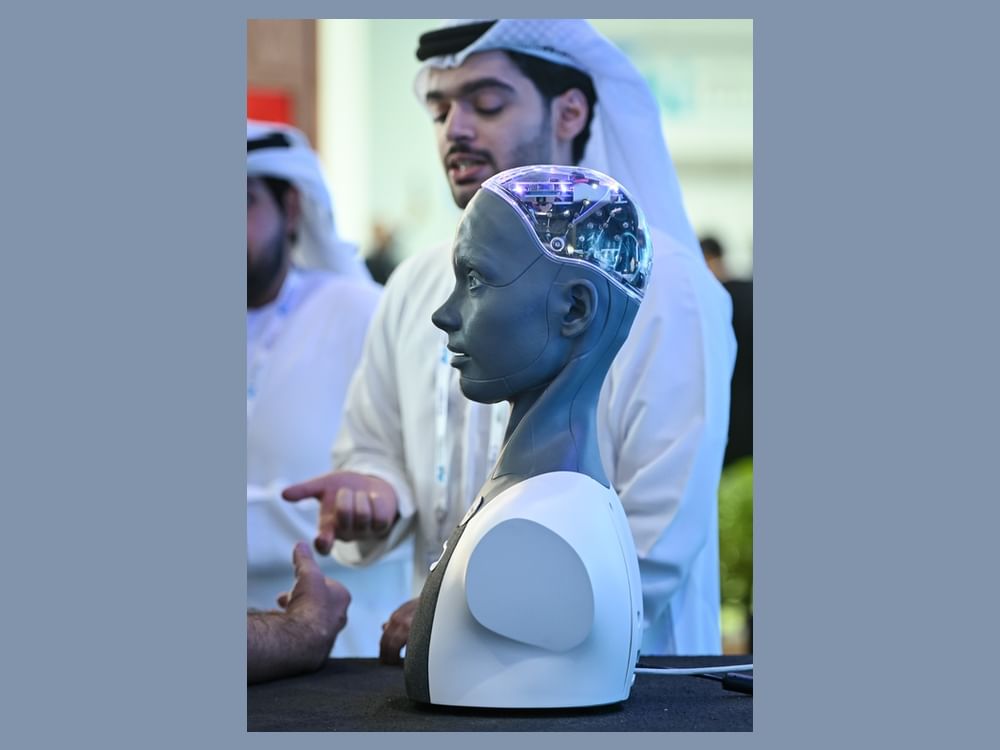
ABU DHABI, 7th October, 2026 (WAM) -- AI’s impact on the physical world and public services drove discussions on day two of Ai Everything Abu Dhabi 2026, as global AI pioneers, government heads and institutional leaders examined what it takes to put increasingly capable AI systems to work safely and responsibly across key industry sectors, from manufacturing to government services to education.
Following a successful opening welcoming over 400 enterprises and startups, over 180 speakers, and thousands of tech, government and business executives from more than 105 countries, Ai Everything Abu Dhabi 2026 reaffirmed the UAE capital’s meteoric rise in the global intelligence economy.
As AI moves beyond digital environments and into the physical world, Marc Raibert, Executive Director of the RAI Institute, and Founder of Boston Dynamics, the US robotics pioneer, charted the rise of a new generation of robotics, and the role of humanoids across industry and everyday life.
With global research by the Bank of America Institute projecting annual humanoid robot shipments could surge from 90,000 in 2026 to 10 million by 2035, the discussion underscored the accelerating transition towards physical AI adoption and its potential to reshape how people live and work.
“The humanoid robot is an exciting challenge. It’s like climbing the Mount Everest of robotics,” Raibert said. “I believe there’s a revolution in reinforcement learning, enabling a remarkable level of mobility in robots. The physical robot and how it’s designed is an important part of the future of robotics and physical AI. If you want to have a robot communicate with a human being, the easiest way to do it is to have a large language model between them. We’ve been looking at trying to use large language models to teach the robot what to do. We hope to leverage the higher levels of AI.”
Ai Everything Abu Dhabi 2026 also reinforced another increasingly evident reality: building national AI capability requires governments to equip their people with the skills needed to translate technological ambition into tangible impact.
Mariam Al Musharrekh, Director General of Government Talent, Department of Government Enablement – Abu Dhabi (DGE), shared insights from Abu Dhabi’s drive to build an AI-ready public-sector workforce.
Al Musharrekh said: “Our goal is to become the first AI-native government by 2027, and to do that, we have to focus on our people first. We have trained 30,000 government employees in AI, with a 95% completion rate, by making sure people understand how AI can benefit them and by tailoring training to their roles and priorities. AI can take on repetitive, transactional tasks and give people more time to focus on critical thinking, judgement, problem-solving and strategic thinking.
Prof. Ebrahim Al Hajri, President of Khalifa University, examined how education must evolve as AI reshapes the skills demanded of tomorrow’s workforce.
His discussion centred on the evolving role of universities in preparing students for an AI-driven future, while ensuring human judgement, creativity, and wisdom remain fundamental to learning and development.
Prof. Al Hajri said: “With AI, content is abundant, so we don’t believe the instructor will be the only source of knowledge. The instructor will become the orchestrator of learning in the classroom, helping students apply the theory and knowledge they have learned to real-world challenges. At Khalifa University, we are building our curriculum around the graduate we want to create — someone who is independent, creative, innovative and entrepreneurial, so rather than simply looking for jobs, they are actually creating jobs. Alongside deep technical skills, we believe ethics, leadership, curiosity, empathy, humility, agility and communication are essential, as well as the ability to become a lifelong learner.”
On the show floor, Abu Dhabi-headquartered Alef Education showcased how AI can be applied across the learning ecosystem to address real educational challenges and create measurable impact – from streamlining marking and feedback to supporting personalised learning journeys; and an AI Curriculum, designed to build AI literacy among students in English and Arabic.
Its Alef Pathways programme, which has supported more than 100,000 students, adapts learning content to individual needs while giving teachers real-time insights into progress and knowledge gaps.
Geoffrey Alphonso, CEO of Alef Education, said: “As AI becomes increasingly embedded in education and everyday life, students will also need to move beyond simply knowing how to use AI. They will need to understand how it works, critically evaluate its outputs, recognise its limitations and make informed decisions about when and how it should be used.”
Connecting university research with commercial deployment, Khalifa University Enterprises Company (KUEC) presented a portfolio of AI ventures solving real-world challenges across healthcare, government, industry, sustainability and enterprise.