
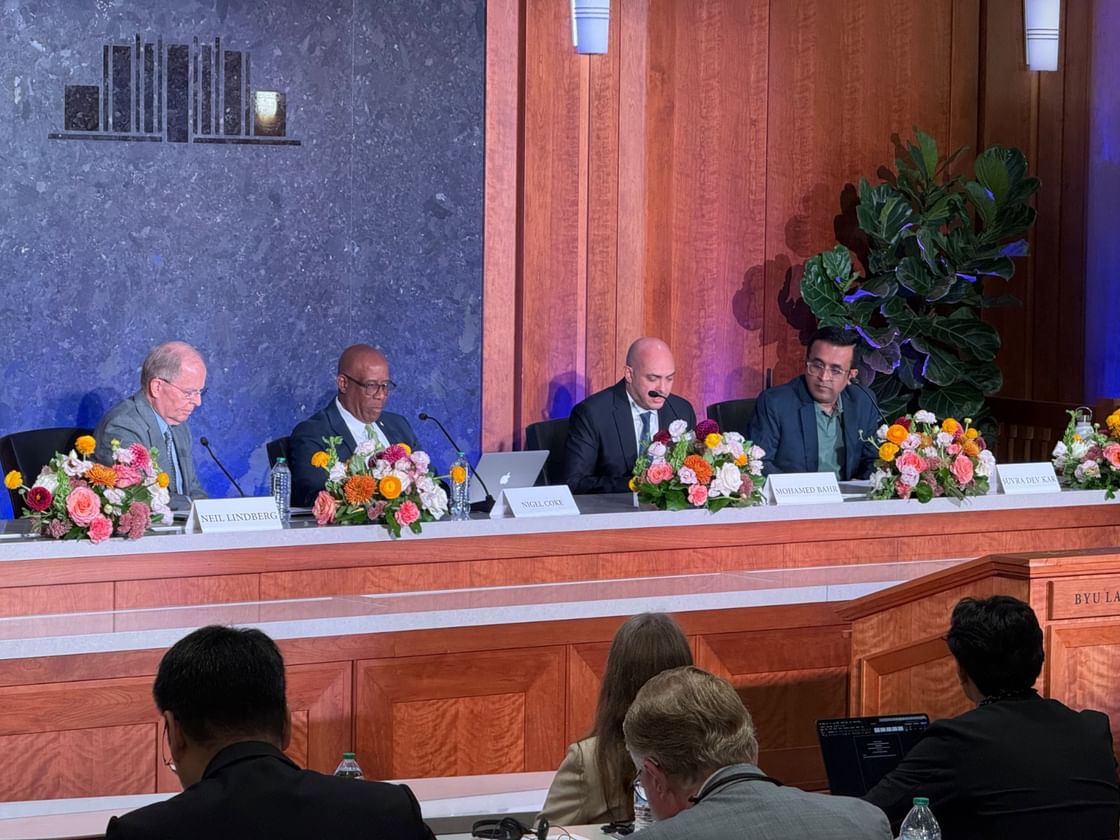
ABU DHABI, 7th October, 2026 (WAM) -- The Muslim Council of Elders participated in the 33rd Annual International Law and Religion Symposium, organised by the International Center for Law and Religion Studies at the J. Reuben Clark Law School, Brigham Young University (BYU), in the United States, from 4 to 6 October 2026.
The symposium brought together religious leaders, intellectuals, academics, and experts from around the world.
During a session entitled “Respect Among Followers of Different Faiths in a Religiously Diverse World,” Mohamed Bahr, Director of Strategic Planning at the Muslim Council of Elders, emphasised that the question is no longer limited to how followers of different religions can be encouraged to respect one another, but rather how societies and institutions can be built in which people of different faiths and cultures work together to help shape the future of humanity.
He noted that religious diversity does not require abandoning one’s convictions or principles; rather, it is grounded in respect for the dignity of others, their right to exist, and a shared responsibility toward humanity and society.
He added that religions, with their moral values and ethical principles, as well as the extensive societal experience accumulated by their institutions over centuries, can play an effective role in shaping responses to future challenges, particularly in the fields of artificial intelligence, climate change, and technology ethics.
He stressed the importance of enhancing the presence of religious leaders, figures, and institutions in international discussions in order to contribute to shaping the global agenda and the ethical foundations of policies related to shared challenges and issues.
Bahr also underscored the importance of fostering the concept of “intellectual respect” among followers of different religions and cultures as a means of promoting appreciation for diversity, pluralism, and differences, while helping to challenge stereotypes and misconceptions within societies. He highlighted the Muslim Council of Elders’ strategy for promoting the values of dialogue, tolerance, and coexistence, as well as its efforts to counter hate speech and extremism and correct misconceptions.
He further noted that the Council works to translate this vision into action by strengthening relationships and partnerships among religious leaders, figures, and institutions, and by linking religious engagement to global issues and challenges through religious diplomacy, the Faith Pavilion at the UN Climate Conferences (COP), and participation in international initiatives focused on artificial intelligence, technology, and human dignity.
Bahr affirmed that, since its establishment in 2014, the Muslim Council of Elders has worked to transform the values of human fraternity into sustainable cooperation and institutional partnerships, inspired by the principles enshrined in the historic Document on Human Fraternity, signed in Abu Dhabi in 2019 by His Eminence Dr. Ahmed Al-Tayeb, Grand Imam of Al-Azhar and Chairman of the Muslim Council of Elders, and the late His Holiness Pope Francis, former Head of the Catholic Church. These efforts have helped strengthen the role of followers of different religions and cultures in building peace and serving humanity.
On the sidelines of the symposium, Mohamed Bahr held a dialogue with a number of Brigham Young University students studying Arabic language and Middle East studies. The discussion focused on the importance of dialogue among followers of different religions and cultures in promoting understanding and coexistence, the role of youth in building bridges of communication, respect for cultural and religious diversity, and confronting stereotypes and hate speech, all of which contribute to building more cohesive and peaceful societies.