
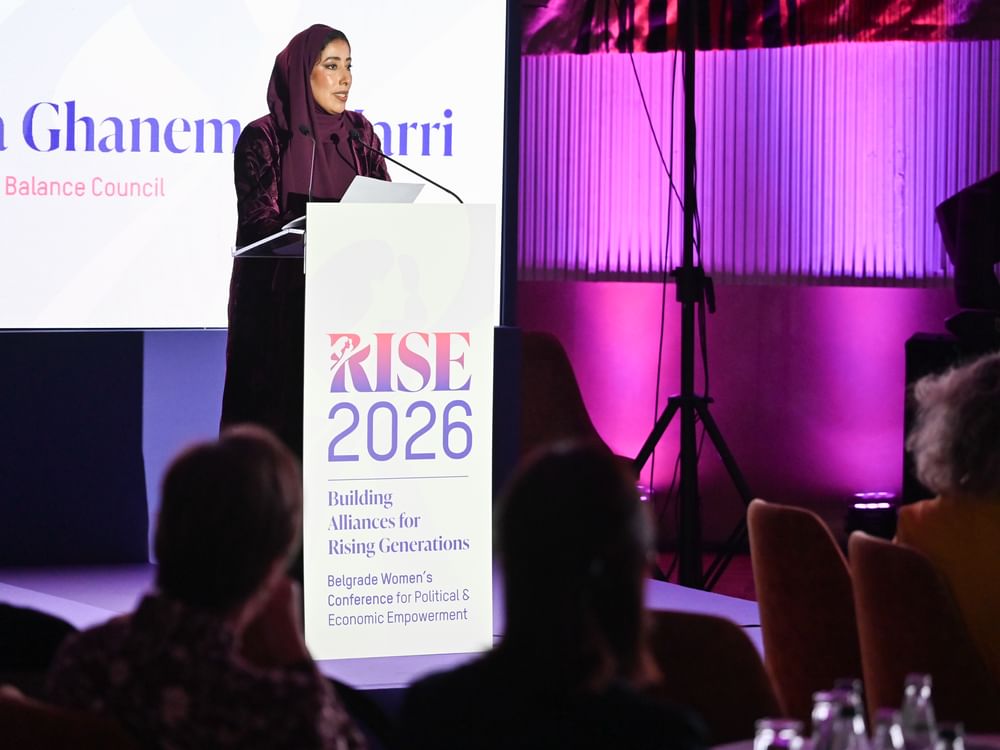
DUBAI, 7th October, 2026 (WAM) -- The UAE Gender Balance Council participated in the Second International High-Level Political Conference on the Political and Economic Empowerment of Women, RISE 2026, held in Belgrade, Serbia, on 7 October under the theme ‘Building Alliances for Rising Generations.’
The conference brought together government officials, ministers, representatives of international organisations, experts and private sector representatives to advance women’s participation in development and decision-making.
The Council’s delegation included Mona Ghanem Al Marri, Vice President of the UAE Gender Balance Council, and Mouza Mohammed Al Ghuwais Al Suwaidi, Secretary-General of the Council.
Mona Al Marri delivered a keynote address and participated in a closed high-level ministerial roundtable, highlighting the legislation, policies and practices underpinning the UAE’s progress in gender balance and women’s participation in leadership and the economy.
H.H. Sheikha Manal bint Mohammed bin Rashid Al Maktoum, President of the UAE Gender Balance Council and wife of His Highness Sheikh Mansour bin Zayed Al Nahyan, Vice President and Deputy Prime Minister of the UAE, and Chairman of the Presidential Court, said the UAE’s participation in international forums reflects its commitment to exchanging knowledge and learning from global experiences. These exchanges support the development of policies and practices that advance women’s participation and respond to the aspirations of communities and future generations.
H.H. affirmed that the UAE’s gender balance achievements are rooted in a comprehensive vision that places women’s participation in development and decision-making at the heart of the country’s development approach. Investing in women’s capabilities and expanding their opportunities, she noted, strengthens their role as partners in development and enables society to draw on its full human potential.
She said: “The UAE recognises that investing in women’s capabilities is an investment in the future of families, society and the economy. Expanding women’s participation across different fields strengthens their contribution to shaping the future. The UAE’s experience has demonstrated that providing opportunities for women, alongside an environment that supports their development and participation, helps translate national potential into achievements that advance society and sustain its growth and prosperity.”
In her keynote address, Mona Al Marri outlined the UAE’s approach to advancing gender balance through legislation, policies, investment in education, and institutional development. She focused on three priorities: expanding women’s opportunities in leadership and decision-making; strengthening accountability and measuring institutional progress; and connecting education with career and leadership opportunities amid the changes driven by artificial intelligence and emerging technologies.
She highlighted the UAE Gender Balance Index as a tool for measuring progress and strengthening institutional performance. The Index recognises individuals and federal entities whose efforts advance gender balance across leadership, workplace practices and specialised fields.
She also highlighted the private sector’s contribution to equal opportunities through the SDG 5 Acceleration Pledge, launched by the Council in 2022 to increase women’s representation in middle and senior management at participating companies to 30%, with a 2025 target for the first cohort and a 2028 target for later signatories. She emphasised the importance of family-supportive workplaces and wider opportunities for women to contribute to sectors shaping the future economy.
Mona Al Marri said: “The UAE Gender Balance Council’s participation in this conference underscores its importance as a global platform for exchanging expertise, developing solutions and building partnerships that respond to emerging challenges and opportunities. Our experience in the UAE demonstrates that women’s effective participation depends on clear policies, institutions capable of measuring outcomes, and partnerships that bring different sectors together around shared goals.”
On the sidelines of the conference, the Council’s delegation held a series of bilateral meetings with participating officials and leaders. These included Josie Christodoulou, Commissioner for Gender Equality of the Republic of Cyprus; Margaret Sarofim, Deputy Minister of Social Solidarity of the Arab Republic of Egypt; Imaan Sulaiman-Ibrahim, Minister of Women Affairs of the Federal Republic of Nigeria; Randa Gharib, Minister of State for Women’s Affairs of the State of Libya; and Tatjana Macura, Minister without Portfolio in charge of Gender Equality, Prevention of Violence Against Women, and Economic and Political Empowerment of Women of the Republic of Serbia.
The meetings focused on exchanging expertise, identifying shared priorities and exploring opportunities for cooperation in gender balance and women’s empowerment. They also strengthened dialogue and opened new avenues for collaboration in the period ahead.