
ABU DHABI, 8th October, 2026 (WAM) -- Dr. Tareq Ahmed Al Ameri, Acting Director-General of the Abu Dhabi Agriculture and Food Safety Authority (ADAFSA), said Abu Dhabi is moving rapidly towards establishing a global model for future agriculture based on innovation, advanced technologies and efficient resource use to strengthen food security and economic and environmental sustainability, while developing a more productive and resilient agricultural sector capable of addressing future challenges.
He made the remarks while outlining the key features of Abu Dhabi's Agricultural Transformation Strategy at Partners Forum 2026, organised by ADAFSA on the sidelines of Global Food Week (GFW), in the presence of strategic partners and representatives of government and private-sector entities and regional and international organisations.
Al Ameri said the strategy, which reflects the vision of His Highness Sheikh Mansour bin Zayed Al Nahyan, Vice President, Deputy Prime Minister, Chairman of the Presidential Court and Chairman of ADAFSA's Board of Directors, provides a roadmap for transforming the agricultural sector by 2040.
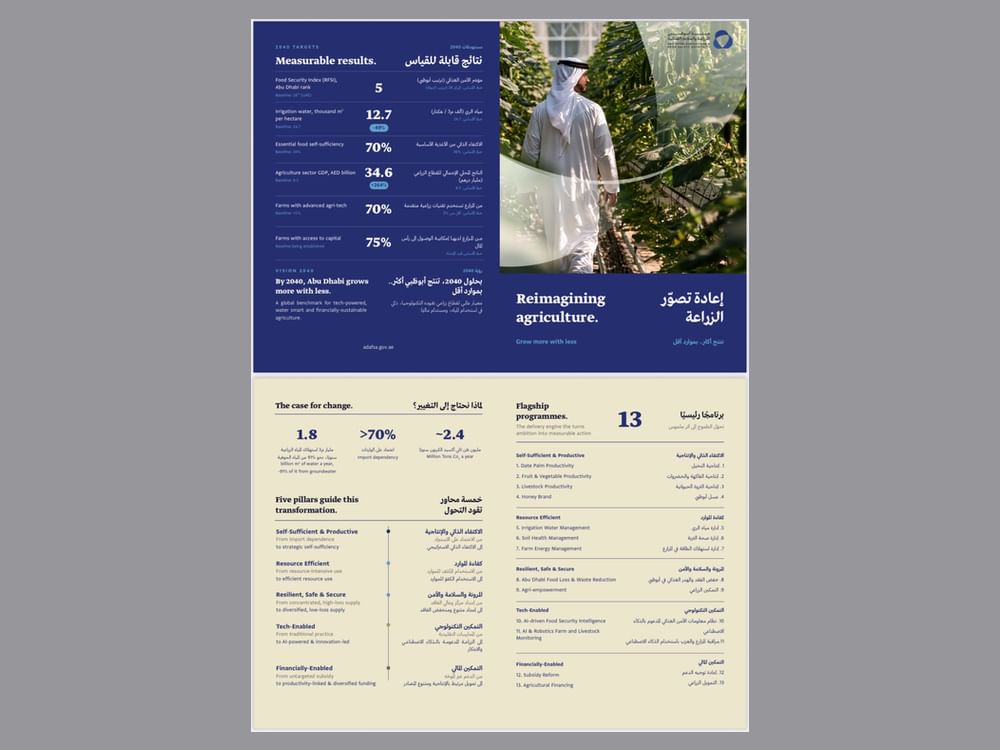
Centred on the principle of "Grow more with less", the strategy supports ADAFSA's vision of global leadership in food security and aims to position Abu Dhabi as a global model for technology-driven, water-efficient and financially sustainable agriculture.
Al Ameri said the strategy sets measurable targets for 2040, including raising Abu Dhabi's ranking in the Food Security Index (RFSI) to fifth globally, increasing the agricultural sector's contribution to GDP from AED9.5 billion to AED34.6 billion, a rise of 264 percent, and boosting self-sufficiency in essential food products from 30 percent to 70 percent.
The strategy also aims to reduce irrigation water consumption by around 49 percent, from 24,700 cubic metres per hectare to 12,700 cubic metres, expand the adoption of advanced agricultural technologies to 70 percent of farms and enable 75 percent of farms to access capital, improving the sector's competitiveness and long-term productivity.
Al Ameri said the strategy is built around five pillars: Self-Sufficient & Productive, Resource Efficient, Resilient, Safe & Secure, Tech-Enabled and Financially-Enabled.
ADAFSA is implementing the strategy through 13 flagship programmes covering the agricultural value chain, from infrastructure and agricultural and livestock production inputs to manufacturing, logistics, trade and consumption, to support long-term economic and environmental sustainability.
ADAFSA is implementing the strategy through 13 flagship programmes covering the agricultural value chain, from infrastructure and agricultural and livestock production inputs to manufacturing, logistics, trade and consumption, to support long-term economic and environmental sustainability.
He stressed that the strategy's success depends on cooperation with government entities, the private sector and academic and research institutions, noting that ADAFSA has established a network of partnerships and agreements to help achieve its targets and accelerate implementation.
"Through joint efforts with our partners, we seek to develop innovative solutions to agricultural challenges, enhance investment in modern technologies, improve production efficiency, and enable farmers to benefit from global best practices," he said.
Al Ameri added that Abu Dhabi has the infrastructure, research institutions and integrated ecosystem needed to become a global model for sustainable agriculture and attract investment and innovation.
Partners Forum 2026 brought together more than 180 of ADAFSA's government and private-sector partners, including 46 federal and local government entities, 25 private and agricultural sector companies and entities, 20 semi-government companies and institutions, and 14 academic, research and international entities, alongside other organisations.
The forum provided a platform to discuss the strategy's targets through 2040 and opportunities for cooperation on its 13 flagship programmes. Participants also exchanged expertise, shared proposals on priorities for the next phase and strengthened communication with ADAFSA.
The discussions aimed to reinforce partners' role in implementing the transformation programmes and shaping future priorities to develop a more productive, sustainable and resilient agricultural sector while strengthening food security in Abu Dhabi.