
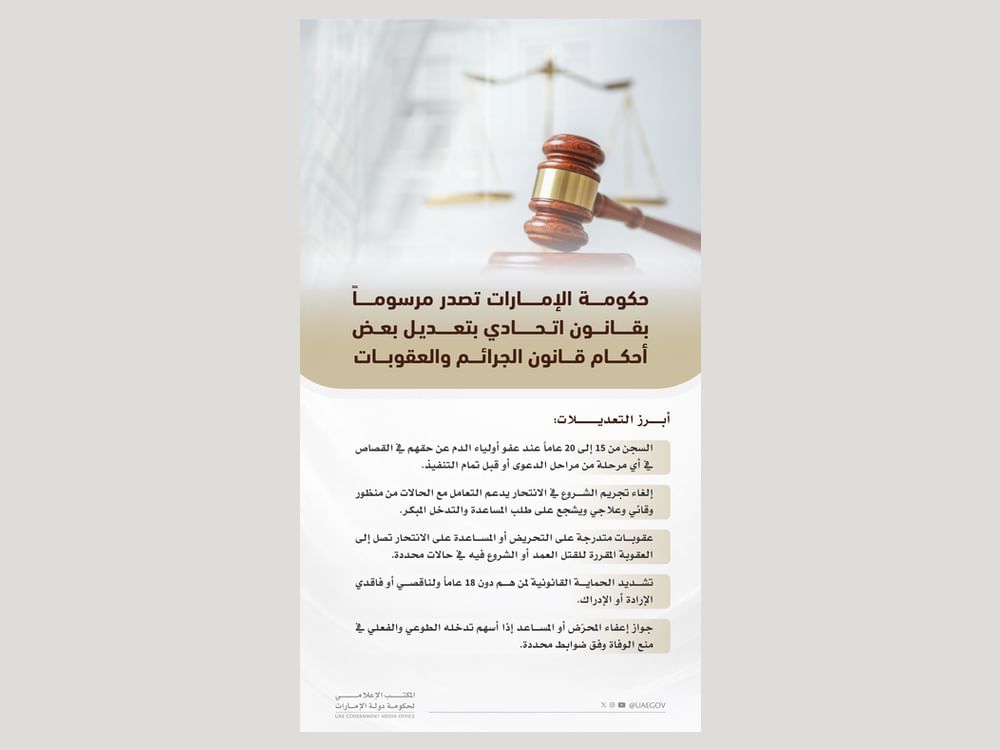
DUBAI, 8th October, 2026 (WAM) -- The UAE Government has issued a Federal Decree Law amending certain provisions of the Crimes and Penalties Law, as part of its continued efforts to advance criminal public policy and the efficiency of the national legislative system, balancing justice requirements, society protection, and humanitarian considerations.
The amendments reorganise a set of provisions on “qisas” (retribution) and on inciting or assisting suicide, which strengthens the protection of the right to life and reinforces the responsibility of society and the State for prevention and protection. It also improves the legal response to cases that call for care and early intervention.
The Decree Law amends Clause (3) of Article (384), so that the penalty is imprisonment for not less than 15 years and not more than 20 years if the victim's heirs waive their right to qisas at any stage of the proceedings or before the sentence is carried out. This amendment strengthens the effectiveness of legal deterrence. It balances the right of the victim's heirs to concede their right to qisas and the requirements of the Public Right and the protection of society from extremely serious crimes, within a justice system that safeguards rights and supports security and societal stability.
The amendments also decriminalise attempted suicide, so that an attempt is no longer punishable, to handle such cases from a preventive, therapeutic and humanitarian perspective and help reduce the fear of legal accountability and encourage victims of psychological crises to timely seek help. The approach improves the chances of early intervention, provides the care and support needed, and supports suicide prevention efforts. It also improves the monitoring of cases and related data, which advances preventive and therapeutic programmes.
The Decree Law sets graduated penalties for anyone who incites a person to commit suicide or assists them by any means, according to the outcome of the crime. The penalty is detention and a fine, or either of the two, if the person attempts suicide as a result of the incitement or assistance but death does not result. The penalty rises to temporary imprisonment of not less than three years and not more than five years, and a fine, if the attempt causes a permanent disability, or leads to the victim's illness or inability to carry out personal tasks for more than 20 days. The penalty is temporary imprisonment of not less than five years and not more than seven years if the incitement or assistance leads to the victim's suicide.
The Decree Law treats incitement or assistance to suicide as an aggravating circumstance if the victim is under 18 years of age according to the Gregorian calendar or has diminished will or perception. These new provisions strengthen legal protection community members who are most vulnerable to exploitation or harm. The Law also provides that the person who incites or assists in attempting suicide is punished with the penalty prescribed for intentional murder or attempted intentional murder, as the case may be, if the person who died by suicide or attempted it lacked will or perception. Any foreign national convicted under the provisions on inciting or assisting suicide is to be deported.
The Decree Law also allows the court to exempt the offender from punishment if, of their own accord and before the suicide is completed, they took action to prevent death and their intervention prevented it. Exemption does not apply if the attempt caused a permanent disability or led to illness or inability to carry out personal tasks for more than 20 days. This provision aims to encourage voluntary withdrawal from criminal conduct and to motivate direct and effective intervention to prevent death, while maintaining the necessary legal safeguards in cases that result in serious harm.
The Decree Law reflects the UAE's continuous approach to modernising legislation and developing the justice ecosystem in response to societal change. It instils the rule of law, strengthens prevention, protection and care, and maintains a balance between legal deterrence and the preservation of human dignity and the safety of society.