
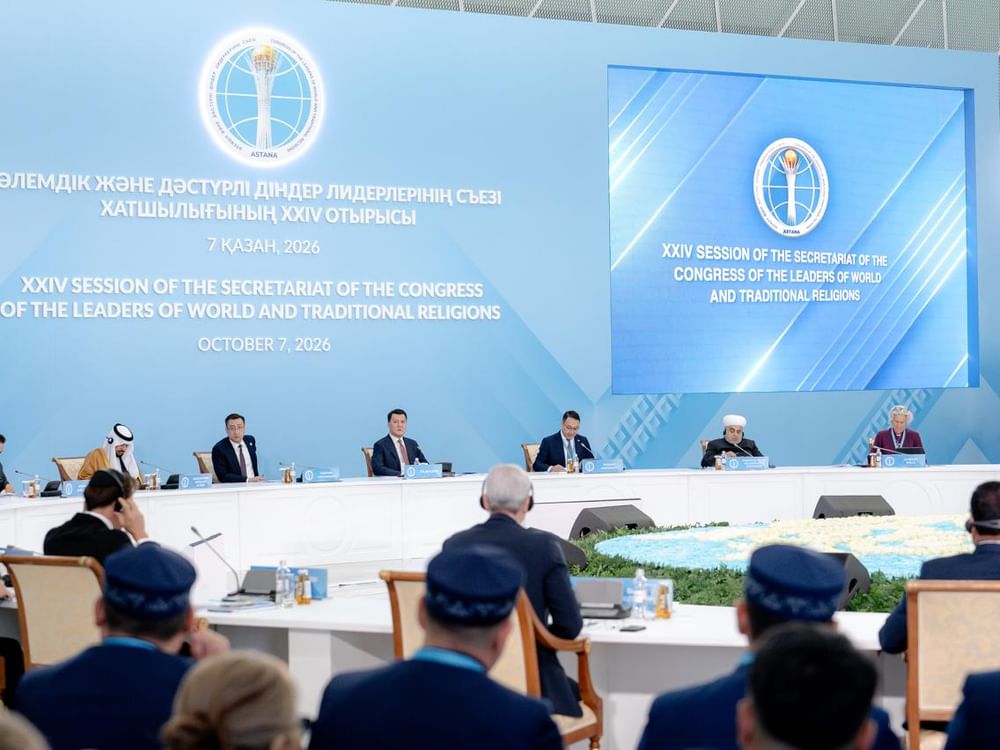
ASTANA, 8th October, 2026 (WAM) -- The Muslim Council of Elders participated in the 24th Meeting of the Secretariat of the Congress of Leaders of World and Traditional Religions, held on Wednesday in Astana, Kazakhstan, with the participation of several religious leaders and international figures.
The Council’s participation comes as part of its ongoing efforts to foster interfaith and intercultural dialogue and promote the values of coexistence, human fraternity, and peace.
In his address during the meeting, Judge Mohamed Abdelsalam, Secretary-General of the Muslim Council of Elders, stressed the importance of religious leaders fulfilling their responsibilities in addressing the challenges facing the world today and working collectively to advance peace, mutual understanding, and coexistence among peoples and societies.
He called on religious leaders to intensify their efforts to promote peace and support international and regional initiatives aimed at ending conflicts. He also commended the United Arab Emirates for its contributions to regional and international peace and its efforts to promote the values of tolerance and human fraternity.
Abdelsalam conveyed the greetings of His Eminence Dr. Ahmed Al-Tayeb, Grand Imam of Al-Azhar and Chairman of the Muslim Council of Elders, and expressed appreciation for the Republic of Kazakhstan’s efforts in advancing interfaith and intercultural dialogue and fostering peaceful coexistence. He underscored the importance of building upon the 2025 Astana Declaration for Peace and translating shared values and principles into tangible actions that positively impact people's lives.
Addressing artificial intelligence, Judge Abdelsalam highlighted the importance of ensuring that technological advancement is guided by ethical principles that safeguard human dignity, privacy, and freedom, while ensuring that technology remains a tool that serves humanity. He emphasized that intelligent systems, despite their ability to provide information and analyze texts, should not replace human conscience, assume spiritual authority, or become an independent source of religious guidance.
He further highlighted the vital role of religious institutions in promoting shared values, nurturing the human conscience, and fostering mutual respect. In this context, he noted that the historic Document on Human Fraternity, signed in Abu Dhabi in 2019 by His Eminence Dr. Ahmed Al-Tayeb, Grand Imam of Al-Azhar and Chairman of the Muslim Council of Elders, and the late Pope Francis, established the principles of human dignity and shared responsibility for the future of humanity.
He also called for expanding cooperation among religious institutions to include educational and community-based initiatives, while encouraging the active engagement of youth, women, researchers, and representatives of local communities in developing and implementing solutions. He reaffirmed the Muslim Council of Elders’ readiness to collaborate on initiatives that promote interfaith and intercultural dialogue, strengthen human fraternity, address contemporary challenges, and contribute to peace and stability.