
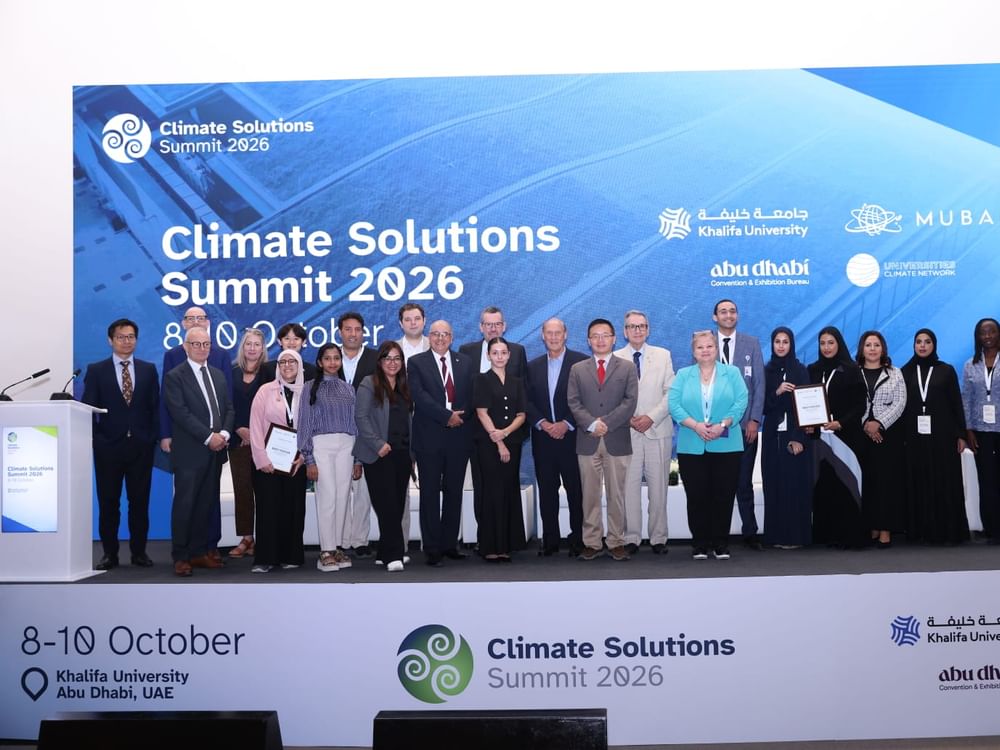
ABU DHABI, 9th October, 2026 (WAM) -- – Khalifa University of Science and Technology today concluded the Abu Dhabi Climate Solutions Summit 2026, following two days of knowledge exchange focused on translating climate research, innovation and expertise into practical solutions with potential for real-world impact.
Over two days, the Summit which was held at Khalifa University’s Main Campus under the theme ‘From Climate Knowledge to Climate Action,’ was co-organized by Khalifa University’s Research Institute for Resource Management and Sustainability and the UAE Universities Climate Network (UCN), with support from the Mubadala Youth Council.
More than 1,000 registrations and over 100 innovative research posters were accepted as part of the program. A total of five youth-focused sessions provided students and young innovators with opportunities to engage with climate challenges through design, communication, pitching and youth-led discussions.
Following the Summit, Khalifa University will work with the Global Alliance of Universities on Climate and the Higher Education Climate Network of Networks to develop recommendations capturing key priorities from the discussions for wider international climate conversations.
Professor Ebrahim Al Hajri, President, Khalifa University and General Chair of the Abu Dhabi Climate Solutions Summit 2026, said: “The Abu Dhabi Climate Solutions Summit has demonstrated the value of bringing research, industry, policy, investment and talent together around shared climate challenges. Khalifa University will continue to strengthen these connections and advance research-driven solutions across critical areas including energy, water, industry and cities. Our focus is on ensuring that knowledge and innovation deliver meaningful impact for society and the economy.”
Researchers, educators, industry representatives, investors, policymakers and young innovators examined emerging climate technologies, alongside the wider conditions needed for their practical adoption. Discussions highlighted affordability and scalability, infrastructure and regulation, financing, workforce development and public acceptance.
Youth engagement extended across both days. Sessions ranged from youth action and a facilitated design simulation to an elevator pitch, climate engagement through social media, a youth-led interaction panel, polar and climate change, and youth-driven AI climate solutions. The programme enabled young participants to engage with climate challenges through different perspectives spanning communication, design, technology and innovation.
Water emerged as one of the prominent areas of discussion, with sessions examining water security and technologies as well as approaches to extracting water from the air. The program reflected the interconnected nature of resource security and climate resilience with discussions on sustainable food and agriculture and an opening keynote on rethinking energy, water and food systems to build well-being.
Women’s contributions to climate research and innovation were highlighted through the ‘Women Scientists for Climate Solutions’ session, while the wider program examined health impacts, the natural and built environment, new materials for sustainability, carbon capture and storage, and communal activation for sustainability.
A recurring theme across the Summit was the need to approach climate change as a systems challenge rather than focus on individual technologies. Discussions explored the complementary roles of renewable energy, peaceful nuclear energy, storage, grids, hydrogen, carbon capture and efficiency can work together, with the infrastructure and enabling environment required for solutions to achieve impact at scale.
A concluding interactive session hosted by Professor Samuel Mao with venture capitalist Bill Shelander focused on ‘Unlocking the Path from Climate Tech Ideas to Commercial Solutions.’ The conversation examined the gap between research and commercialization, including the importance of matching technologies with appropriate capital at different stages, identifying real customers, and designing demonstration projects around market demand as well as technical performance.
Professor Samuel Mao, Senior Director, Research Institute for Resource Management and Sustainability, Khalifa University and Conference Chair of the Abu Dhabi Climate Solutions Summit 2026, said: “A central question throughout the Summit has been how we move the most promising solutions from research and innovation to deployment and global impact. The discussions reinforced that scientific performance alone is not enough. Solutions must also be scalable, affordable and responsive to real-world needs, with the appropriate infrastructure and financing to support their adoption.”
International collaboration was embedded throughout the Summit, with the Global Alliance of Universities on Climate, Higher Education Climate Network of Networks, and World Association of Young Scientists contributing topical sessions. The Summit’s Conference Co-Chairs included Stephen Davison, Higher Education Climate Network of Networks and University of Cambridge, UK; Professor Jian Zhang, Global Alliance of Universities on Climate and Tsinghua University, China; and Professor Rasha Bayoumi, UAE Universities Climate Network and University of Birmingham Dubai.