
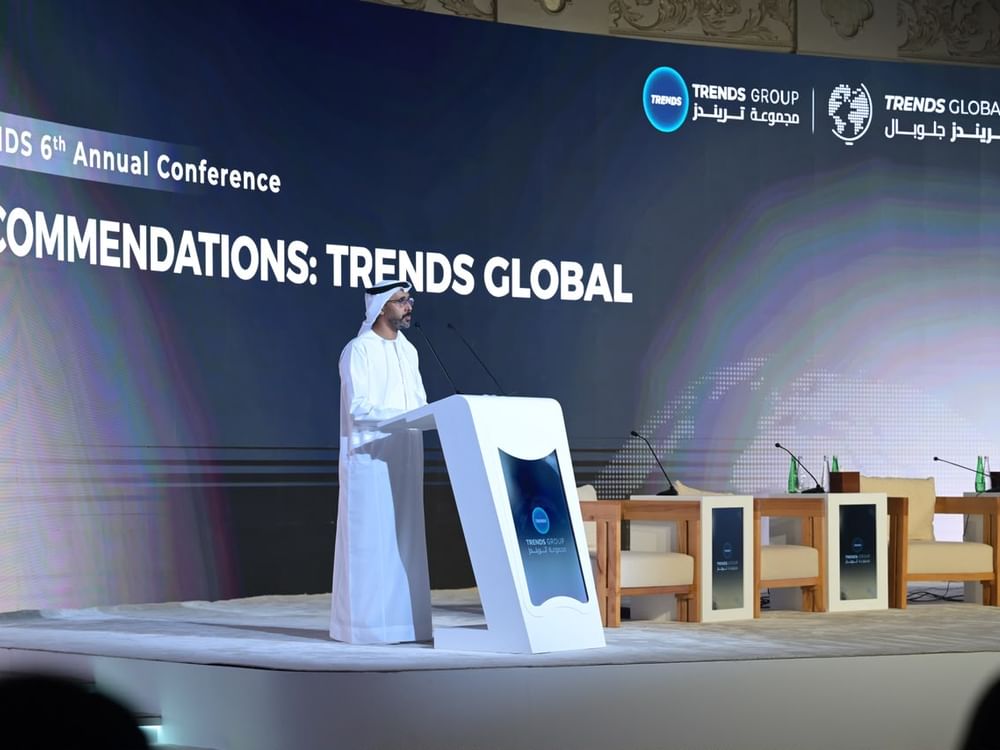
ABU DHABI, 13th October, 2026 (WAM) -- The sixth annual TRENDS conference called for stronger regional security cooperation, strategic partnerships, stronger economic and cybersecurity foundations, and the protection of critical infrastructure.
It also urged translating strategic dialogue into actionable policies and initiatives that help build a safer, more stable Middle East capable of addressing crises and geopolitical shifts.
The conference’s concluding recommendations, presented yesterday in Abu Dhabi, under the theme ''Sustainable Security: The Future of the Middle East After the War'', emphasised that achieving sustainable security requires a comprehensive approach beyond traditional military considerations. This approach should encompass economic, food, and digital security; strengthen societal resilience; enhance early-warning and crisis-management mechanisms; and expand cooperation between regional countries and their international partners.
The recommendations, delivered by Awad Al Breiki, Chief Researcher and Director General of TRENDS Global, followed discussions across four key areas: the future of deterrence and regional security; the information domain as an arena of conflict; evolving strategic partnerships and shifting balances of power; and the security of energy and trade flows amid geoeconomic competition.
The recommendations stressed the importance of developing early warning mechanisms, intensifying intelligence coordination, and better integrating existing defense systems to improve responses to shared and cross-border threats. They also called for an integrated regional security approach that combines military capabilities, deterrence, diplomacy, confidence-building measures, and crisis-management mechanisms, while reinforcing regional countries’ responsibility for their own security and stability.
On international partnerships, the recommendations underscored the need to establish more sustainable strategic relationships with the United States, Europe, and other international partners, grounded in shared interests and long-term commitments. Such partnerships should extend beyond government cooperation to include universities, businesses, research centers, and civil society institutions, strengthening institutional collaboration and ensuring continuity amid political changes.
On the economic front, the recommendations called for placing economic resilience at the heart of national security by protecting critical infrastructure, including energy facilities, ports, maritime corridors, undersea cables, and supply chains. They also emphasised accelerating regional integration in transport, electricity interconnection, logistics, and digital connectivity.
The recommendations further highlighted the need to strengthen cybersecurity and information resilience by protecting critical digital infrastructure, countering information manipulation, raising public awareness, and ensuring that artificial intelligence is deployed within responsible governance frameworks and ethical standards that reinforce public trust.
They also stressed the need to move from strategic dialogue to structured, practical cooperation by deepening collaboration among Gulf countries, expanding partnerships with European, Asian, and African counterparts, and launching joint initiatives in scientific research, policy coordination, crisis preparedness, and the protection of shared economic interests.
In this context, the recommendations highlighted think tanks' pivotal role in connecting research with policymaking, developing evidence-based solutions, and translating ideas into actionable policies that support a more sustainable regional framework for security, stability, and prosperity.
The first session – Towards a New Vision for Regional Security: What Comes After Deterrence? – examined the war’s implications for deterrence, defense and regional security, as well as ways to develop a security framework capable of addressing strategic shifts and growing threats to critical, civilian and digital infrastructure.
Participants discussed the future of the conflict with Iran, the limits of military deterrence, and prospects for new regional security arrangements. They emphasised the importance of combining advanced defense capabilities with intelligence cooperation, digital resilience, and strategic partnerships. Karen Gibson stressed that restoring stability requires securing maritime navigation and freedom of trade while reducing threats to critical infrastructure. Choi Jong-kun noted that the Strait of Hormuz is a major strategic pressure point shaping the course of confrontation and negotiations.
The session also examined the limits of traditional deterrence in addressing cyber threats, highlighting the importance of securing critical systems, building resilient digital infrastructure, and strengthening coordination between governments and the private sector. Participants also called for multilayered defense systems and greater integration of data, sensor networks, and command-and-control centers.
They concluded that regional security extends beyond military affairs to encompass economic, food, and cybersecurity, civilian protection, civil defense preparedness, societal cohesion, and countering disinformation and rumors.
The second session – The Information Domain as an Arena of Conflict: Narratives, Influence and Information Warfare – explored the growing use of artificial intelligence to produce misleading content and the impact of competing narratives on public opinion and political responses during crises and conflicts.
Dr Saif Al Dhaheri, Director of the National Operations Center and Official Spokesperson of the UAE National Emergency Crisis and Disaster Management Authority, noted that the volume and speed of information circulation have made crisis management more complex. Images, videos and AI-generated content can confuse communities, affect markets and influence decision-making. He outlined the UAE’s national preparedness framework, which includes more than 40 national emergency plans, over six recovery plans, more than 200 operational plans and protocols, and over 40 specialized studies and research projects supporting proactive capabilities.
He highlighted the importance of deploying AI within clear governance frameworks, noting that the UAE’s early-warning system accommodates the country’s diverse population by issuing alerts in 11 languages and considering the needs of People of Determination. He stressed that public trust is fundamental to confronting crises and countering disinformation. Nina Jankowicz warned against using large language models to spread propaganda and flood the internet with coordinated content that could influence AI-generated responses. She called for greater public awareness and access to reliable, fact-based information.
The third session – Power Through Partnerships: Alignments Reshaping the Balance of Power – examined shifts in regional and international power dynamics and the war’s implications for alliances, as countries increasingly pursue flexible relationships shaped by shared interests and national priorities.
The fourth session – Resilient Connectivity: Securing Energy and Trade Flows in an Era of Geoeconomic Competition – focused on how geopolitical tensions affect energy, trade, and investment flows, and how maritime disruptions affect supply chains and economic stability.
On the sidelines of the conference, TRENDS Research & Advisory launched its book, The Middle East After the War, which offers a forward-looking assessment of the transformations unfolding across the region following the military confrontation involving the United States, Israel, and Iran.
The book examines the confrontation’s strategic implications, including the weakening of traditional deterrence frameworks, structural shifts in the political and regional order, and the direct impact on global energy markets and maritime security.