
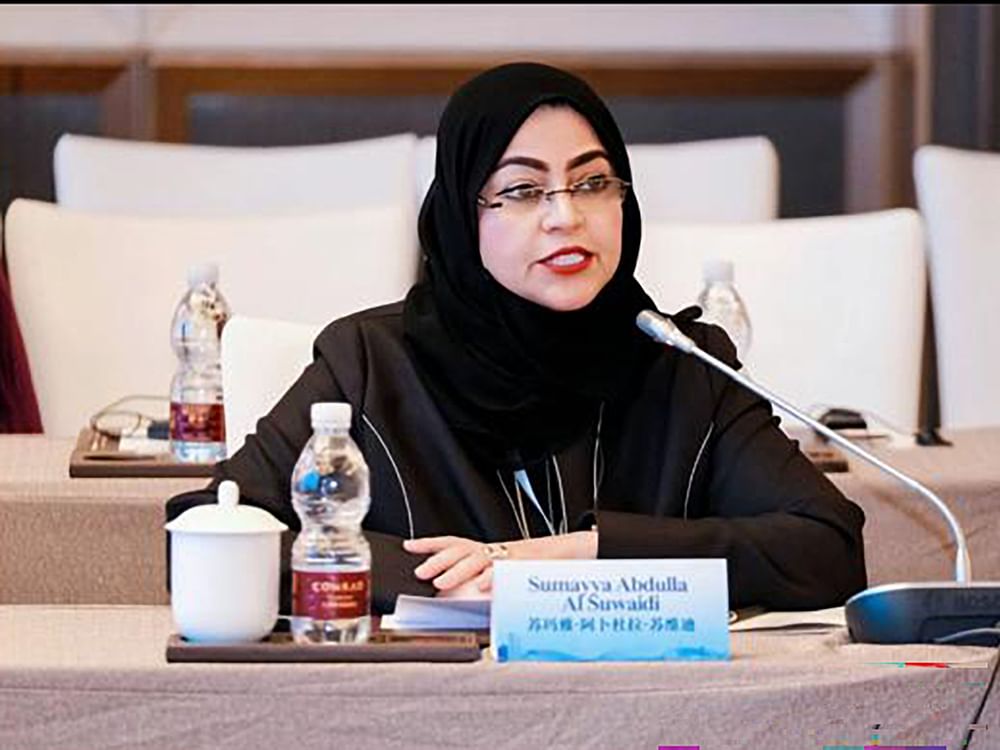
TIANJIN, China, 13th October, 2026 (WAM) -- The Federal National Council (FNC) participated today in the 2026 Legislators Forum for Friendly Exchanges, organised by the Chinese People’s Association for Friendship with Foreign Countries in Tianjin, the People’s Republic of China.
The 2026 Legislators Forum for Friendly Exchanges, held under the theme "Sharing High-quality Growth for a Sustainable Future", brought together more than 300 participants, including 66 foreign legislators and representatives from 52 countries, regions and international organizations across five continents.
The forum was attended by Sumaya Abdullah Al Suwaidi and Mona Rashid Tahnoon, members of the Federal National Council.
During a session entitled “Industry-Education Integration and New Quality Productive Forces,” Al Suwaidi highlighted the important role of parliaments in establishing a legislative environment that supports partnerships between the education and industrial sectors, encourages investment in scientific research and training, and monitors the impact of these efforts on skills development and productivity growth.
She stressed that the future of industry depends on developing human capabilities and providing opportunities for learning and innovation.
She noted that the UAE’s wise leadership has directed efforts towards building an advanced industrial base and strengthening the knowledge economy. This vision has been reflected in the launch of several national initiatives and strategies, most notably the “Operation 300bn” initiative, which aims to increase the industrial sector’s contribution to GDP to AED 300 billion by 2031, with a focus on advanced technology industries and the Fourth Industrial Revolution.
She added that the National Strategy for Higher Education 2030 aims to equip students with the technical and practical skills required by vital sectors and strengthen research cooperation between higher education institutions and the private sector.
She also highlighted the launch of the “Manufacturers” programme, which seeks to prepare national talent for technical and specialised roles in the industrial and advanced technology sectors by aligning training with professional requirements, thereby supporting sustainable development goals.
For her part, Mona Rashid Tahnoon, during a discussion on “Cultural Heritage and Urban Renewal,” underscored the importance of the role of parliaments in supporting legislation and policies that contribute to protecting cultural heritage and preserving national identity. She also highlighted the need to ensure integration between urban development requirements and the preservation of sites and buildings of historical and architectural significance.
Tahnoun stressed the importance of strengthening parliamentary cooperation and exchanging expertise and experiences in heritage protection and heritage site management. She also emphasised the value of drawing on successful practices to strike a balance between urban development and the preservation of cultural heritage for future generations.
She further noted that the UAE Cabinet had approved the National Plan for the Inscription of Cultural Heritage Elements on the Lists of the United Nations Educational, Scientific and Cultural Organisation (UNESCO) for the period 2026–2036. The plan aims to increase the number of UAE sites inscribed on the World Heritage List to six and the number of intangible cultural heritage elements to 44 by 2036. It forms part of national efforts to safeguard both tangible and intangible cultural heritage and enhance its international presence and standing.