
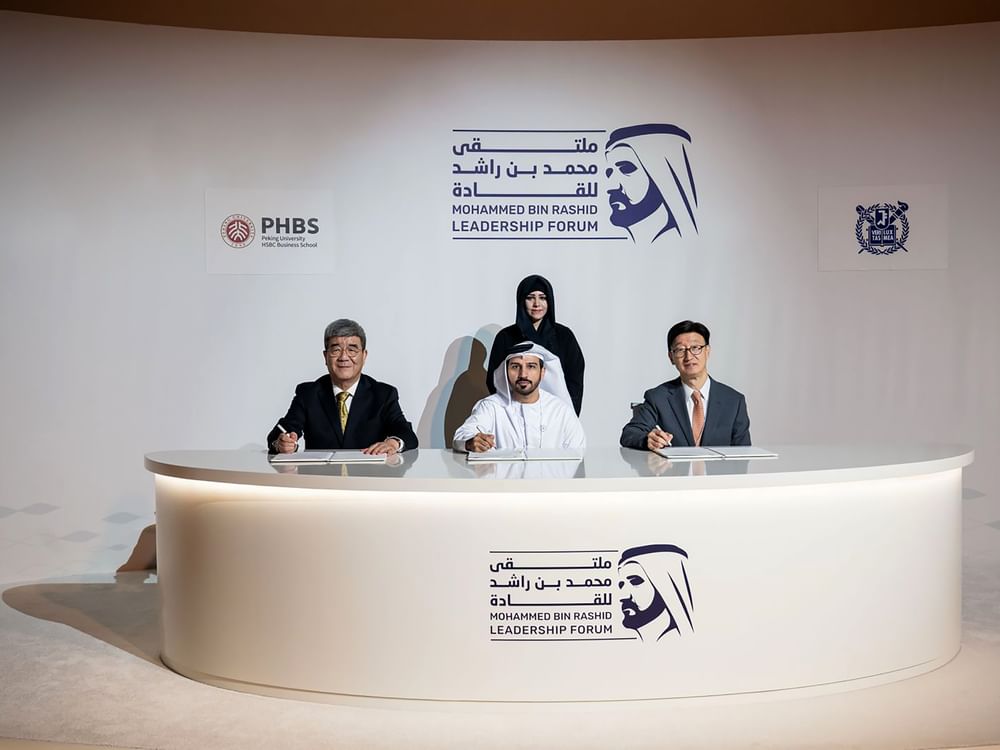
DUBAI, 14th October, 2026 (WAM) -- H.H. Sheikha Latifa bint Mohammed bin Rashid Al Maktoum, Chairperson of Dubai Culture and Arts Authority (Dubai Culture), witnessed the signing of two memoranda of understanding (MoUs) between the Mohammed bin Rashid Centre for Leadership Development (MBRCLD) and two leading universities, Seoul National University in South Korea and Peking University in China.
The agreements aim to launch a new series of Dubai Leadership Research inspired by the leadership and management experience of His Highness Sheikh Mohammed bin Rashid Al Maktoum, Vice President, Prime Minister and Ruler of Dubai.
The signing took place during the Mohammed bin Rashid Leadership Forum, the premier annual gathering dedicated to management and leadership. Organised by MBRCLD, the Forum brought together 1,000 senior figures from Dubai’s government and private sectors to discuss the future transformation of management and leadership, establish best practices in both fields, and advance the vision of His Highness Sheikh Mohammed bin Rashid Al Maktoum to strengthen Dubai’s global standing as a centre of excellence and innovation.
The two MoUs, signed as a key outcome of the Mohammed bin Rashid Leadership Forum, aim to launch a new series of Dubai Leadership Research specifically designed for MBA and executive education programmes.
The research will serve as a global reference in inspirational leadership and decision-making and will be featured at conferences, workshops and academic platforms to extend its impact and establish the leadership experience of H.H. Sheikh Mohammed bin Rashid Al Maktoum as an inspiring model studied by institutions across the East and West.
Saeed Al Eter, Director-General of The Executive Office of His Highness Sheikh Mohammed bin Rashid Al Maktoum, signed the two MoUs on behalf of MBRCLD. The agreements were signed on behalf of the partner universities by Professor Jun-Ki Kim, Executive Vice President of Seoul National University and Professor at its Graduate School of Public Administration, and Professor Young Joon Park, Associate Dean of Peking University HSBC Business School.
The two MoUs will make a significant contribution to enriching leadership curricula in the UAE, inspiring future leaders locally and globally, and consolidating Dubai’s position as a global centre for leadership philosophy. They will also document the legacy of H.H. Sheikh Mohammed bin Rashid Al Maktoum in creativity, governance and future foresight through prestigious, internationally recognised educational platforms.
The MoUs include integrating the Dubai case study into MBA and executive education programmes at the two partner universities, providing direct access to hundreds of students and executive leaders worldwide in each cohort.
Dubai Leadership Research will be published through The Case Centre, reaching more than 500 business schools in over 90 countries and benefiting tens of thousands of students and leaders annually. In addition, the research will be published in Harvard Business Review, which reaches more than 10 million readers, to enhance the initiative’s impact among practitioners, consultants and thought leaders worldwide.
Mohammad bin Abdullah Al Gergawi, Chairman of The Executive Office of His Highness Sheikh Mohammed bin Rashid Al Maktoum and Chairman of the Mohammed bin Rashid Centre for Leadership Development, affirmed that Dubai has become a unique global model of comprehensive development and institutional work founded on innovation, the courage to take initiative and decisive decision-making.
This reflects the leadership and management vision of His Highness Sheikh Mohammed bin Rashid Al Maktoum, as well as His Highness’s directives to launch strategic plans that place people at the forefront of priorities. This approach has made His Highness’s leadership philosophy a global reference and a model to emulate in sustainable development.
Al Gergawi said, “Today, Dubai is at the centre of global attention, and its development and cultural experience has become a shining example of how creative ideas can be transformed into tangible reality through determination and the ability to cultivate ambitious leaders equipped to realise Dubai’s long-term visions through unconventional approaches.”
He noted that the launch of a new series of Dubai Leadership Research aligns with MBRCLD’s mission to advance leadership thought, enhance the future readiness of institutions and consolidate the UAE’s leadership across key sectors.
Professor Jun-Ki Kim said, “The MoU represents a significant step in strengthening cooperation between Seoul National University and the Mohammed bin Rashid Center for Leadership Development, bringing together the expertise of both institutions in leadership and innovation. Through this collaboration, we look forward to developing models and practices that contribute to enhancing the efficiency of government operations and strengthening their ability to keep pace with global transformations and respond to evolving challenges with more effective solutions.”
He noted that the partnership reflects a shared vision to advance government practices and prepare leaders equipped with advanced decision-making tools and the ability to understand global developments, assess their implications for various sectors and turn them into opportunities for improvement, supporting development efforts and aligning with national ambitions to enhance people’s quality of life.
Professor Young Joon Park said, “The collaboration between Peking University and the Mohammed bin Rashid Center for Leadership Development is an extension of the growing relationship between two institutions that recognise the role of knowledge and innovation in supporting growth and developing leaders. Through this partnership, we seek to exchange expertise and develop specialised initiatives that serve business leaders in the UAE and China, while extending the benefits of these experiences to leaders and institutions around the world.”
He added, “This partnership provides an opportunity to draw on diverse experiences in developing business environments and strengthening the ability to understand and respond flexibly to global economic changes. This will support the development of leadership capabilities that are better prepared to seize opportunities and address the challenges posed by the rapidly changing global economy.”
Seoul National University (SNU) is South Korea’s leading national university. It is widely recognised internationally for its academic excellence, research capabilities and decades-long contributions to national development and public sector leadership in South Korea.
The university’s Graduate School of Public Administration (GSPA) holds a prestigious international position in public policy and public administration, ranking eighth globally in Social Policy and Administration in the QS World University Rankings by Subject 2025.
Since its establishment in 1946, Seoul National University has contributed to preparing successive generations of leaders in government, diplomacy, academia, science and industry. It has played a pivotal role in South Korea’s transformation into one of the world’s leading economies and an innovation- and knowledge-based society.
Peking University is one of China’s oldest and most prestigious universities. Founded in 1898 as the country’s first comprehensive national university, it encompasses an extensive network of faculties, schools and research centres covering the humanities, social sciences, economics, management, sciences, engineering, medicine and other fields.
Peking University HSBC Business School was established in Shenzhen in 2004 to expand the university’s contribution to research and education in economics, finance and management. The School offers academic programmes including doctoral degrees, specialised master’s programmes, Master of Business Administration (MBA), Executive Master of Business Administration (EMBA), and executive education and development programmes. It also adopts an international approach that combines a global perspective with an in-depth understanding of China’s economy and business environment.