
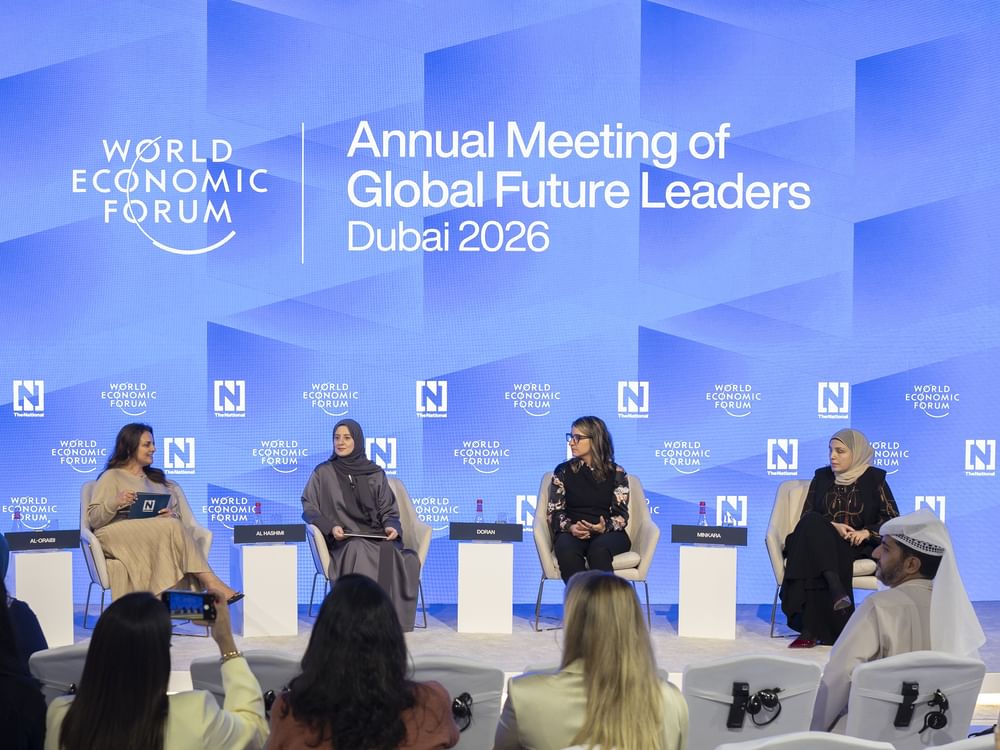
DUBAI, 14th October, 2026 (WAM) -- Pledges on fairness fizzle out when nobody owns them, Huda Al Hashimi, Deputy Minister of Cabinet Affairs for Strategic Affairs, Ministry of Cabinet Affairs, said today at the World Economic Forum’s (WEF) Annual Meeting of Global Future Leaders in Dubai.
Speaking at the “Fair by Design” session, part of the meeting held from 13-15 October 2026 as part of the long-standing strategic partnership between the UAE Government, WEF and the Dubai Future Foundation, she said leadership commitment to women’s advancement is largely in place. Follow-through is what is missing.
Moderated by Mina Al-Oraibi, Editor-in-Chief of The National, the panel also featured Kelsi Doran, Vice-President of Strategy, People, Policy and Purpose Office at Cisco, and Sara Minkara, Founder and Chief Executive Officer of Sara Minkara, LLC and former U.S. Special Advisor on International Disability Rights. The session examined why boardroom commitments and targets have not delivered sustained progress, and how artificial intelligence (AI) can be built into the way organisations hire, promote and reward without reproducing existing inequities.
Al Hashimi said, “Our leadership has consistently supported the empowerment of women across all fields, and the UAE has translated this vision into a deeply institutionalised approach embedded across its strategies, policies, and various sectors.”
She stressed the importance of women's representation in leadership and decision-making bodies across all sectors, noting that it helps pave the way for future generations of women to access opportunities and leadership positions based on competence and merit.
Highlighting the UAE’s efforts to advance equal opportunities globally, Huda Al Hashimi pointed to the Digital School initiative, launched by His Highness Sheikh Mohammed bin Rashid Al Maktoum, Vice President, Prime Minister and Ruler of Dubai, during the COVID-19 pandemic. The initiative has now reached one million students worldwide, helping expand access to quality education and promote educational equity.
Al Hashimi outlined the pioneering model adopted by the UAE Government across its various strategies to ensure all segments of society are engaged in shaping the future and contributing to the country's ambitious economic and social development goals.
Al Hashimi affirmed that the UAE places equal opportunities and inclusive development at the heart of its national priorities, emphasising that the global empowerment of women is a comprehensive journey that begins with education, training, and mentorship, and extends to achieving excellence and developing the leadership skills needed to succeed and thrive.
Minkara offered a different view on quotas, speaking about disability employment laws. She successfully overcame visual impairment to chart her own professional path and establish an independent entrepreneurial venture, emphasised the importance of involving People of Determination (PwD) in shaping the future. Minkara noted that they possess the capabilities, potential, and talent to contribute meaningfully to building a better future for their communities and society at large.
She highlighted that PwD, like all members of society, are fully capable of playing a significant role in community development. She called for viewing them through the lens of their skills, talents, and potential, rather than treating them as a box to be ticked in institutional employment policies.
Mingara also stressed the need to address bias in artificial intelligence systems used in recruitment and talent selection processes, warning that such biases could create barriers to the inclusion and integration of PwD in today’s workforce.
Doran said embedding inclusion into institutional culture is among the fastest routes to equal opportunity. She called for balance and equity to be built into organisational processes to extend their impact across society.
On AI, Doran identified trust as the critical pressure point. “We talk about how trust is eroding, more and more, just as transformation needs it most,” she said, urging organisations to be transparent about how roles may change. She added that AI could widen access to economic opportunity: “I believe that AI will democratise access to economic empowerment… but that only happens if we’re intentional about providing access to capital, providing access to education.”
Doran concluded that transparency on progress is essential to turning institutional commitments on equal opportunity, inclusion and diversity into measurable results.
The speakers emphasised that equal opportunity, inclusion, and fairness must be embedded in the design of initiatives and opportunities to harness individual talent and drive sustainable, prosperous growth.
The Annual Meeting of Global Future Leaders 2026 is a flagship initiative of the strategic partnership between the UAE Government and the World Economic Forum, bringing together more than 700 leaders and experts from 100 countries to explore emerging global shifts and develop practical solutions for future challenges. The meeting focuses on six strategic themes: AI, Technology and Human Agency; Science, Discovery and Innovation; Economic Growth; Geopolitics, Security and Trade; Leadership and Human Flourishing; and Climate and Nature.