
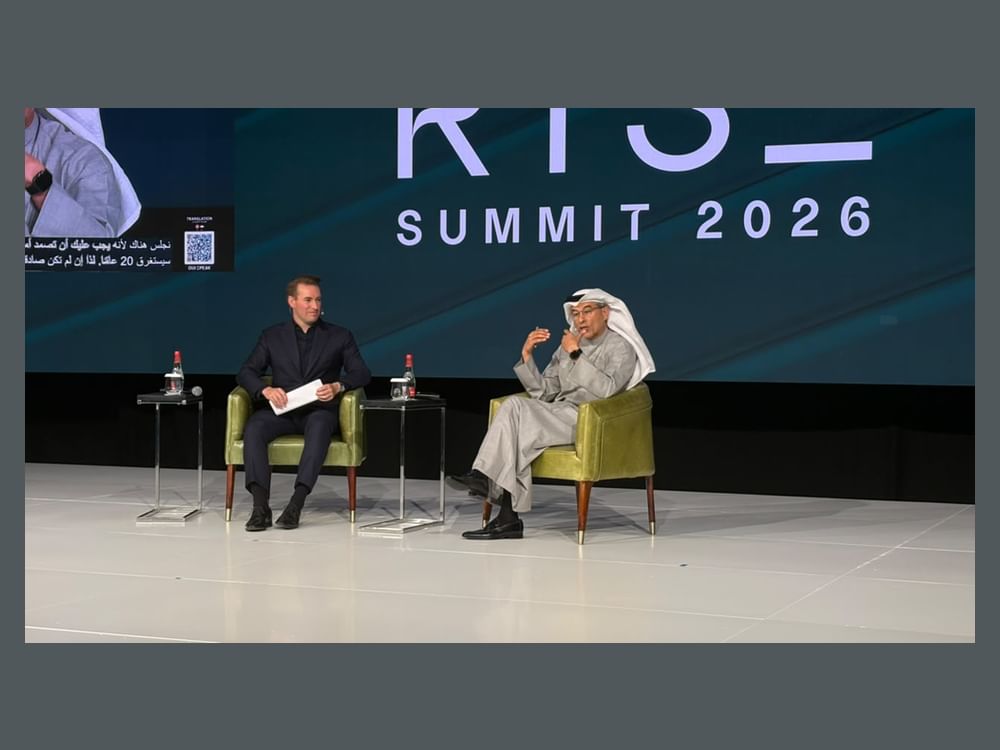
DUBAI, 14th October, 2026 (WAM) -- Mohamed Alabbar, Founder and Managing Director of Emaar Properties, has unveiled plans to invest more than US$16 billion in real estate and tourism development projects in Syria, saying markets facing economic and geopolitical challenges offer promising investment opportunities, provided investment decisions are based on feasibility studies, economic development, and social responsibility.
Speaking during a session titled "Building Through the Cycle" at RISE Summit 2026, held today at the Dubai World Trade Centre and moderated by CNBC Anchor and Correspondent Dan Murphy, Alabbar discussed developments in property markets, investment opportunities in Syria and the future of urban development amid global technological and economic transformations.
Alabbar said the planned investments in Syria would range between $16 billion and $17 billion, highlighting the country's substantial natural and human resources, including agricultural land, water, oil and gas, as well as local expertise, which provide a foundation for long-term development projects.
He said his recent visit to Syria had allowed him to explore investment opportunities firsthand, expressing appreciation for the competence of officials and the level of cooperation he encountered.
He stressed that investment decisions must be guided by clear economic and commercial considerations while contributing to job creation, business development, local economic activity and government revenues.
Alabbar noted that major investment projects could extend over 20 years, underscoring the importance of building sustainable relationships with local communities and maintaining transparency and social responsibility.
He added that UAE companies investing overseas have a responsibility to contribute to development and improve quality of life in the markets where they operate.
Turning to Emaar Properties' performance, Alabbar revealed that the company's real estate sales backlog stands at approximately AED150 billion, adding that buyers continue to meet their payment obligations at levels comparable to 2025, and even better in some respects, despite market challenges.
He said Emaar typically sells around 4,000 property units a month, while cancellations rose from approximately 600 units in 2025 to 1,200 during the period of regional tensions, before falling to fewer than 600 currently.
He described the decline in cancellations as an indication of improving buyer confidence and resilient property demand.
Although current sales remain below previous levels, Alabbar said the overall market trend remains positive, noting that regular payment collections are among the most reliable indicators of the property sector's strength, particularly given that buying property represents one of the largest financial decisions individuals make.
Alabbar stressed that Emaar does not offer discounts or alter payment terms, even during periods of slower sales, to ensure fairness among buyers and protect customers who previously purchased properties at established prices.
He explained that some developers resort to substantial discounts to manage cash flow and meet financial obligations, particularly amid high debt levels, emphasising that market conditions vary according to project location, developer and financial position.
He said it would be unfair to offer a new buyer a 30% discount on a unit in a building where other customers had already paid the full price, reaffirming Emaar's commitment to a stable pricing policy that maintains customer confidence.
Alabbar noted that property prices in Dubai and the wider UAE remain competitive compared with international markets such as London, Singapore, Chicago and Mumbai. He called for prices to be assessed according to cost per square metre, location and project characteristics rather than market averages alone.
He added that Dubai developers do not necessarily enjoy the world's highest profit margins, citing differences in construction costs and selling prices between Dubai and Belgrade, with returns varying according to market conditions and sales volumes.
In the hospitality sector, Alabbar said occupancy rates had improved to between 60% and 65%, describing these as favourable levels under current conditions.
He noted that companies had benefited from growth rates ranging between 20% and 30% over the past four years, enabling them to build financial reserves to withstand periods of slower economic activity.
He stressed the importance of preparing for economic fluctuations, referring to the guidance of His Highness Sheikh Mohammed bin Rashid Al Maktoum, Vice President, Prime Minister and Ruler of Dubai, on preparing for difficult times during periods of prosperity, given the recurring cycles of economic growth and slowdown.
Alabbar also highlighted more than 200,000 daily deliveries across the commercial activities he discussed, saying their continuity reflects the efficiency of logistics services and the strength of consumer activity.
He explained that digital platforms provide daily data on user numbers, purchasing patterns and consumption rates, allowing businesses to monitor market performance in real time and make operational decisions based on measurable indicators.
On future developments, Alabbar revealed that Emaar has completed a design for a distinctive new building, responding to a question about the possibility of developing another skyscraper comparable to Burj Khalifa.
He said the company was awaiting improvements in conditions affecting logistics, ports and supply chains before proceeding with the project.
Alabbar also highlighted the rapid transformation of urban development through modern technology, citing an example of a 15-storey building constructed in just 12 days using automated construction and robotics.
According to figures he presented during the session, the building achieved a 100% improvement in energy efficiency and four times the earthquake resistance of conventional buildings.
He said such advances could accelerate project delivery and improve construction efficiency, while human expertise would remain essential for supervision and operational management. Fully AI-driven construction without human intervention, he added, remains a future challenge.
Addressing artificial intelligence, Alabbar warned that companies failing to integrate AI deeply into their operations within the next 12 months could rapidly fall behind competitors, given the growing capabilities of smart systems in data analysis, forecasting and decision-making.
He said AI applications are improving efficiency across retail, manufacturing, and real estate while strengthening institutional performance and customer services. He also revealed that he uses the Dots application in his daily work.
Alabbar said his experience with Noon had deepened his understanding of modern technology, adding that AI-driven changes in business operations are exceeding expectations and compelling companies to reassess their organisational structures and management approaches.
He revealed that specialist AI engineers had joined a new team involved in development activities, noting that finding professionals capable of designing and operating AI agents effectively remains a major challenge for companies.
He stressed that technological progress does not eliminate the need for human talent but requires employees to develop their skills and work more closely with intelligent systems to enhance productivity and organisational performance.
Discussing international urban development experiences, Alabbar praised China's progress in construction technology, urban planning and infrastructure development.
He noted that Dubai had drawn on the experiences of countries and cities worldwide, including the United States, Singapore, Hong Kong and London, throughout its development journey.
He highlighted China's expertise in delivering urban projects rapidly and efficiently, citing a visit to Xiamen, where he observed significant economic and urban development.
Alabbar said many Chinese achievements receive insufficient international media attention because of language barriers and the media's focus on Western experiences, calling for greater openness to diverse sources of knowledge and technology.
On economic resilience, Alabbar said economic and geopolitical fluctuations are not new, noting that countries and institutions capable of learning and adapting often emerge from crises stronger and more experienced.
He cited the UAE's response to the 2008 global financial crisis and the COVID-19 pandemic, highlighting the strength of its banking system, financial discipline and continuity of services and economic activity as evidence of the country's economic resilience.
He said uninterrupted trade, shopping and logistics activities, the continuity of daily life and residents' sense of security and confidence in the future are important indicators of the UAE economy's ability to withstand challenges.
Alabbar emphasised that a property developer's responsibility does not end with selling and handing over residential units but extends to ensuring residents' safety and providing appropriate services and living environments for families and children within communities.
He concluded that long-term planning, investment in technology, human capital development, and maintaining customer confidence are fundamental to sustainable corporate growth and resilience amid global transformations.
He stressed that continuous performance improvement and preparedness for risks remain essential to success in a changing economic environment.