
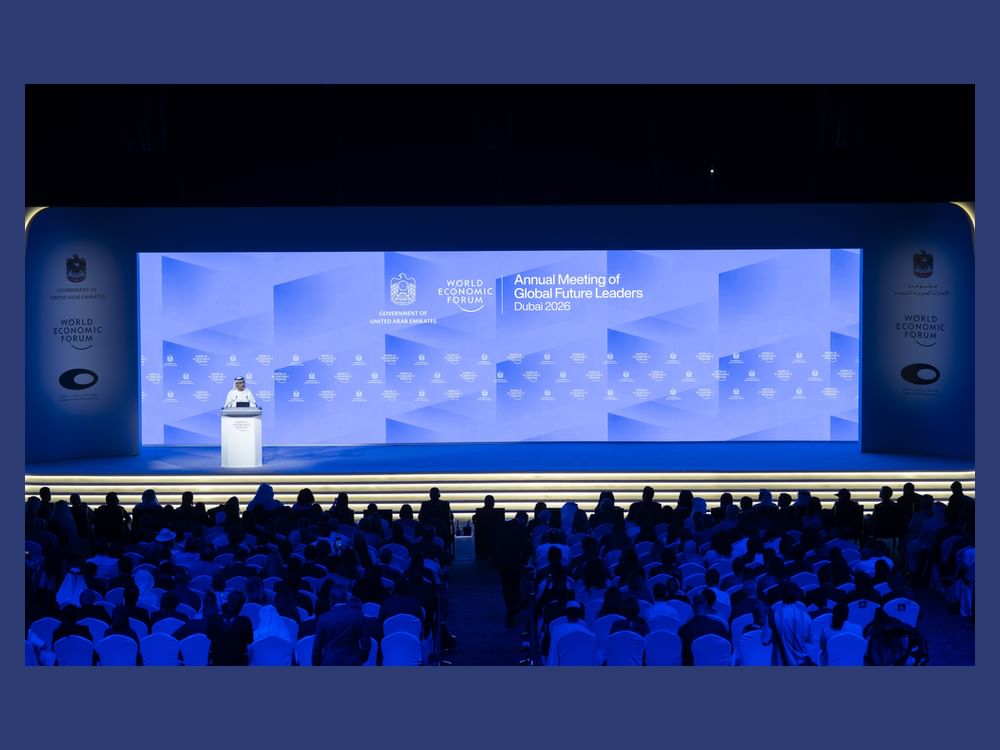
DUBAI, 15th October, 2026 (WAM) -- The Annual Meeting of Global Future Leaders 2026 concluded today in Dubai. Organised by the UAE Government and the World Economic Forum (WEF), in collaboration with the Dubai Future Foundation (DFF), it was held under the patronage of His Highness Sheikh Mohammed bin Rashid Al Maktoum, Vice President and Prime Minister of the UAE and Ruler of Dubai.
Over three days, the meeting brought together more than 700 leaders and experts from 100 countries in more than 60 sessions and events. Its outcomes will help shape the agenda of WEF’s Annual Meeting in Davos in early 2027.
The meeting closed with a plenary where Co-Chairs of the meeting, Ohood bint Khalfan Al Roumi, Minister of State for Government Development and the Future, and Khalfan Belhoul, Chief Executive Officer of the Dubai Future Foundation, joined other speakers to reflect on the ideas, partnerships and actions to emerge from the three days.
H.H. Sheikh Hamdan bin Mohammed bin Rashid Al Maktoum, Crown Prince of Dubai, Deputy Prime Minister and Minister of Defence of the UAE, and Chairman of The Executive Council of Dubai, attended part of the proceedings. Participants included prime ministers, ministers, officials and government leaders, 300 Young Global Leaders, and representatives of the business, academic, sports and cultural sectors.
Ohood bint Khalfan Al Roumi, Minister of State for Government Development and the Future and Co-Chair of the Annual Meeting of Global Future Leaders 2026, said: “In the UAE, we remain optimistic about the future, even in challenging times. This optimism has always been part of the approach of our leadership.”
She added: “We know that the future will bring opportunities and challenges. We believe challenges can open new possibilities. Our optimism is a commitment to keep developing and moving forward. It gives us the courage to begin, the humility to learn as we go, and the determination to change course when needed.”
She continued: “This is a new era that calls for a new generation of leaders who look ahead and face uncertainty with resilience and adaptability. The Annual Meeting of Global Future Leaders opens a new chapter in the UAE’s longstanding relationship with the World Economic Forum, a partnership built on a shared commitment to shaping a better future. Our ambition is for this meeting to make a meaningful contribution from the UAE towards a better future for humanity, creating lasting value by providing a global platform where leaders from different generations, sectors and countries can learn from one another and work together.”
On translating the meeting’s outcomes into action, she said: “We want the perspectives shared here to help shape the wider global conversation. Building on this, the World Economic Forum will soon launch the Future Leaders Outlook in partnership with the UAE.”
She concluded: “The decisions we make today will affect future generations. Our responsibility is to give them more opportunities.”
Khalfan Juma Belhoul, Chief Executive Officer of Dubai Future Foundation and Co-Chair of the Annual Meeting of Global Future Leaders 2026, said: “Foresight helps us understand change and transformation, but action is what turns opportunities into reality. This is why we actively design the future, and the UAE provides a leading global model for this proactive approach.”
Highlighting key outcomes from the meeting, Belhoul said that His Highness Sheikh Hamdan bin Mohammed bin Rashid Al Maktoum announced the launch of the Centre for Global Future Opportunities, established through a partnership between the UAE Government and the World Economic Forum. He also announced the UAE Centre for the Fourth Industrial Revolution’s report, Fourth Industrial Revolution in the UAE: 100 Use Cases.
Belhoul highlighted three key insights emerging from the meeting: future readiness and preparedness as a national priority; sustainable resilience as a foundation for long-term economic success; and global dialogue and cooperation as essential to ensuring the safe use of artificial intelligence.
Addressing participants, he said: “To the Young Global Leaders, Global Shapers, scientists, entrepreneurs, policymakers and business leaders here today: you have succeeded in connecting the decisions being made today with the lives people will live tomorrow.”
The meeting saw the launch of several major initiatives, including the Centre for Global Future Opportunities, a first-of-its-kind initiative designed to convert promising opportunities into policies, legislation, projects and initiatives.
It also featured the launch of the Agentic AI Award, a joint initiative between the World Economic Forum and Dubai Municipality engaging more than 10,000 Global Shapers to develop innovative and practical Agentic AI applications that improve quality of life in future cities.
Other initiatives included the Alliance for Future Generations, bringing together leading UAE and international companies to develop the next generation of talent; the Global Strategic Intelligence Programme; and Future 20, recognising 20 outstanding global leaders under the age of 30 who are driving change and creating future opportunities across sectors.
The meeting also hosted Global Shapers Community gatherings aimed at transforming innovative ideas into impactful initiatives inspired by Dubai’s model and Dubai-it initiative.
Initial findings from the Youth Pulse survey were also unveiled, capturing the perspectives of more than 11,000 young people from 134 countries and 433 cities across five areas: constructive optimism, opportunity, AI adoption, participation in leadership, and sustainability in designing future cities and communities.
Sessions, Opportunity Labs and specialised experiences were organised around six central themes: Artificial Intelligence, Technology and Human Agency; Science, Discovery and Innovation; Economic Growth; Geopolitics, Security and Trade; Leadership and Human Flourishing; and Climate and Nature.
Participants also explored Dubai’s development model, success story and continued leadership across global indicators through a range of activities under Dubai-it.
Discussions addressed the resilient governance of Agentic AI systems, economic resilience, the future of international trade, and collaboration between experienced and emerging leaders. The programme brought together the Young Global Leaders Community, Global Shapers, Social Innovators, and winners of the Great Arab Minds initiative.