
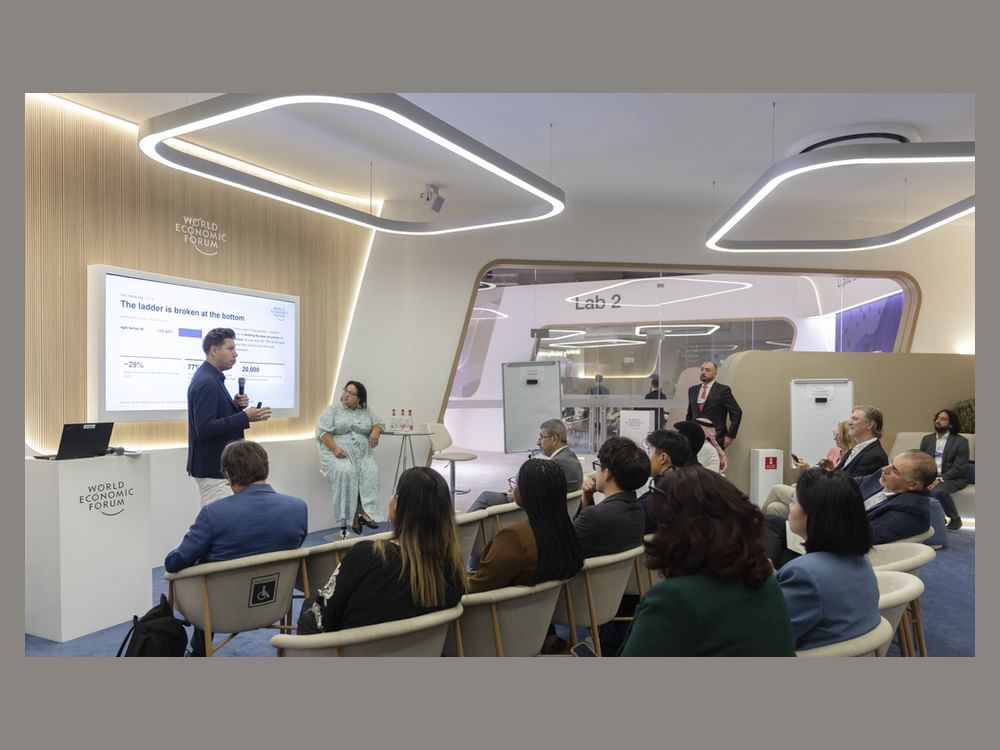
DUBAI, 15th October, 2026 (WAM) -- The 2026 Annual Meetings of the Global Future Leaders convened five Opportunity Labs to turn future challenges into practical solutions. Organised through a partnership between the UAE Government, the World Economic Forum and the Dubai Future Foundation, the sessions brought young leaders together with global experts, researchers and policymakers to explore priorities spanning science, artificial intelligence, resilience, decision-making and the future of work.
Using a backcasting approach, each lab defined a desired outcome for the next decade and worked backwards to identify the decisions, partnerships and actions required today.
The first lab examined how discoveries in fields such as materials science and biotechnology can move from research to large-scale application as AI accelerates knowledge creation. Facilitated by Peter Engelke, Resident Senior Fellow at the Atlantic Council’s Scowcroft Strategy Initiative, USA, the session highlighted the education, research, financing and policy ecosystems needed to turn breakthroughs into wider economic and social impact.
The second lab explored the physical and economic foundations of AI, including semiconductors, data centres, energy networks, capital and cloud computing. Featuring Vilas Dhar, President of the Patrick J. McGovern Foundation, USA, and moderated by Jonathan David Moyer of the University of Denver, USA, it identified the investment, partnerships and governance needed to build more reliable, inclusive and sustainable AI infrastructure.
The third lab considered how institutions and economies can maintain essential systems amid mounting climate and nature-related pressures. Co-led by Dimple Patel, Chief Executive Officer of NatureMetrics, UK, and moderated by Anthony Vassallo, Director of the Forecasting Initiative at RAND, USA, it explored scalable approaches to supply chains, land, water and resource use that balance near-term costs with long-term resilience.
The fourth lab focused on improving collective decision-making when information is incomplete or conflicting. Featuring Maha Hosain Aziz, Professor at New York University, USA, and Karen E. Young, Senior Research Scholar at Columbia University’s Center on Global Energy Policy, USA, the session explored how diverse perspectives, risk analysis and strategic foresight can support responsible choices amid rapid change.
The fifth lab examined how productivity gains, particularly those driven by AI, can support inclusive growth and better jobs. Featuring Katy Knight, President and Executive Director of the Siegel Family Endowment, USA; Jonathan David Moyer of the University of Denver, USA; and Florian Hoffmann, Founder and Chief Executive Officer of The DO, Germany, it linked investment in skills and more inclusive labour markets with policies that convert competitiveness gains into sustainable economic opportunity.
Together, the labs produced practical insights for governments, businesses, research institutions and civil society, while giving young leaders a platform to shape inclusive and sustainable responses to shared global challenges.
The 2026 Annual Meetings of the Global Future Leaders bring together more than 700 leaders and experts from 100 countries, including ministers and officials, 300 Young Global Leaders and 150 UAE government leaders. The meetings form part of the strategic partnership between the UAE Government and the World Economic Forum to anticipate global transformations and develop practical responses to future challenges.