
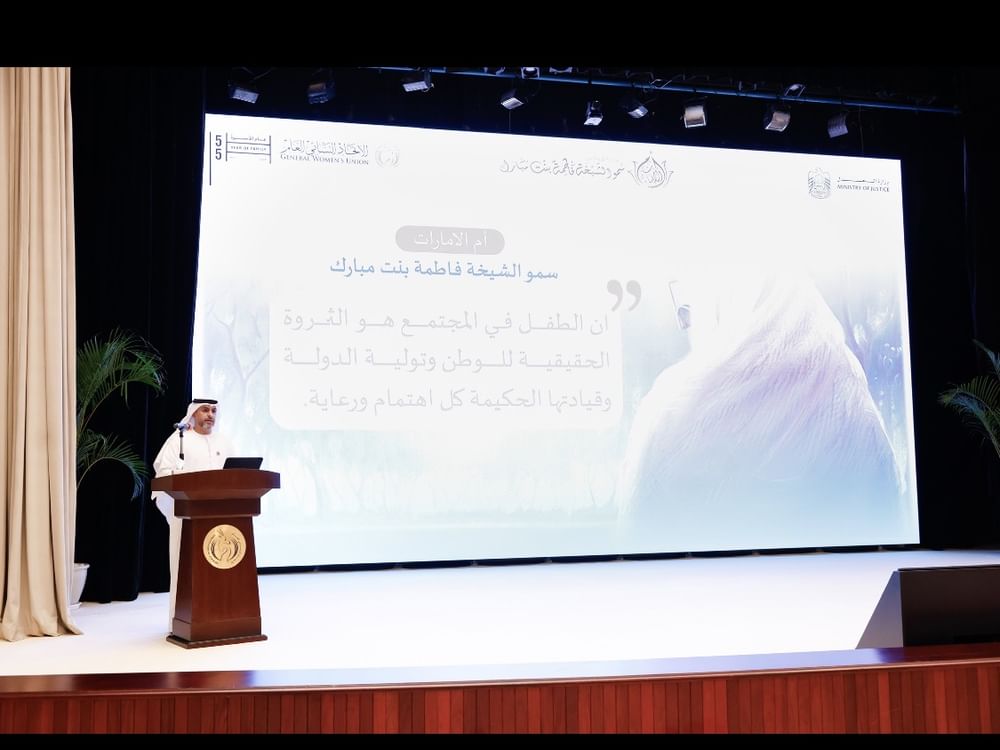
ABU DHABI, 15th October, 2026 (WAM) -- Under the gracious patronage of H.H. Sheikha Fatima bint Mubarak, “Mother of the Nation”, Chairwoman of the General Women’s Union, President of the Supreme Council for Motherhood and Childhood, and Supreme Chairwoman of the Family Development Foundation, the Judicial Training Institute at the Ministry of Justice, in collaboration with the General Women’s Union, organised a conference entitled “Protecting and Caring for Children in Custody: A Shared Family and Institutional Responsibility.”
The conference featured high-level calls for establishing a comprehensive national partnership among judicial, security and community institutions to ensure that the best interests of the child remain the foremost priority whenever family disputes arise.
The event brought together a wide range of judges, legal experts, psychologists and media professionals, with the aim of strengthening a safe environment for children in custody and ensuring their healthy development.
In his opening address, Abdullah Sultan Al Nuaimi, Minister of Justice and Chairman of the Federal Judicial Council, affirmed that, under the leadership of President His Highness Sheikh Mohamed bin Zayed Al Nahyan, the country has established an integrated legislative and judicial framework that provides comprehensive protection for children, including safeguarding the rights of children in custody and prioritising their best interests when family disputes arise.
He stressed that ensuring the stability and healthy development of children in custody requires genuine coordination and complementary roles among all entities concerned with family affairs and the judiciary.
For her part, Noura Khalifa Al Suwaidi, Secretary-General of the General Women’s Union, emphasised that caring for children and safeguarding their rights extends beyond legal protection to include ensuring their psychological and social stability. This approach stems from the humanitarian vision of H.H. Sheikha Fatima bint Mubarak, “Mother of the Nation”, and her directives to place child safety at the forefront of national priorities.
Al Suwaidi added that this vision is being translated into practice through the Ru’ya Centre for Children in Custody, located at the headquarters of the General Women’s Union and operating in partnership with the Judicial Department. The centre provides a safe environment offering comprehensive psychological and social support to children in custody and their families, helping children feel comfortable with both parents and strengthening their sense of security away from family disputes.
She stressed that putting the best interests of children in custody into practice requires the integration of judicial, legal and community expertise to establish a comprehensive protection system that places children at the centre of its priorities.
The opening session also featured an address by Dr Mohammed Mahmoud Al Kamali, Director-General of the Judicial Training Institute, alongside the screening of an awareness film entitled “The Child in Custody Comes First”, highlighting the importance of family stability for children.
During a series of intensive working sessions, participants discussed three key issues, examining the subject from various practical and specialised perspectives.
Under the legislative and judicial pillar, discussions addressed the legal frameworks governing child custody in the courts, emerging digital challenges, and the role of public prosecution in providing digital protection for children in custody.
For the psychological and social pillar, sessions focused on the importance of early psychological intervention to identify the effects of family disputes on children and foster their sense of security. Participants also examined the Ministry of Family’s strategies in coordination with its partners.
The institutional and future-oriented pillar addressed specialised preventive measures, the “Post-Separation Family Charter” initiative aimed at regulating family relationships following separation, and the responsibility of the media and digital platforms in protecting children.
The conference concluded with a set of recommendations calling for the establishment of a unified and sustainable mechanism for cooperation among judicial, police and community sectors. The recommendations also urged the modernisation of practical implementation tools and educational approaches to safeguard children in custody and ensure their psychological and social stability under all circumstances.