
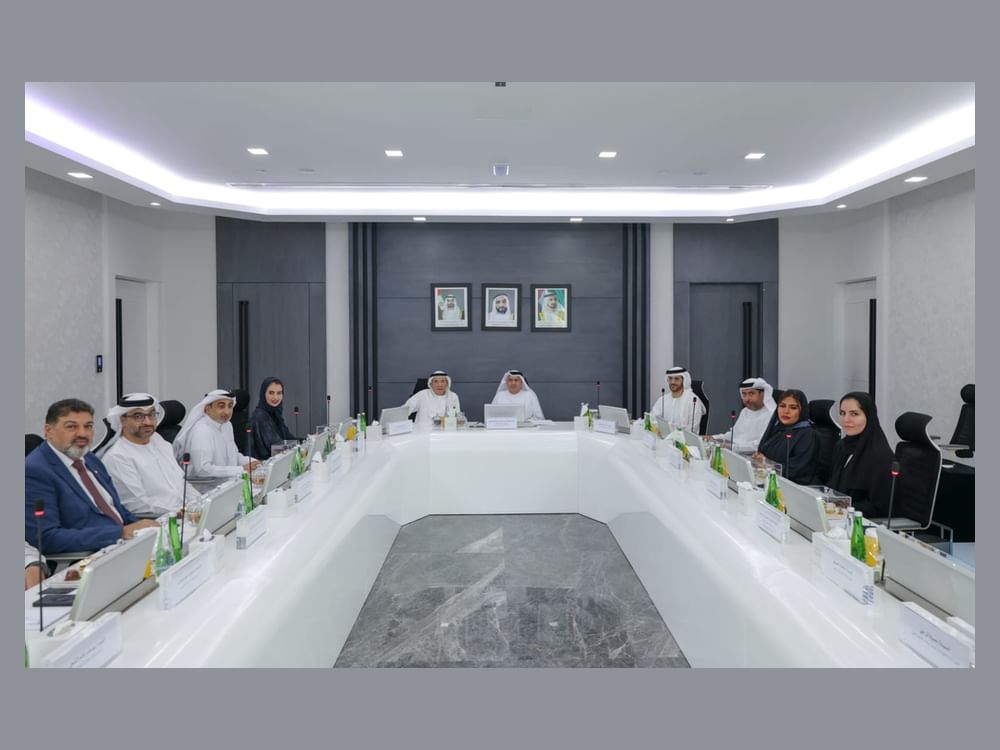
DUBAI, 18th October, 2026 (WAM) -- The Higher Education Committee held its seventh meeting at the headquarters of the Ministry of Higher Education and Scientific Research in Dubai, chaired by Dr. Abdulrahman Al Awar, Minister of Human Resources and Emiratisation and Acting Minister of Higher Education and Scientific Research.
The meeting reviewed new legislation and regulatory decisions governing the UAE's higher education system, university admissions results for the 2026–2027 academic year, and efforts to enhance data quality, alongside the real-time connectivity project and the use of artificial intelligence (AI) to support the higher education system.
Dr. Al Awar affirmed that developing the UAE's higher education and scientific research system is a national priority to enhance the sector's efficiency and align its outcomes with the needs of the economy and labour market.
He said, “We continue to work towards consolidating an integrated and flexible higher education system that is aligned with national priorities and underpinned by effective governance, quality assurance of educational outcomes, efficient legislative and regulatory frameworks, oversight, and stronger integration between higher education institutions and various economic sectors. We also seek to harness the latest artificial intelligence technologies in support of the higher education system.”
The meeting reviewed improvements achieved through the National Unified Registration and Admission Platform for Higher Education Institutions, part of the unified digital higher education gateway, EduHub. The platform has reduced the number of registration steps from eight to three — a 62 percent reduction — while cutting service completion time from 10 minutes to three minutes, representing a 70 percent reduction.
The platform draws on three official data sources, eliminating the need for students to submit documents. It automatically reads students' data and recommends the most suitable academic programmes from more than 1,000 programmes, while also enabling students to track their applications through to university admission.
The Committee also reviewed university admissions results for the first semester of the 2026–2027 academic year, assessing the effectiveness and flexibility of university admissions policies and criteria in expanding students' opportunities to access higher education.
The Committee discussed the impact of four Cabinet resolutions issued during 2026 to regulate the higher education sector. These include Cabinet Resolution No. 104 of 2026 on the National Framework for Licensing Higher Education Institutions; Resolution No. 92 of 2026 on Review Fees for Higher Education Institutions and Technical and Vocational Education and Training Institutions; Resolution No. 103 of 2026 on Fees and Financial Guarantees Related to Services Provided by the Ministry; and Resolution No. 143 of 2026 on the Regulations of Violations, Penalties and Administrative Measures Related to the Ministry's Mandates and Services.
The meeting also discussed the draft National Framework for Classification, Performance Quality and Oversight of Higher Education Institutions. As part of efforts to raise awareness of the new regulatory frameworks, the Ministry has held three dialogue sessions and two workshops, attended by 566 officials and representatives of higher education and technical and vocational education and training institutions, as well as training centres across the UAE.
The meeting reviewed progress in implementing the recommendations of the sixth meeting, most notably the significant improvement in the quality of data submitted by federal higher education institutions since the launch of the Data Quality Dashboard. It also reviewed the findings of joint field visits conducted by the Ministry of Higher Education and Scientific Research, in collaboration with the Ministry of Human Resources and Emiratisation, to a number of practical training providers during the summer semester to assess the effectiveness of training programmes.