
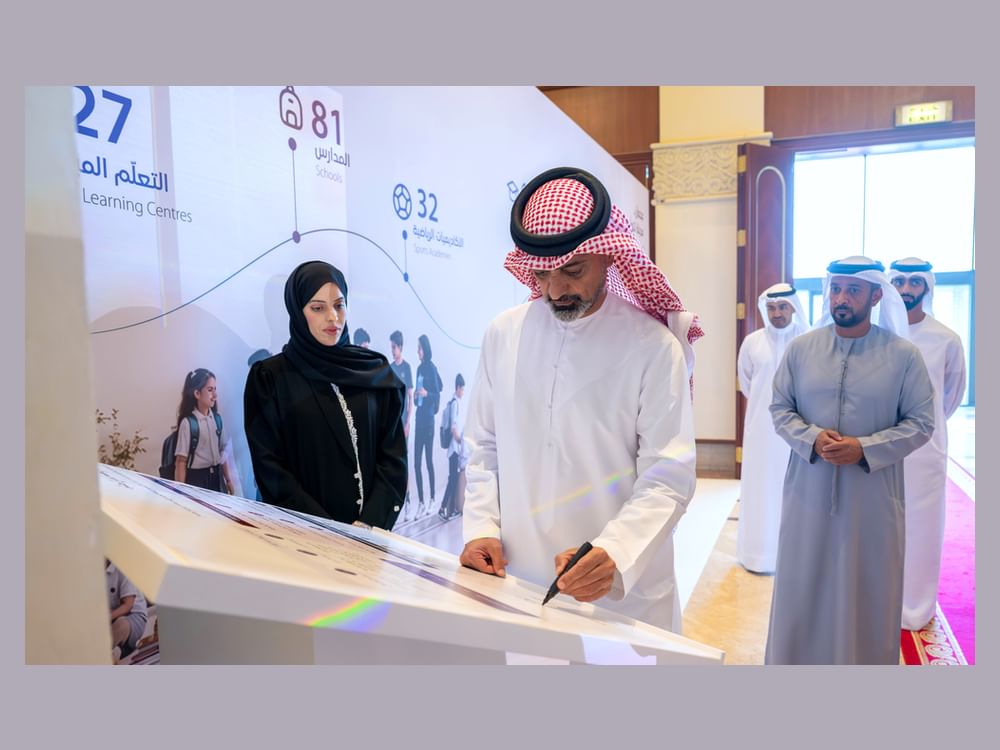
AJMAN, 19th October, 2026 (WAM) -- H.H. Sheikh Ammar bin Humaid Al Nuaimi, Crown Prince of Ajman and Chairman of the Executive Council, attended the Lifelong Learning Forum, organised by Ajman Lifelong Learning Council, in the presence of Sheikh Rashid bin Humaid Al Nuaimi, Chairman of Ajman Municipality & Planning Department and Chairman of Ajman Lifelong Learning Council, along with a number of senior officials, academic leaders and representatives of relevant entities.
During the Forum, H.H. approved the Ajman Lifelong Learning Strategic Framework, a step aimed at strengthening an integrated lifelong learning ecosystem and developing human capital, in line with Ajman Vision 2030: Ajman for People.
Sheikh Ammar bin Humaid Al Nuaimi affirmed that approving the Strategic Framework reflects Ajman’s commitment to investing in people as the solid foundation of sustainable development. He noted that building a society capable of keeping pace with change and shaping the future requires embedding a culture of continuous learning and enabling individuals to develop their knowledge throughout every stage of life.
H.H. said: “We believe that learning is a continuous journey of capacity-building, skills acquisition and broadening the horizons of knowledge. Through this Strategic Framework, we seek to make learning a way of life in Ajman’s community, supporting the emirate’s competitiveness and quality of life.”
He explained that the Framework represents an important step towards achieving the objectives of Ajman Vision 2030 by providing inclusive and equitable learning opportunities for all segments of society, linking learning outcomes to labour-market and economic needs, strengthening research and innovation, promoting health and environmental awareness, and consolidating national identity and community values.
Accompanied by Sheikh Rashid bin Humaid Al Nuaimi and Dr Ashwin Fernandes, Vice President for Strategic and International Engagement at QS, Sheikh Ammar bin Humaid Al Nuaimi also attended the Ajman Higher Education Excellence Ceremony, held as part of the Forum.
H.H. honoured three universities in Ajman in recognition of their distinction in the QS Quacquarelli Symonds Arab Region University Rankings 2027.
The certificates of recognition were received by Dr Karim Al Sagheer, Chancellor of Ajman University; Professor Dr Manda Venkatramana, Director of Gulf Medical University; and Imran Khan, President of City University Ajman.
The Crown Prince of Ajman affirmed that the academic achievements of Ajman’s universities reflect the development of the emirate’s higher education ecosystem and demonstrate the importance of investing in education and scientific research as two fundamental pillars for human development and progress.
H.H. stated: “Progress in academic rankings is not an end in itself, but an incentive to continue development and innovation, and to strengthen the connection between education and research outcomes and the needs of society and the economy, thereby consolidating universities’ role in supporting sustainable development.”
The Forum also witnessed the launch of the “State of Lifelong Learning in Ajman 2026” report, a presentation on the emirate’s lifelong learning journey, and a discussion session on the role of higher education in building a knowledge economy.
H.H. reviewed a visual display presenting indicators on the current state of lifelong learning in the emirate and signed the Strategic Framework, which is founded on the vision of making Ajman “a city in which lifelong learning is the foundation for personal growth, community development and building a prosperous future for all”.
The Framework identifies six principal objectives:
1. Ensuring inclusive access to lifelong learning opportunities for all segments of society.
2. Enhancing learning quality and the connectivity of learning pathways.
3. Aligning learning opportunities with labour-market and economic needs.
4. Embedding learning in family, community and cultural life.
5. Strengthening research, innovation and knowledge production.
6. Encouraging residents to value learning and pursue it throughout their lives.
The Framework links these objectives to Ajman Vision 2030 priorities in building employability, entrepreneurship and life skills; promoting health literacy, safety awareness and active lifestyles; enhancing environmental awareness and sustainable behaviours; and strengthening cultural knowledge, Arabic-language skills and civic participation.
The Framework serves all segments of society through three learning tracks—academic, professional and community learning—while prioritising youth, women, senior citizens, people of determination, lower-income groups and jobseekers. It is underpinned by a governance ecosystem encompassing institutional readiness, strategic governance and implementation governance.
Sheikh Rashid bin Humaid Al Nuaimi said: “The distinction achieved by Ajman’s universities is an accomplishment for the entire emirate and the result of their academic institutions’ efforts to advance the quality of education and scientific research.”
He added: “Universities are essential partners in human development, knowledge production and preparing talent capable of contributing to the development journey and shaping the future. Ajman is committed to providing them with full support to continue preparing future generations and advancing development.”
In his address to the Forum, Dr Saeed Saif Al Matrooshi, Secretary General of the Executive Council of Ajman and Vice Chairman of Ajman Lifelong Learning Council, affirmed that His Highness the Crown Prince of Ajman’s approval of the Framework embodies the leadership’s belief that investing in people is the foundation for building the future.
He noted that it marks the beginning of a new phase of joint action, explaining that learning is no longer confined to classrooms but has become a lifelong companion.
He said: “The success of this Framework will not be measured by the number of initiatives and programmes, but by the real change they create in people’s lives.” He noted that this requires a transition from isolated efforts to integrated action, from multiple initiatives to clear priorities, and from measuring activities to measuring outcomes and impact.
He affirmed that Ajman Lifelong Learning Council will coordinate partners’ efforts and transform strategic directions into learning opportunities that make a tangible difference in the community.
The “State of Lifelong Learning in Ajman 2026” report, available to the public in Arabic and English, identified 256 entities providing lifelong learning opportunities in the emirate. More than half of these—141 entities—operate outside the formal education system, compared with 115 entities within it.
These include 27 early childhood education institutions, 81 schools, six higher education institutions, one adult education centre, 63 training centres and institutes, 32 sports academies, 22 public learning institutions—including museums, libraries and cultural centres—19 non-profit associations, clubs and community groups, and five rehabilitation centres for people of determination.
Dr Denise Gossage, Strategy and Policy Adviser at the General Secretariat of the Executive Council of the Emirate of Ajman, delivered a presentation entitled “Ajman’s Lifelong Learning Journey: From Vision to Action”. She reviewed the emirate’s journey since joining UNESCO’s Global Network of Learning Cities in February 2024, which includes 425 cities across 91 countries, and stressed the importance of transitioning from separate initiatives to an interconnected learning ecosystem.
The presentation called on institutions to activate learning opportunities linked to community and labour-market needs, reach the groups most in need, share data and information on initiatives to identify gaps and measure progress, and communicate and build partnerships at local, federal and international levels.
The Forum also included a panel session entitled “Higher Education in Ajman: A Driver of the Knowledge Economy”, moderated by Dr Ashwin Fernandes and featuring the leaders of the three universities. The discussion addressed universities’ role in preparing talent, supporting scientific research and innovation, and aligning academic programmes with labour-market needs, alongside a keynote by Dr Fernandes on higher education quality and academic excellence.