
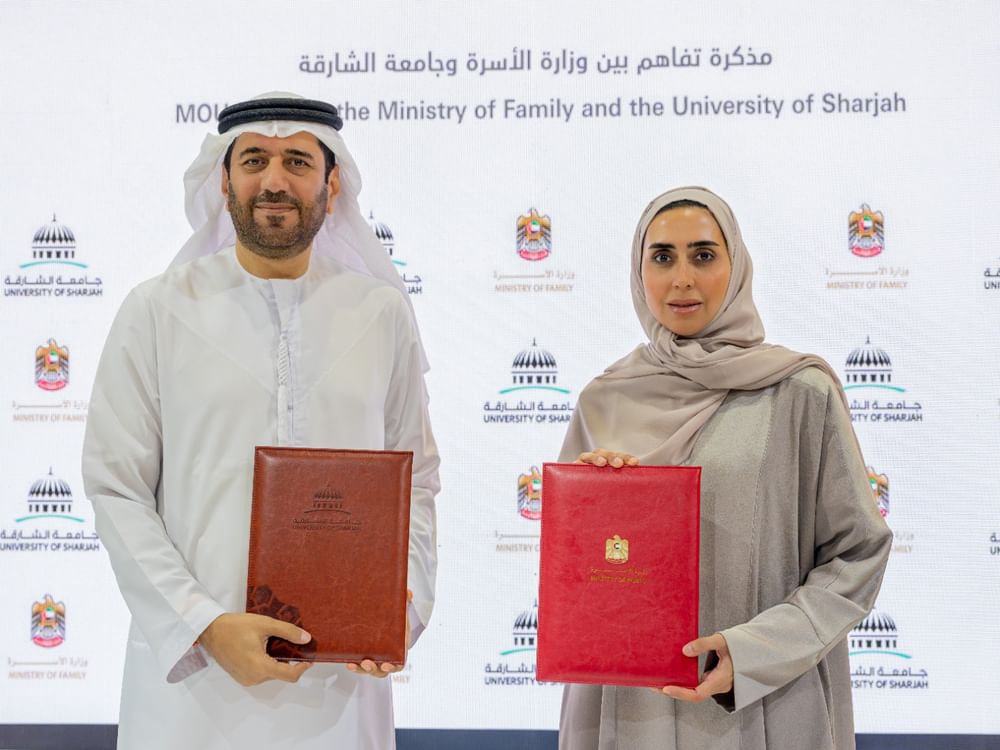
DUBAI, 20th October, 2026 (WAM) -- The Ministry of Family has signed two memoranda of understanding (MoUs) with the University of Sharjah (UoS) and Sharjah City for Humanitarian Services (SCHS) to strengthen institutional cooperation and leverage complementary expertise in family and community development.
The agreements aim to develop policies, programmes, and services designed for families and their individual members, with a focus on empowering People of Determination and supporting their independence and community participation.
The MoUs form part of the Ministry’s strategy to expand its partnerships with academic and specialised institutions, leveraging their research expertise, professional capabilities, and community engagement to develop solutions tailored to family and community needs, while aligning institutional efforts with national social development priorities.
The two memoranda were signed as part of the Ministry of Family’s participation in the 8th edition of the AccessAbilities Expo 2026. Hessa Tahlak, Assistant Undersecretary for the Empowerment of People of Determination and Senior Citizens at the Ministry of Family, signed the agreement with the University of Sharjah, represented by Dr. Salah Taher Al Haj, Vice Chancellor for Community Affairs. She also signed the agreement with Sharjah City for Humanitarian Services, represented by Mona Abdul Karim Al Yafei, Director General of SCHS.
The MoU with the University of Sharjah focuses on leveraging academic expertise and scientific research capabilities to support family and community development. This involves examining family and social issues, analysing relevant data and indicators, tracking evolving family needs, and assessing the impact and effectiveness of programmes, initiatives and services, thereby contributing to the development of evidence-based policies and practices.
The collaboration also includes directing university research, graduation projects and postgraduate studies towards priorities identified by the Ministry of Family, in addition to developing training, awareness, and guidance programmes and organising joint scientific and community events.
It further provides for the exchange of expertise and scientific and technical consultancy, as well as field training and volunteering opportunities for students. This integrated approach will, in turn, help align academic outcomes with community needs and support the development of specialised talent.
The MoU with Sharjah City for Humanitarian Services aims to strengthen integrated efforts to empower People of Determination, supporting greater accessibility and economic and social inclusion by supporting progression from education and rehabilitation to vocational training, employment, and independent living.
Areas of cooperation include delivering training and awareness programmes for SCHS’s graduates and their families to familiarise them with available services, as well as facilitating the enrolment of nominated graduates in the Ministry’s “Mashaghel” Rehabilitation Centres programmes and other vocational training programmes, subject to established admission and assessment criteria.
The agreement also provides for the promotion and marketing of the projects and products developed by SCHS’s graduates from People of Determination through relevant initiatives, events and available promotional channels.
The memorandum further establishes a framework for exchanging rehabilitation and employment data and statistics, jointly developing community initiatives, promoting awareness of the rights and capabilities of People of Determination, and sharing professional and technical expertise. This collaboration will contribute to improving the quality and effectiveness of services and programmes for People of Determination and their families.
Hessa Tahlak stated that the signing of the two memoranda underscores the Ministry of Family’s commitment to establishing strategic partnerships that support the development of an integrated ecosystem for family support and empowerment.
She emphasised the importance of collaborating with academic and specialised institutions to develop knowledge- and expertise-driven solutions that address the genuine needs of families and diverse community groups. She noted that these partnerships build on the Ministry’s ongoing efforts to advance the efficiency and effectiveness of its policies and programmes, while ensuring that services remain responsive to evolving social needs, thereby promoting family stability and reinforcing the family’s role in community development.
“The significance of the two memoranda lies in translating institutional partnerships into practical initiatives that advance the empowerment of People of Determination. This involves connecting rehabilitation and scientific research with labour market needs and the skills required for independent living, thereby creating more effective opportunities for community participation and opening broader prospects for showcasing their capabilities and fulfilling their aspirations,” Tahlak added.
She stressed that this integrated approach provides a foundation for developing an empowerment ecosystem that is more responsive to the needs of People of Determination, shifting the focus from service delivery to capacity-building, expanding opportunities for stronger participation, and enabling them to make a greater contribution to community development.
For his part, Dr. Salah Taher Al Haj, Vice Chancellor for Community Affairs at the University of Sharjah, affirmed the University’s commitment to strengthening cooperation with ministries responsible for the affairs of People of Determination.
He noted that the agreement opens up new opportunities for collaboration in joint scientific research and studies addressing family and community issues. He also emphasised that the University has the human resources and expertise needed to conduct rigorous research and studies that serve the UAE community.
“The partnership offers diverse opportunities for cooperation with the Ministry of Family, particularly given the UAE’s emphasis on reinforcing the family’s role during the ‘Year of Family’. This focus seeks to support family development and enhance the family’s contribution to society through collaboration in social fields and the utilisation of the University’s programmes and specialised expertise in areas such as sociology, medicine and other disciplines relevant to family well-being,” Al Haj added.
He also expressed his aspiration for the agreement to foster fruitful and sustainable cooperation between the Ministry of Family and the University of Sharjah across scientific research, student training, continuing education and professional development. The collaboration will also encompass events, conferences and exhibitions designed to highlight and advance the family’s role in society.
Meanwhile, Mona Abdul Karim Al Yafei, stated that the MoU with the Ministry of Family marks a significant milestone in advancing joint institutional efforts and fostering greater integration among entities involved in empowering persons with disabilities.
She said: “We view this memorandum as a new avenue for collaboration and an opportunity to integrate our respective expertise and capabilities, enabling us to turn shared objectives into practical initiatives that broaden opportunities for persons with disabilities, support their right to build their capacities and realise their potential, and help them fulfil their aspirations.”
“We place particular emphasis on the memorandum’s provisions relating to rehabilitation, training and employment, alongside support for SCHS’ graduates, their projects and products. True empowerment is achieved when individuals can translate their acquired skills and knowledge into practical outcomes, supported by clear pathways from learning and rehabilitation to productive participation and economic independence,” Al Yafei added.
The two memoranda further strengthen cooperation in developing initiatives and programmes that promote family stability and cohesion, with due consideration for the needs of People of Determination, senior citizens, and their families. The partnership will leverage shared knowledge and expertise and harness the partners’ specialised capabilities to develop services that are more responsive to beneficiaries’ needs.
The cooperation framework also creates opportunities to strengthen workforce capabilities, advance training and awareness programmes, organise joint events, and exchange professional and scientific expertise and best practices. This will foster greater integration among government, academic and community institutions, improve service efficiency, and support the long-term sustainability of the impact of these efforts.