
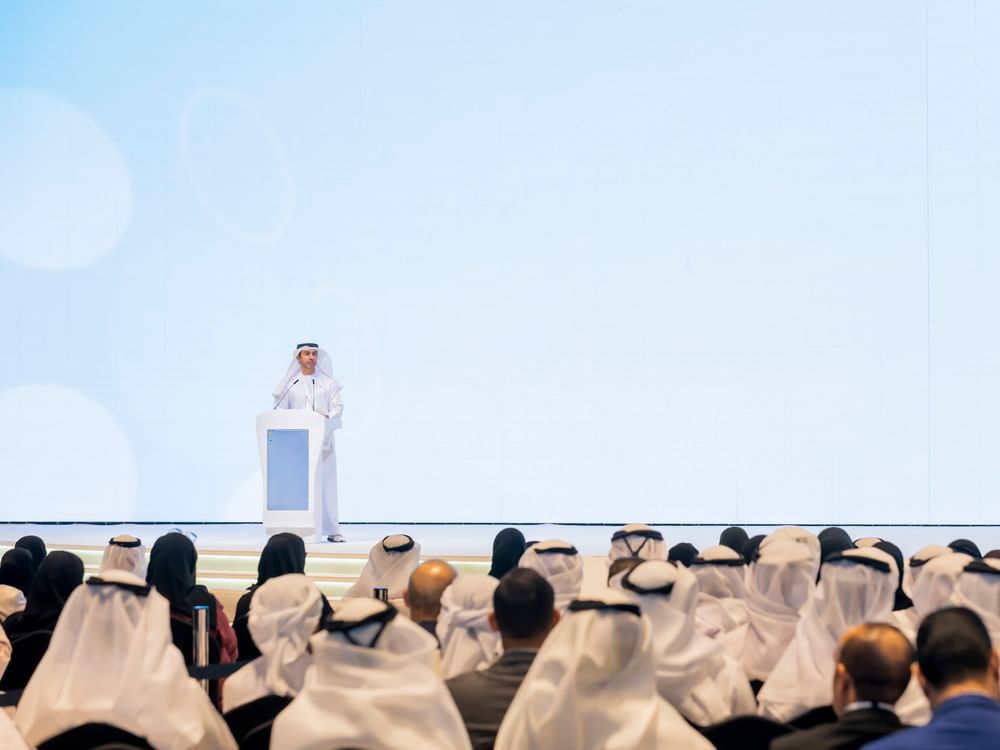
ABU DHABI, 21st October, 2026 (WAM) -- The inaugural Emirati Education Forum 2026 opened today at ADNEC Centre Abu Dhabi, bringing together ministers, officials, policymakers, experts, academics, educators and representatives of educational institutions to discuss the future of education in the UAE.
Organised by the Emirates Centre for Strategic Studies and Research (ECSSR) in partnership with national educational institutions, the forum was held under the theme "Five Pillars of Education: Toward an Integrated Education Ecosystem".
The programme featured four dialogue sessions, two plenary sessions, eight parallel sessions and an "In 7 Minutes" segment. The National Education Charter was a central focus of discussions, which explored ways to translate its objectives into educational practices and strengthen cooperation among the various components of the education system to enhance the learning experience of Emirati students and prepare them for future requirements.
In his opening address, Dr. Sultan Mohammed Al-Nuaimi, Director-General of the ECSSR, said the forum was guided by a vision that moves beyond the traditional concept of education towards the Five Pillars of Education, placing students at the heart of the education system.
He stressed that the forum serves as a national platform for strengthening cooperation among the various components of the education system, examining the current state of education and its challenges, and exploring its future.
The forum opened with a dialogue session entitled "The National Education Charter: From Vision to Practice – How Can the Five Pillars of Education Work Together?"
During the session, Sarah bint Yousif Al Amiri, Minister of Education, emphasised the need for the education system to keep pace with technological advances and changing labour market requirements by promoting lifelong learning and developing students' independent learning and critical thinking skills, thereby strengthening their ability to adapt to future demands.
Addressing the relationship between education and the media during a session entitled "Education and Media: Who Influences Whom?", Abdulla bin Mohammed bin Butti Al Hamed, Chairman of the National Media Authority, said students' growing attraction to screens and the increasing influence of technology and artificial intelligence pose mounting challenges to raising younger generations and safeguarding their awareness.
He stressed the importance of transparency in media practices amid the growing influence of prominent personalities on society.
During a session on youth and education policies and building readiness for the future, Dr. Sultan bin Saif Al Neyadi, Minister of State for Youth Affairs, highlighted the importance of establishing an integrated national framework linking education, national service and the labour market, while involving young people in policymaking.
He emphasised the need to promote lifelong learning and develop critical thinking and problem-solving skills to meet future requirements.
Dr. Khalifa Mubarak Al Dhaheri, Director-General of Mohamed bin Zayed University for Humanities, highlighted the importance of Islamic education in reinforcing religious and national values, promoting positive behaviour, and fostering tolerance and citizenship.
Speaking during a session on Islamic education, its fundamental principles, objectives and impact within the education system, he stressed the importance of instilling respect for knowledge and rejecting any artificial conflict between religion and scientific facts.
The first plenary session examined the Emirati learner's journey and the roles of the five pillars of education in improving education quality and strengthening cooperation among the components of the education system.
Dr. Ahmed Sultan Al Shuaibi, Under-Secretary of the Ministry of Higher Education and Scientific Research, emphasised the importance of balancing access to education with quality and harnessing smart technologies to expand learning opportunities.
Dr. Mansoor Al Awar, Chancellor of Hamdan Bin Mohammed Smart University, stressed that the success of the Five Pillars of Education should be measured by their impact on the lives of Emiratis and their ability to promote lifelong learning, rather than by the number of joint initiatives or qualifications obtained.
The second plenary session, entitled "The Emirati Teacher: From Knowledge Transfer to Transformational Leadership", focused on developing teachers' roles in building students' skills.
Sulaiman Al Kaabi, Assistant Under-Secretary for the Professional Development Sector at the Ministry of Education, emphasised the importance of identifying students' talents and developing their abilities in ways that reflect national identity and future requirements.
Maryam Al Hallami, Executive Director of the Private Education and Partnerships Schools Sector at the Abu Dhabi Department of Education and Knowledge, explained that teachers' roles are no longer confined to imparting knowledge but increasingly focus on equipping students with skills, requiring continuous professional development supported by educational institutions.
Discussions extended to eight parallel sessions addressing the development of Emirati learners' character, stronger partnerships between families and educational institutions, alignment of education with the requirements of the future economy, and assessment methods in the age of artificial intelligence.
The sessions also examined the role of national research in shaping education policies, ways to attract young Emirati talent to the teaching profession, strengthening the status of the Arabic language, and establishing national standards for the balanced use of digital technology in education.
During the "In 7 Minutes" segment, Dr. Ebrahim Saeed Al Hajri, President of Khalifa University of Science and Technology, emphasised the importance of transforming scientific research and intellectual property into commercial products and ventures.
He highlighted the experience of a start-up emerging from the university's research in attracting investment and creating employment opportunities.
Marwan Ahmed Lutfi, Director-General of Etihad Credit Bureau, stressed the importance of raising young people's awareness of their credit records and managing their financial obligations to make responsible decisions.
Aref Hamad Al Awani, Secretary-General of the Abu Dhabi Sports Council, highlighted the role of school sports in developing motor skills, balance and self-confidence, while enhancing students' quality of life.
The forum also featured interactive spaces where national institutions showcased initiatives supporting education and the development of the education system.
Other activities included the Emirati Education Hackathon, held under the theme "Educational Innovation Challenge", to encourage young people to develop innovative solutions to educational challenges, and a graduation ceremony for a cohort of the National Space Academy.
The forum concluded following a series of dialogues and sessions addressing priorities for educational development in the UAE. Discussions highlighted the importance of cooperation among educational institutions, families, communities and education policymakers in advancing national efforts to prepare Emirati learners for future requirements.