
DUBAI, 22nd October, 2026 (WAM) -- The Ministry of Higher Education and Scientific Research (MoHESR) continues to develop its regulatory framework by adopting a proactive, data-driven approach that leverages modern technologies and risk-based oversight.
These efforts contribute to protecting students’ rights, strengthening the compliance of higher education institutions, technical and vocational education and training institutions, and training centres with approved requirements and regulations and enhancing the quality and competitiveness of the UAE’s higher education system.
The results recorded in 2025 and 2026 reflect the evolution of the Ministry’s regulatory role from a focus on identifying violations to an integrated system centred on risk prevention, early detection of non-compliance and monitoring corrective measures, thereby reinforcing the quality of the educational process.
The Ministry has strengthened its proactive oversight framework by leveraging digital technologies and artificial intelligence tools to monitor and track published advertisements, as well as academic and educational practices. This supports the early detection of non-compliance and enables swift and accurate action.
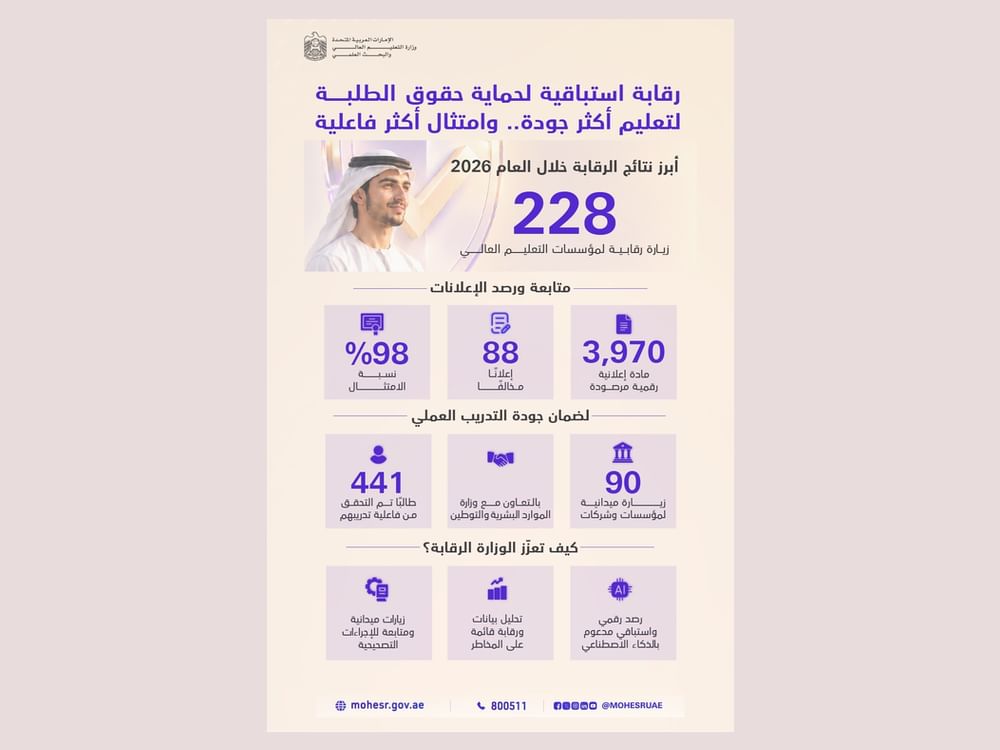
The Ministry reported that it had monitored 3,970 digital advertisements since the beginning of 2026, of which 88 were found to be in violation, representing an overall compliance rate of approximately 98%. This was achieved through a proactive monitoring system enhanced by artificial intelligence tools, which enabled the Ministry to take the necessary measures to limit the spread of non-compliant advertisements and address instances of non-compliance.
The integration of digital monitoring, field visits, data analysis and risk-based oversight enhances the Ministry’s ability to direct its efforts towards priority areas and higher-risk cases. This supports the development of a more efficient and high-quality higher education system and strengthens confidence in its outcomes.
Statistics from the Higher Education Oversight and Quality Department show that the Ministry conducted 228 regulatory visits and inspection campaigns to verify the compliance of institutions and entities subject to oversight with approved requirements and regulations. These activities were carried out from the beginning of the year through the end of the third quarter.
The regulatory activities resulted in 32 corrective action plans to address identified violations, while the rate at which entities closed their corrective action plans reached 84%. This reflects the Ministry’s approach, which focuses on addressing the root causes of non-compliance and following up on the rectification of observations.
This approach is aligned with the move towards applying graduated measures when addressing violations, allowing institutions to remedy instances of non-compliance and rectify their status, while taking appropriate measures in cases that affect educational quality, academic integrity, or students’ opportunities for training and learning.
As part of its efforts to strengthen coordination with government entities, the Ministry, in cooperation with the Ministry of Human Resources and Emiratisation, has conducted nearly 90 field visits since the beginning of the year to verify the quality and compliance of practical training provided to higher education students. The training of 441 students at 90 institutions and companies was verified during these visits.
The inspections aim to enhance the quality of students’ training experiences, ensure compliance with approved requirements and protect students’ rights. The Ministry issued corrective action plans outlining observations related to practical training to the relevant educational institutions, which subsequently took the required corrective measures.
The Ministry’s regulatory activities include verifying institutional licensing, accreditation of academic programmes, and the accuracy and transparency of advertisements and information provided to students. They also cover monitoring requirements related to the quality of the educational process, verifying academic integrity and the accuracy of data and records, and following up on corrective measures.
These efforts are aligned with Cabinet Resolution No. (143) of 2026 concerning the Regulation of Violations, Penalties and Administrative Measures Related to the Mandates and Services of the Ministry of Higher Education and Scientific Research. The Regulation covers areas including licensing and accreditation, data accuracy, oversight and evaluation, academic integrity, practical training and academic advertising, while placing the protection of students’ and trainees’ rights at the forefront of the Ministry’s priorities.