
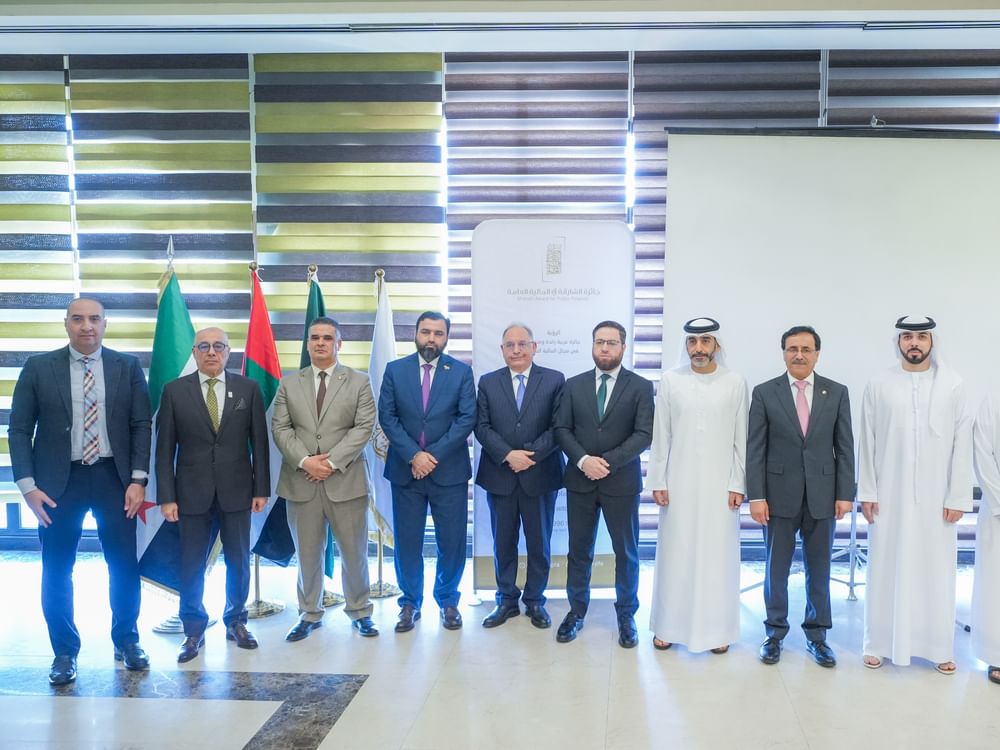
DAMASCUS, 22nd October, 2026 (WAM) -- The Sharjah Award for Public Finance (SAPF) organised an introductory seminar in Damascus, the Syrian capital, in cooperation with the Arab Administrative Development Organisation (ARADO), affiliated with the League of Arab States, and under the patronage of Mohammed Hassan Al-Sakkaf, Minister of Administrative Development of the Syrian Arab Republic.
The seminar formed part of the Award’s ongoing efforts to expand its presence across the Arab region and promote the exchange of knowledge and expertise in public financial management and institutional excellence.
The event brought together officials, specialists, and professionals interested in advancing financial and administrative performance. It aimed to introduce participants to the Award’s mission, objectives, categories, evaluation criteria, and participation procedures, while providing Syrian institutions and professionals with opportunities to benefit from the knowledge-sharing and professional development initiatives offered by the Award.
The opening session featured addresses by Mohammed Hassan Al-Sakkaf, Minister of Administrative Development of the Syrian Arab Republic; Sheikh Rashid bin Saqr Al Qasimi, Director of the Sharjah Finance Department and Secretary-General of the Sharjah Award for Public Finance; and Dr. Nasser Al-Hatlan Al-Qahtani, Director General of the Arab Administrative Development Organisation (ARADO), affiliated with the League of Arab States. The session also included an introductory film highlighting the Award.
Sheikh Rashid bin Saqr Al Qasimi affirmed that the Award embodies the visionary leadership of His Highness Sheikh Dr. Sultan bin Mohammed Al Qasimi, Supreme Council Member and Ruler of Sharjah, in investing in human capital, developing institutions, and fostering a culture of excellence.
He noted that the Award’s mission extends beyond recognising achievements to serving as an Arab platform for exchanging expertise, stimulating innovation, and advancing public financial management practices, thereby enhancing institutional efficiency and reinforcing the principles of governance, transparency, and sustainability.
Sheikh Rashid said, “Excellence in public finance is no longer limited to improving procedures and enhancing spending efficiency. It has become a fundamental pillar in strengthening the effectiveness of financial decision-making and directing resources towards development priorities. Through the Award, we are committed to encouraging Arab institutions and professionals to adopt best practices and strengthen their capabilities, contributing to the development of more resilient, efficient, and adaptable financial systems.”
He added, “Hosting this seminar in the sisterly Syrian Arab Republic represents an important step towards expanding cooperation and facilitating the exchange of knowledge and expertise across the Arab region. We look forward to seeing this initiative encourage greater participation by Syrian institutions and professionals in the Award, while showcasing their distinguished experiences and initiatives, enriching the journey towards financial excellence, and supporting sustainable institutional development.”
Dr. Nasser Al-Hatlan Al-Qahtani, Director General of the Arab Administrative Development Organisation (ARADO), affiliated with the League of Arab States, emphasised the importance of developing specialised competencies in public financial management.
He noted that advancing government performance requires investment in professional knowledge, the modernisation of working methods, and stronger institutional capabilities to utilise advanced tools for financial planning, resource management, and performance measurement.
Dr. Al-Qahtani said, “Building institutional and human capabilities is fundamental to achieving sustainable transformation in public administration. This makes knowledge-sharing and training programmes essential for keeping pace with economic and administrative developments. The seminar and its accompanying workshop provide an opportunity for practical learning and a deeper understanding of financial excellence criteria and how they can be applied to performance evaluation and the identification of improvement opportunities. This will help institutions translate acquired knowledge into practical approaches that enhance operational efficiency and the quality of their outcomes.”
The introductory seminar featured two specialised sessions delivered by the Sharjah Award for Public Finance team, focusing on the Award’s objectives, institutional and individual categories, and the evaluation criteria adopted for each category.
The sessions were designed to help institutions and individuals better understand participation requirements and apply the Award’s criteria to review their existing practices and identify opportunities for development.
The programme also covered participation conditions, registration procedures, and the application process through the Award’s electronic platform. Dedicated time was allocated to addressing participants’ questions and enquiries regarding nomination procedures and evaluation requirements.
These sessions reflect the Award’s commitment to ensuring clarity and transparency in its participation procedures and providing institutions and professionals with the information needed to benefit from the Award as a framework for performance assessment and continuous improvement.
The programme continued on Thursday, 22 October 2026, with a specialised training workshop entitled “Integrating Financial and Administrative Reform to Enhance Government Performance,” delivered by Dr. Mohammed Mustafa Al-Bakour.
The workshop comprised two training sessions. The first explored the role of financial and administrative reform in improving government performance, while the second focused on related practical applications. The programme concluded with an open discussion, providing participants with an opportunity to exchange perspectives and experiences and raise questions.
The workshop builds on the introductory sessions covering the Award’s objectives, categories, evaluation criteria, participation conditions, and registration procedures. It aims to strengthen the event’s educational and practical dimensions, reflecting the Award’s commitment to moving beyond awareness-raising towards capacity building, knowledge transfer, and the exchange of expertise.