
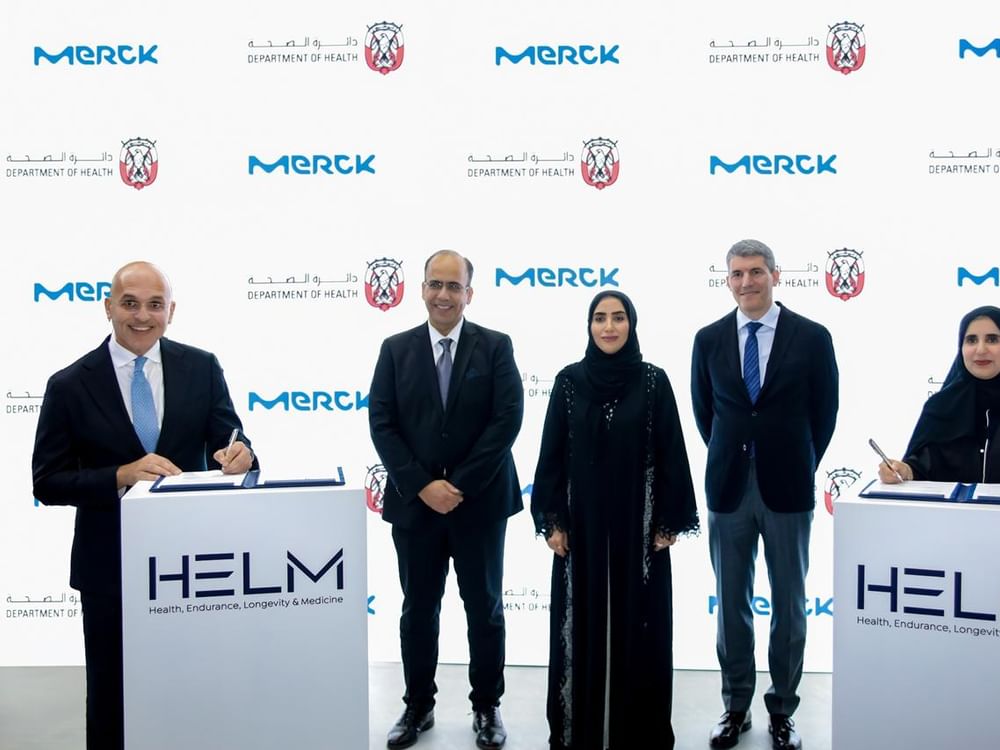
ABU DHABI, 23rd October, 2026 (WAM) -- Abu Dhabi is bringing reproductive science and specialist expertise together to explore new possibilities for fertility care. The Department of Health – Abu Dhabi (DoH), the regulator of the healthcare sector in the Emirate, has signed a tripartite Memorandum of Understanding (MoU) with Cleveland Clinic Abu Dhabi, and Paterna Biosciences, a U.S. biotechnology company developing laboratory-grown sperm for men with infertility.
Signed on the sidelines of the Abu Dhabi Future Health Summit (ADFHS) 2026, the collaboration will advance research into severe male infertility, connecting stem-cell science with specialist clinical expertise, to build new and innovative infertility treatment pathways, and provide new hope for individuals and families.
In the presence of Dr. Noura Al Ghaithi, Undersecretary of the Department of Health – Abu Dhabi and Dr. Georges Pascal Haber, Chief Executive Officer of Cleveland Clinic Abu Dhabi, the MoU was signed by Dr. Khuloud Al-Dhalei, Executive Director of the Healthcare Quality sector at DoH, Dr. Scott Lundy, Chief Research Officer at Cleveland Clinic Abu Dhabi and Dr. Alexander W. Pastuszak, Chief Executive Officer of Paterna Biosciences.
Dr. Khuloud Al-Dhalei, Executive Director of the Healthcare Quality sector at DoH, said: “For individuals and families facing infertility, scientific progress can offer hope, but that hope must be grounded in evidence and ethics. Our collaboration with Cleveland Clinic Abu Dhabi and Paterna Biosciences brings specialist care and emerging reproductive science together to deepen our understanding of male infertility and explore possibilities for the future. Abu Dhabi’s connected health ecosystem enables this work to progress with responsible oversight, keeping people’s safety and trust at its heart.”
Dr. Georges-Pascal Haber, Chief Executive Officer of Cleveland Clinic Abu Dhabi, said: “Reproductive medicine is now poised for the most impactful series of breakthroughs since in vitro fertilization was first introduced nearly five decades ago. The Department of Health – Abu Dhabi has recognized the importance of this work and has fostered an ideal ecosystem that supports the integration of emerging scientific rigor by industry leaders such as Paterna Biosciences into the world-class clinical care infrastructure and clinical trial expertise at Cleveland Clinic Abu Dhabi. The future of reproductive science is indeed bright.”
Alexander W. Pastuszak, Co-founder and CEO of Paterna Biosciences said: “Men who produce no sperm have had almost nothing to turn to, and many are told biological fatherhood is out of reach. Our team has grown human sperm in the laboratory from their testicular starting cells, and working with our partners in Abu Dhabi will help us establish, rigorously and in phases, whether that science can become a safe treatment. The goal is to get these therapies into the hands of the millions of patients who need them as quickly and responsibly as possible.”
The proposed collaborative research laboratory would be operated by Paterna Biosciences within Cleveland Clinic Abu Dhabi’s facilities, to study sperm development and maturation, with the long-term aim of expanding options for men whose severe impairment of sperm production may currently prevent biological parenthood.
Research will progress in phases, beginning with studies of sperm cells, technologies for selecting genetically normal gametes and approaches to improving the development of mature sperm from existing precursor cells, before progressing to in vitro spermatogenesis. A potential later phase may involve gene editing in sperm-producing stem cells to correct genetic defects leading to disease, which would remain laboratory research subject to separate ethical and regulatory review, alongside other emerging technologies.
The approaches under study will remain investigational, with DoH supporting their rigorous evaluation through its health-licensing and research ethics pathways. Access to biological samples and relevant data will be subject to research consent and frameworks that protect patient privacy and comply with Abu Dhabi’s data governance requirements and regulations. Any progression to clinical use, including first-in-human studies in Abu Dhabi, would require scientific validation and a separate ethical and regulatory pathway agreed by all parties.
Abu Dhabi is advancing an integrated ecosystem that supports individuals and families throughout their reproductive health journey. Through the Abu Dhabi Programme for the Future of Reproductive Health, genetic screening programmes and the Global Reproductive Health Advisory Council, the Emirate is strengthening prevention, fertility care and research, translating innovation into better outcomes and reinforcing its position as a global capital for the future of reproductive health.