
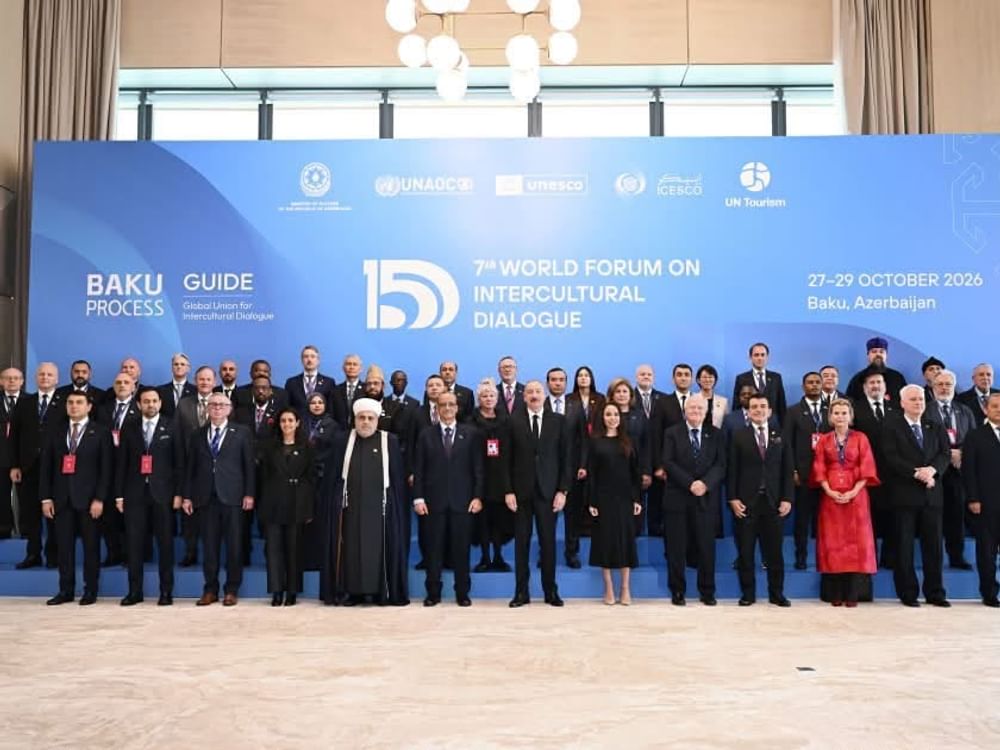
BAKU, 28th October, 2026 (WAM) -- The Muslim Council of Elders participated in the 7th World Forum on Intercultural Dialogue, hosted in Baku, Azerbaijan, from 27 to 28 October under the theme, “Dialogue for a Shared Future: Building Bridges in a Fractured World.” The forum brought together heads of state and government, ministers, representatives of international and regional organisations, and various intellectuals and experts from around the world.
During a session entitled “Dialogue of Religions: A Roadmap to a Shared Future,” Judge Mohamed Abdelsalam, General Advisor to the Muslim Council of Elders, emphasised that the real challenge facing the world is not the existence of religious and cultural diversity, but rather the inability to manage such diversity with wisdom, justice, and mutual respect. He stressed that differences should serve as a source of mutual understanding and complementarity, rather than a pretext for conflict and division, and that dialogue is a moral responsibility that requires moving beyond coexistence toward collective action for the future of humanity.
Judge Abdelsalam noted that the historic Document on Human Fraternity, which was co-signed in Abu Dhabi in 2019 by His Eminence Dr. Ahmed Al-Tayeb, Grand Imam of Al-Azhar and Chairman of the Muslim Council of Elders, and the late Pope Francis, affirmed that genuine faith is a moral force for protecting human beings and safeguarding their dignity, rather than a justification for hatred or exclusion. He stressed that exploiting religion to justify extremism, terrorism, and incitement to hatred represents a distortion of the true message of religions, which is rooted in spreading mercy and peace. He further emphasised that the responsibility of religious leaders extends beyond advocating coexistence to confronting extremist ideologies, countering attempts to exploit religion to fuel discord and conflict, and protecting young people from radicalisation and intolerance.
Abdelsalam also called for the development of a shared vision that would make interreligious dialogue an effective force for ending wars and conflicts, building peace, combating extremism, terrorism, and hate speech, and strengthening partnerships among religious, cultural, and international institutions. Such efforts, he noted, would help transform the values of human fraternity into a tangible reality. He underscored that a shared future begins with recognising that differences do not negate our common humanity and that the values that unite people are far deeper than the perceptions that divide them.
The forum was also attended by His Eminence Sheikh-ul-Islam Allahshukur Pashazadeh, member of the Muslim Council of Elders and spiritual leader of Muslims in Azerbaijan and the Caucasus. His Eminence for his part, emphasised the importance of promoting dialogue and mutual understanding among followers of different religions and cultures, fostering the values of tolerance, coexistence, and human fraternity, and strengthening cooperation among religious leaders in confronting extremism and hatred while advancing peace and stability within societies.