
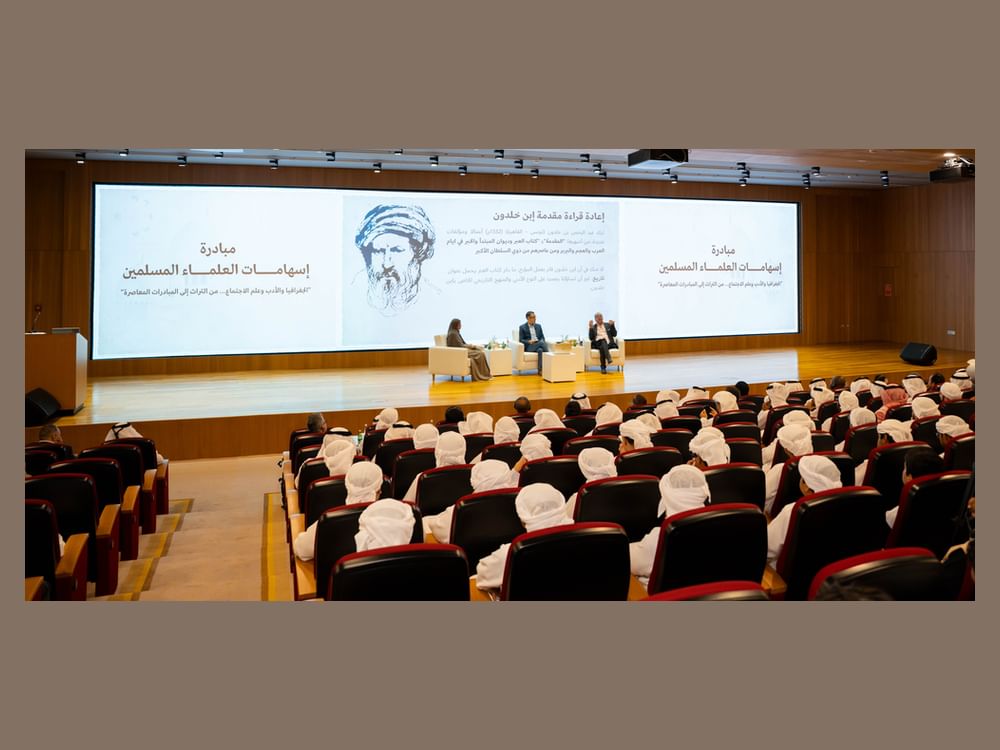
ABU DHABI, 30th October, 2026 (WAM) -- Sheikh Zayed Grand Mosque Centre has launched the second phase of its “Contributions of Muslim Scholars” initiative, following the directives of His Highness Sheikh Mansour bin Zayed Al Nahyan, Vice President, Deputy Prime Minister and Chairman of the Presidential Court, to highlight the civilisational role of Muslim scholars across the ages.
The initiative showcases the scientific and intellectual achievements of Islamic civilisation and the role of Muslim scholars in laying the foundations of modern sciences.
It also reflects the UAE's commitment to preserving shared cultural heritage and builds on the mission of the Centre's Light & Peace Museum, which highlights Islamic civilisation and its values.
The second phase, titled “Geography, Literature and Sociology”, features cultural programmes and events, including an exhibition documenting the contributions of Muslim scholars, dialogue sessions, a visual cultural series and activities that enrich Abu Dhabi’s cultural landscape.
The launch was attended by a number of ambassadors to the UAE, representatives of various entities, cultural and intellectual specialists, and school students.
Dr. Yousif Alobaidli, Director-General of the Centre, said the initiative reflects the Centre’s commitment to highlighting the civilisational role of Muslim scholars and their contributions to the advancement of human sciences and knowledge.
“The second phase of the initiative extends the cultural and intellectual mission that the Centre embodies, and its commitment to showcasing the richness of Islamic civilisation and the diversity of its intellectual and literary output," he said.
He added that the initiative highlighted the contributions of Muslim scholars in geography, literature and sociology, their influence on human civilisation and their role in shaping knowledge throughout history.
The exhibition explores the achievements of prominent Muslim scholars across three main themes.
The geography theme highlights the work of Muhammad al-Idrisi; Ibn Battuta, through his book Tuhfat al-Nuzzar fi Ghara’ib al-Amsar wa ‘Aja’ib al-Asfar (A Gift to Those Who Contemplate the Wonders of Cities and the Marvels of Travelling); and Zakariya al-Qazwini, author of ‘Aja’ib al-Makhluqat wa Ghara’ib al-Mawjudat (The Wonders of Creation and the Oddities of Existence) and Athar al-Bilad wa Akhbar al-‘Ibad (Monuments of Places and Chronicles of God’s Servants). It examines their role in describing countries, documenting the lives of peoples and mapping the world.
The literature theme features the contributions of al-Hariri, through his Maqamat al-Hariri (The Assemblies of al-Hariri), which combine eloquence, storytelling and portrayals of social life; and al-Mutanabbi, through his diwan, on loan from the private collection of Mohammed Ahmed Al Murr, with its poetry of wisdom, ambition and dignity and its place in Arab cultural memory.
The sociology theme explores the thought of Ibn Rushd (Averroes), through his works Fasl al-Maqal fi-ma bayn al-Hikma wa al-Shari’a min al-Ittisal (The Decisive Treatise) and Tahafut al-Tahafut (The Incoherence of the Incoherence), and the influence of his commentaries on the transmission of knowledge to Europe. It also presents Ibn Khaldun’s contributions to the study of societies and history in Al-Muqaddimah (The Introduction) and Kitab al-‘Ibar wa Diwan al-Mubtada’ wa al-Khabar (Book of Lessons and Record of Beginnings and Events), which offer insights into human civilisation and the rise and transformation of states.
The programme also featured two cultural dialogue sessions.
The first, titled "Ibn Khaldun and Understanding Societies", brought together Professor Abdelhamid Larguèche, Emeritus Professor of History and Heritage at Manouba University in Tunisia and former Director-General of Heritage, and Professor Houssem Eddine Chachia, Associate Professor of Early Modern History at the University of Tunis.
The session examined Ibn Khaldun's approach to studying societies and historical change, including his theories on the rise and decline of states, social cohesion (asabiyyah), human civilisation (umran) and the social and economic forces shaping history.
The second session, titled “Literature and Sociology: From Heritage to Modernity”, was led by Prof. Ridwan al-Sayyid, Dean of the College of Graduate Studies at Mohamed bin Zayed University for Humanities, and Prof. Fatima Al Sayegh, university professor and member of the Board of Trustees of the Sultan bin Ali Al Owais Cultural Foundation.
Discussions focused on the role of Arab and Islamic intellectual heritage in understanding social change and its relevance to contemporary social issues.
A workshop titled "Make Your Own Book: In the Footsteps of Muslim Scholars" also invited participants to explore the achievements of Muslim scholars before creating their own books through drawing and writing.
The Centre also released the second episode of its "Contributions of Muslim Scholars" series, focusing on the initiative's themes of geography, literature and sociology.
Produced by staff at the Centre, the series uses artificial intelligence technologies in content design and production. It features a narrator representing Emirati identity and visual scenes depicting the cultural and historical dimensions of Islamic civilisation.
The exhibition is located in the Dome of Peace at the Mosque's Visitor Centre, where visitors can also explore the Light & Peace Museum, which presents Islamic civilisation's intellectual and artistic heritage through rare artefacts and interactive displays.
Visitors can also experience "Diya", an immersive presentation combining 360-degree technology, sound and light.
The exhibition forms part of the Centre's wider cultural programme, which includes permanent and temporary exhibitions such as "Hajj: Memories of a Journey", "Andalusia: History and Civilisation" and "Islamic Coins: History Revealed".
The "Contributions of Muslim Scholars" exhibition is open during the Mosque's official visiting hours, from Saturday to Thursday, 9:00 am to 9:00 pm, and on Fridays from 9:00 am to noon and from 3:00 pm to 9:00 pm.