
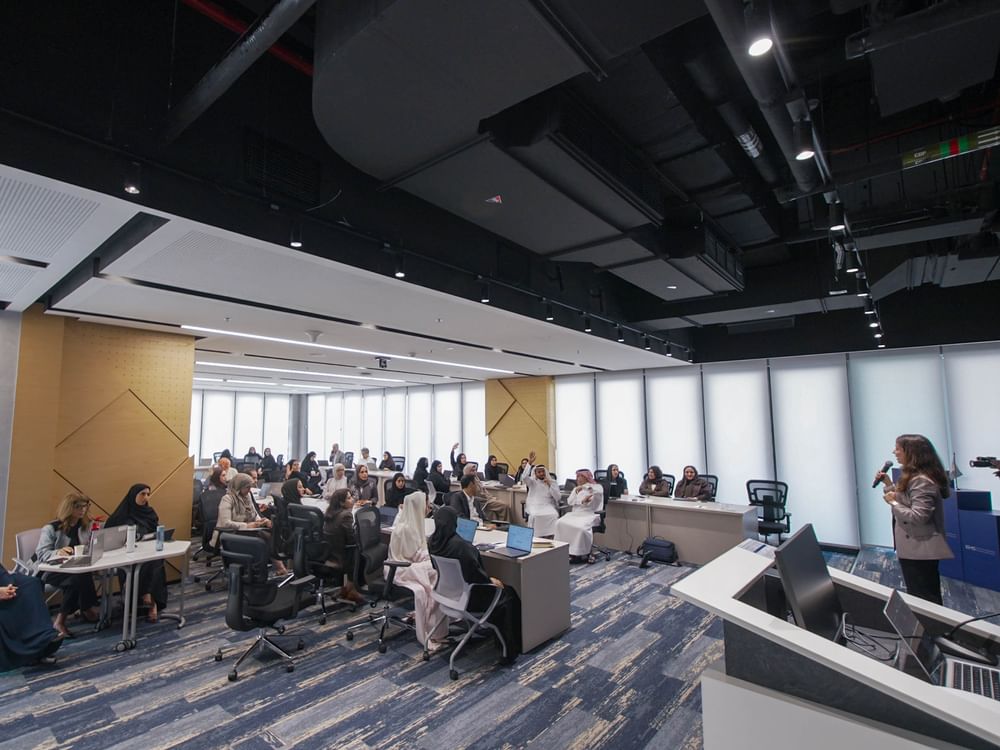
DUBAI, 2nd November, 2026 (WAM) -- The UAE Artificial Intelligence Office, in collaboration with Emirates Health Services (EHS) and Siemens, has organised a specialised training programme for EHS leaders, hospital directors, consultants and medical specialists on harnessing agentic artificial intelligence (AI) to advance healthcare services.
The programme aims to equip healthcare leaders with the capabilities to adopt innovative operating models that enhance operational efficiency, service quality and patient experience.
Held in conjunction with UAE Codes Day, the programme reflects the UAE’s drive to move beyond AI applications supporting individual tasks towards integrated intelligent systems capable of understanding objectives, executing tasks and managing complex operations efficiently.
The programme was attended by Yousif Mohammed Al-Serkal, Director-General of EHS, and highlighted the importance of partnerships between government entities and global technology companies in transferring knowledge and developing national capabilities.
Abdelrahman Al Mahmoud, Director at the UAE Government Artificial Intelligence Office, said investing in leadership capabilities is fundamental to accelerating the transition towards advanced AI-powered operating models.
He said, “UAE Codes Day is an opportunity to reaffirm that the foundation of our digital future lies in the people empowered to lead it.”
Al Mahmoud added that equipping healthcare leaders with a deeper understanding of agentic AI and its practical applications helps foster an institutional culture that embraces innovation and translates technological potential into solutions that strengthen the healthcare sector’s competitiveness and future readiness.
Kalthoom Al Blooshi, Director of the Training and Development Centre and Chief Innovation Officer at EHS, said developing leadership capabilities in AI is an essential part of translating technological advances into tangible value across healthcare services and institutional operations.
She said the next phase requires integrated institutional capabilities to identify, assess and develop high-impact AI use cases within clear frameworks for governance, safety and accountability.
Al Blooshi added that AI should be viewed as a strategic enabler for developing healthcare operating models rather than simply a technological tool, with innovation directed towards scalable and practical solutions that deliver sustainable value for patients, healthcare professionals and the wider system.
Rohit Kumar, Head of Siemens Advanta Middle East, said the UAE has set ambitious targets for adopting AI across vital sectors, with healthcare offering significant opportunities to integrate intelligent technologies throughout the patient journey.
He added that the programme supports EHS teams in identifying opportunities to deploy AI effectively and responsibly through a safe and structured approach to transforming healthcare operations.
The programme focuses on progressing from individual AI applications and agents towards interconnected systems capable of coordinating workflows across the healthcare journey, from patient registration and appointment management to clinical and administrative processes and post-care follow-up.
It includes interactive sessions, practical demonstrations and regional use cases exploring agentic AI applications and their potential to improve operational and administrative processes.
Interactive labs also enable healthcare leaders to work directly with AI tools and explore solutions addressing the needs of healthcare institutions.
The programme covers organisational change management, AI governance, risk management and clinical safety to strengthen leaders’ ability to make informed decisions when adopting, implementing and scaling AI solutions.
It concludes with specialised workshops to identify priority transformation and innovation opportunities at EHS. These will be assessed according to expected impact, technological readiness, data availability and safety requirements, with initial pilot-project proposals supported by performance indicators and implementation plans.
UAE Codes Day is celebrated annually on 29th October following directives issued in October 2021 by His Highness Sheikh Mohammed bin Rashid Al Maktoum, Vice President and Prime Minister of the UAE and Ruler of Dubai.
The date marks the launch of the region’s first eGovernment initiative on 29th October 2001 and the announcement of Dubai Internet City on the same date in 1999.
In November 2023, the United Nations Educational, Scientific and Cultural Organization (UNESCO) adopted the UAE’s proposal to designate 29th October annually as World Coding Day.