
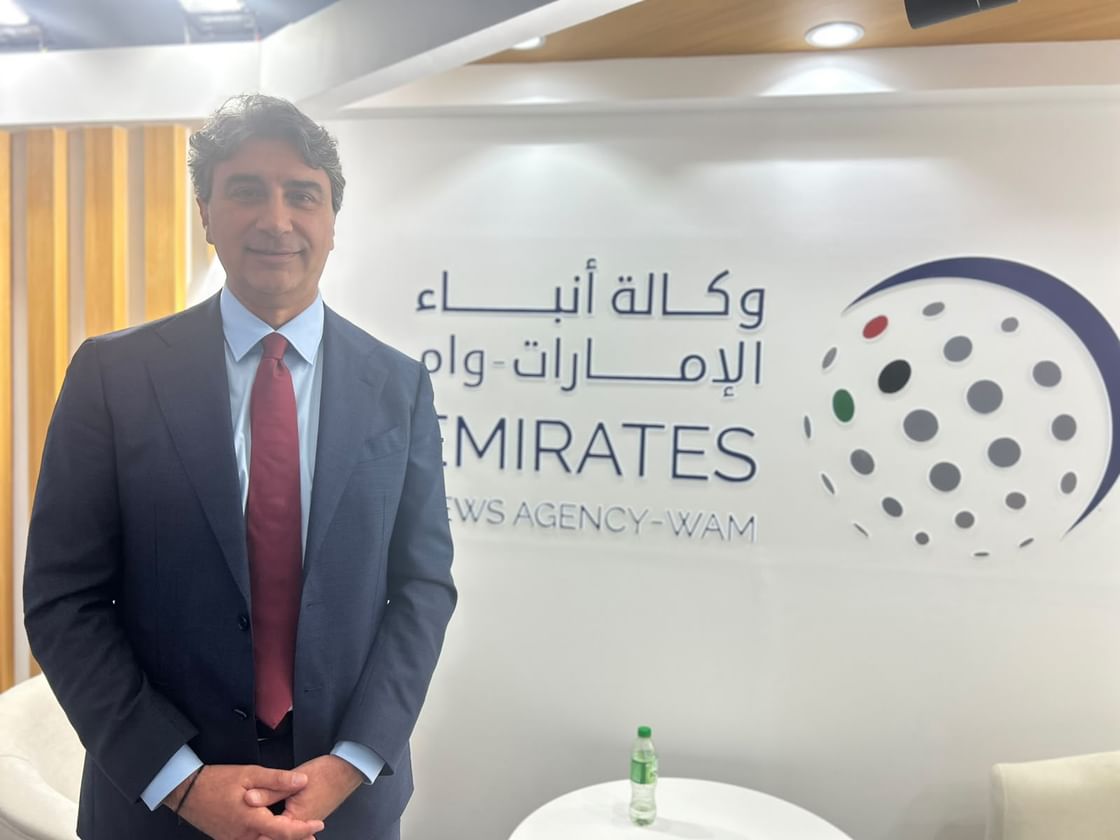
ABU DHABI, 2nd November, 2026 (WAM) -- The Abu Dhabi International Petroleum Exhibition and Conference (ADIPEC) 2026 is providing a global platform to showcase the latest artificial intelligence and digital technology solutions and their role in advancing the energy sector, improving the efficiency of industrial operations, increasing productivity and supporting sustainability.
Nayef Bou Chaaya, Vice President for the Middle East, Africa, Türkiye and Central Asia at AVEVA, said the exhibition offers an important opportunity to engage with customers and partners and showcase the latest technology solutions designed to address challenges facing the energy and industrial sectors.
In statements to the Emirates News Agency (WAM), Bou Chaaya said AVEVA is participating in ADIPEC for the fifth consecutive year and remains committed to presenting its latest innovations, with an increased focus this year on artificial intelligence applications.
He said the company is working with customers to develop practical solutions that help improve operational efficiency, optimise energy consumption, reduce emissions and support decarbonisation efforts.
Bou Chaaya explained that AVEVA is a global industrial software company providing solutions for the oil and gas, energy, water and other sectors, covering various stages of the asset lifecycle, from design and construction through operation and maintenance to performance and operational efficiency optimisation.
He added that the company works closely with customers and partners to deploy artificial intelligence technologies to address operational and industrial challenges, noting that these technologies have become an important tool for improving facility performance, enhancing energy efficiency, reducing emissions and achieving sustainability objectives.
He said more than 90 percent of leading industrial enterprises rely on AVEVA to support the delivery of essential products and services, including safe and reliable energy, food, medicines and infrastructure, by connecting people with trusted information and AI-enhanced insights.
Bou Chaaya explained that AI- and machine learning-powered predictive maintenance is among the company's key applications. It uses advanced models to analyse data from industrial assets and equipment and understand their operating patterns and behaviour, enabling potential failures to be predicted before they occur and preventive action to be taken.
He said this approach helps reduce unplanned downtime, ensure continuity of production and improve the reliability of industrial facilities, while also enhancing the safety of personnel and operations.
He added that the use of artificial intelligence in this area delivers tangible value to organisations by improving asset management and increasing operational efficiency.
Bou Chaaya said the use of these technologies can also help increase production levels by between 3 percent and 5 percent through process optimisation and better utilisation of available capacity, without necessarily requiring major capital investment or new expansion projects.
He noted that this demonstrates the importance of digital solutions in generating both operational and economic gains.
Bou Chaaya stressed that the success of artificial intelligence applications depends fundamentally on the quality of available data, explaining that organisations require accurate, structured and connected data collected within a unified system that allows it to be accessed, understood in context and used effectively.
He said incomplete or inaccurate data can produce unreliable results even when the latest artificial intelligence technologies are used.
He therefore highlighted the importance of unifying data sources and connecting them through an integrated system that serves as a trusted reference for the organisation, enabling intelligent technologies to analyse information and produce accurate results that support decision-making.
Bou Chaaya added that the first step towards successfully deploying artificial intelligence is to identify the objective and the operational or economic value an organisation seeks to achieve.
This should be followed by an assessment of the available data and its quality, and then by selecting the appropriate artificial intelligence technology to meet those requirements, rather than starting with the technology before clearly defining the organisation's needs.
He said the UAE has consolidated its position as a regional and global hub for business, innovation and advanced technology, adding that hosting international events on the scale of ADIPEC strengthens its role in bringing together energy-sector leaders, global companies and experts.
Such events, he added, provide a platform for dialogue, knowledge exchange and exploration of solutions that can help shape the future of the sector.
Bou Chaaya said ADIPEC also gives companies an important opportunity to strengthen cooperation with organisations operating across the region, better understand market requirements and exchange expertise on best practices and emerging technologies, helping accelerate digital transformation and the adoption of artificial intelligence across the energy and industrial sectors.