
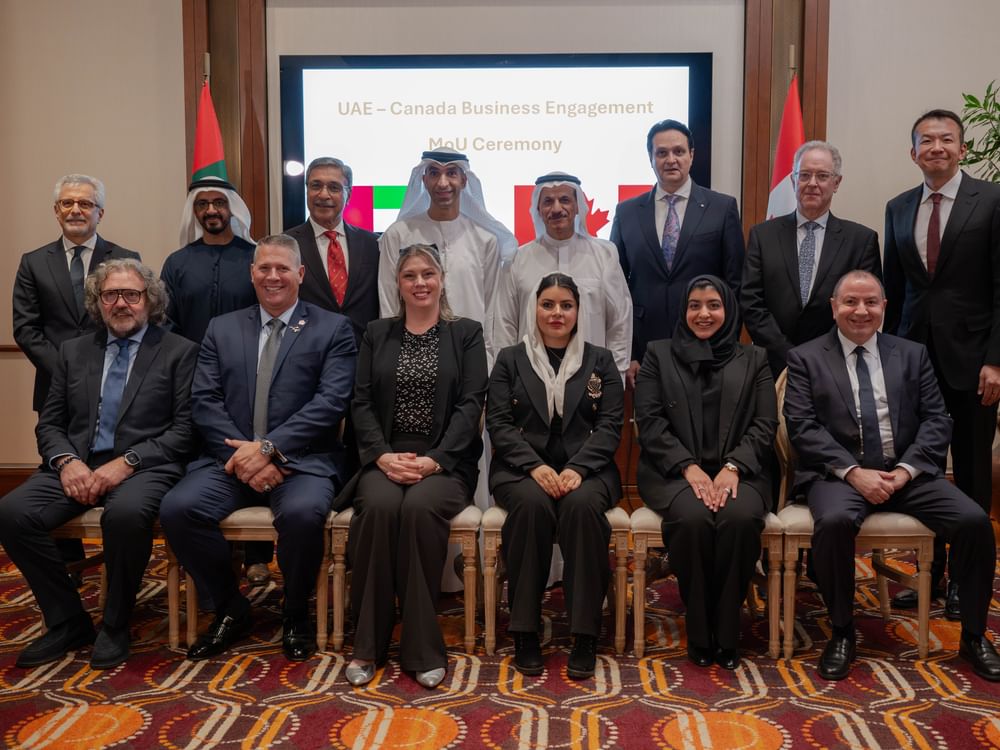
OTTAWA, 2nd November, 2026 (WAM) -- The United Arab Emirates and Canada have signed a number of agreements and memoranda of understanding and entered into commercial partnerships aimed at strengthening trade and investment cooperation and expanding their economic partnership across a range of vital and strategic sectors, coinciding with the recent official visit of H.H. Sheikh Khaled bin Mohamed bin Zayed Al Nahyan, Crown Prince of Abu Dhabi, to Canada.
The agreements covered digital infrastructure and advanced technology, space, industry, logistics, transport and ports, as well as food security, education and human capital development, housing and core infrastructure.
The signing ceremonies were attended by Dr. Thani bin Ahmed Al Zeyoudi, Minister of Foreign Trade; Sultan bin Saeed Al Mansoori, the UAE Foreign Minister's Envoy to Canada; and Abdulrahman Ali Almur Al Neyadi, UAE Ambassador to Canada, alongside officials and business leaders from both countries.
The agreements were signed amid growing trade and investment cooperation between the UAE and Canada and alongside the signing of the Comprehensive Economic Partnership Agreement (CEPA), reflecting both sides' commitment to translating their close economic relations into practical projects and long-term partnerships and enhancing private-sector participation in developing investment opportunities that add value to both economies.
The agreements and commercial partnerships fall within the investment cooperation framework set out under the Canada-UAE Investment Framework, valued at up to C$70 billion (US$50 billion), announced during the visit of Mark Carney, Prime Minister of Canada, to the UAE in November 2025.
The framework aims to accelerate cooperation in priority strategic sectors, strengthen two-way investment flows and broaden partnerships between Emirati and Canadian institutions and companies.
The signed memoranda of understanding and agreements covered several strategic areas of cooperation between the UAE and Canada, including cooperation between Space42 and Terrestar Solutions to support Canada's participation in developing the world's first satellite network using 5G technology, including the potential use of satellites manufactured in Canada in cooperation with MDA Space and Kepler Communications to provide Arabic-language coverage.
A strategic memorandum of understanding was also signed between Al Shaikh Holdings and the Government of Nova Scotia to explore opportunities to deploy UAE-supported private investment in the development and financing of student and workforce housing projects, as well as their long-term ownership and operation across the province.
In education and human capital development, the Khalifa Bin Zayed Al Nahyan Foundation and McGill University concluded a five-year framework agreement aimed at developing human capital in the education sector and other strategic sectors through scholarships, support for scientific research, and training and development programmes.
In the transport and logistics sector, cooperation involved DP World, Arctic Gateway Group and CentrePort Canada, together with the Port of Churchill, to explore opportunities in port operations and logistics services and develop an integrated transport corridor linking the Port of Churchill with the Hudson Bay Railway and CentrePort Canada, and onward to DP World's global logistics network, thereby strengthening trade connectivity and supply-chain efficiency.
The agreements also included a memorandum of cooperation between Al Barakah Dates and Just Quality International to explore opportunities to distribute Al Barakah date products in the Canadian market, as part of efforts to develop bilateral trade and investment and advance the objectives of the UAE-Canada CEPA.
On the occasion, Al Zeyoudi said the UAE and Canada share a firm commitment to strengthening trade, productive investment and cooperation between private-sector institutions in both countries, noting that the growth in UAE-Canada non-oil trade reflects the widening opportunities to deepen the economic partnership and develop joint projects in sectors where the capabilities of the two countries are complementary.
He added that the CEPA provides an important framework for expanding trade flows, improving market access and strengthening investor confidence, stressing that the agreements and partnerships signed help translate this framework into tangible commercial and investment opportunities and support innovation, supply-chain resilience and sustainable growth in both countries.
UAE-Canada non-oil foreign trade reached C$5.88 billion ($4.2 billion) in 2025, compared with around C$4.86 billion ($3.47 billion) in 2024, representing growth of 20.9 percent.
UAE non-oil exports to Canada rose by 10.8 percent to C$891.24 million ($636.6 million), while re-exports grew by 67.8 percent to C$909.02 million ($649.3 million). Imports from Canada reached C$4.07 billion ($2.91 billion), up 16 percent compared with 2024.
Bilateral trade continued to grow during the first half of 2026, with non-oil foreign trade reaching C$2.84 billion ($2.03 billion), an increase of 18.4 percent compared with the same period in 2025.
Imports from Canada rose by 16.6 percent to C$2.03 billion ($1.45 billion), while re-exports increased by 63.8 percent to C$451.22 million ($322.3 million).
On investment, the stock of UAE foreign direct investment in Canada reached C$9.22 billion ($6.59 billion) in 2025, distributed across sectors including oil and gas, chemicals and plastics, aviation, real estate development, ports and logistics, clean energy, trade and commodities.
The stock of Canadian foreign direct investment in the UAE reached C$7.82 billion ($5.59 billion) in the same year.
The signed agreements, memoranda of understanding and partnerships reflect the breadth of economic opportunities between the two countries, given the complementary strengths of their economies in clean energy and hydrogen, agriculture and food industries, healthcare and life sciences, financial technology and advanced manufacturing, aviation and space, logistics and digital innovation.
These opportunities provide scope to expand joint projects and strengthen the presence of Emirati and Canadian companies in regional and global markets.