
ABU DHABI, 2nd November, 2026 (WAM) -- Sheikh Zayed Grand Mosque Centre continues its civilisational presence in Switzerland, from the Academy of Architecture in Mendrisio to the headquarters of the Universal Postal Union (UPU) in Bern, under the umbrella of its “Jusoor” programme, in coordination with the Ministry of Foreign Affairs and the UAE Embassy in Switzerland.
In Bern, the Centre unveiled a model of Sheikh Zayed Grand Mosque in the Rowland Hill Room at the UPU headquarters, a United Nations specialised agency. The unveiling extends the initiative launched in cooperation with the Ministry of Foreign Affairs in 2012, which has seen more than 22 models of the Mosque unveiled in a number of countries and displayed, together with the Centre’s specialised publications, at the UAE’s principal embassies and cultural institutions around the world.
The model allows visitors to the UPU headquarters to explore the details of a Mosque in which the arts of different civilisations come together in one place, a message that reflects coexistence and tolerance.
This presence forms part of the Centre’s strategy to consolidate its civilisational and cultural standing globally, promote its message of tolerance and coexistence, and build bridges of cultural and civilisational understanding among peoples and cultures around the world.
In addition to the model, the visit included a working paper at the Academy of Architecture, the mobile exhibition of the “Spaces of Light Photography Award” seasons, the presentation of a selection of the Centre’s publications, and meetings with international cultural and dialogue institutions.
Commenting on the visit, Dr Yousif Alobaidli, Director General of Sheikh Zayed Grand Mosque Centre, said: “The Centre’s presence in Switzerland reflects the extension of Sheikh Zayed Grand Mosque’s message of strengthening civilisational engagement among cultures and peoples and promoting the values of tolerance and coexistence, grounded in the fact that the Mosque is a place for all, in which the arts of different civilisations have come together. The Centre continues to build meaningful partnerships with academic, cultural and dialogue institutions around the world, and to use architecture, the arts and photography as a shared language that brings peoples closer and introduces the civilisational and humanitarian face of the United Arab Emirates.”
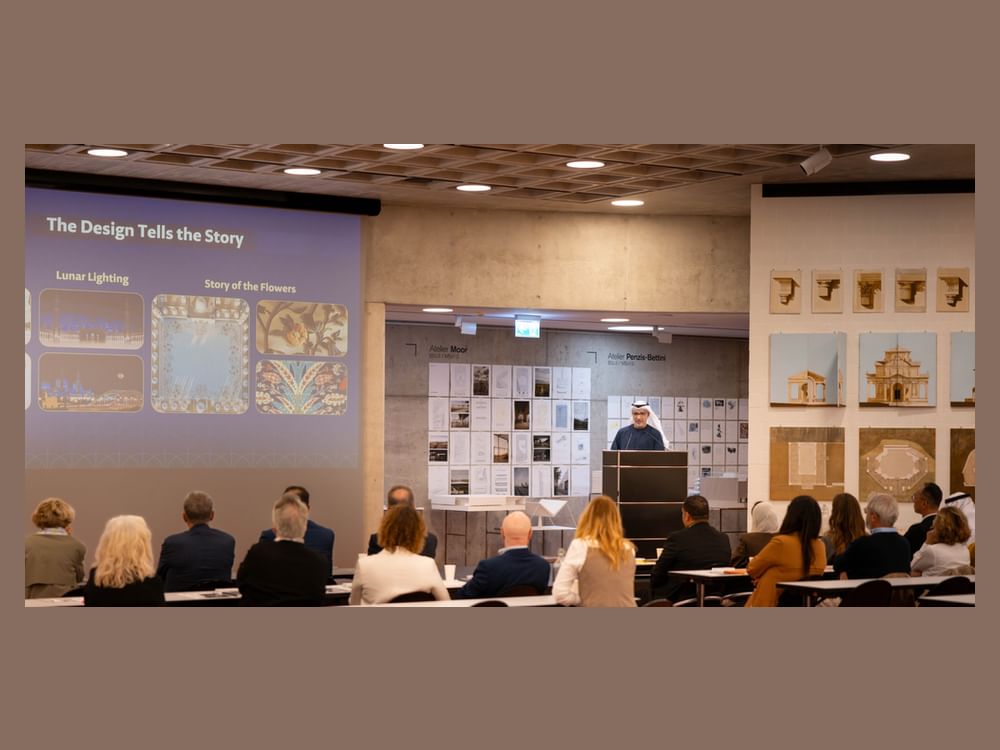
As part of the programme, Dr. Alobaidli presented a working paper at the Architecture Theatre of the Academy of Architecture, part of the Università della Svizzera italiana (USI), in Mendrisio, titled “Sheikh Zayed Grand Mosque Centre: A Place for All”.
The paper outlined the Mosque’s message as a religious, cultural and civilisational landmark. Given the Academy’s specialisation in architecture, it explored the architectural arts evident in the Mosque, where arts from different civilisations meet.
It affirmed that the arts are a universal language that speaks to the peoples of the world and expresses noble values, and that the arts of the civilisations that meet in the Mosque express, through their harmony, bridges of communication with the world’s peoples and a message of coexistence and rapprochement among cultures.
It also highlighted the Mosque’s role, since its construction, as a destination for university and academy students from outside the UAE to see these arts first-hand and enrich their architectural studies with field experience.
The paper further highlighted the concept of the Mosque as an inclusive space that enables guests from around the world to learn about Islamic culture, its arts and its architecture in an environment that fosters mutual respect and human understanding, and underscored the role of cultural institutions in creating spaces for dialogue and interaction among cultures.
The paper was accompanied by the mobile exhibition of the “Spaces of Light Photography Award”, held at the Academy of Architecture. The exhibition expressed through photography what the paper discussed about the architectural arts of the Mosque, and offered attendees a visual experience that explored its beauty, its architectural and artistic details, and the values and humanitarian meanings of Islamic architecture.
The exhibition will continue its journey to the UAE Embassy in Switzerland, where it will be displayed as part of events hosted or attended by the embassy. This reflects the importance of partnership between cultural institutions and diplomatic missions in conveying the UAE’s civilisational messages to a wider audience, and in using the arts and photography to present the Mosque as a model that combines depth of cultural identity with openness to the world.
Following the paper, the Director General met Prof. Claudio Bassetti, Rector of the Università della Svizzera italiana, and presented a selection of the Centre’s publications specialising in the history of Islamic architecture and arts to the university library.
The visit also included a series of meetings with figures and institutions concerned with cultural and interfaith affairs in Switzerland, including the Swiss Association for Interfaith Dialogue, headed by Abduselam Halilovic, in Zurich; Dr. David Vitali, Deputy Director of the Swiss Federal Office of Culture in Bern; and Masahiko Metoki, Director General of the International Bureau of the Universal Postal Union.
The Centre’s delegation also visited Kunsthaus Zürich and met the museum’s director, Ann Demeester.
The Centre’s presence in Switzerland, through the working paper, the “Spaces of Light” exhibition, and its cultural and academic meetings and partnerships, reflects an approach built on extending bridges of civilisational communication from the UAE to the world, and offering an integrated cultural and civilisational experience that starts from the Mosque as a landmark combining art, architecture and a humanitarian message, and reaches institutions and audiences around the world.