
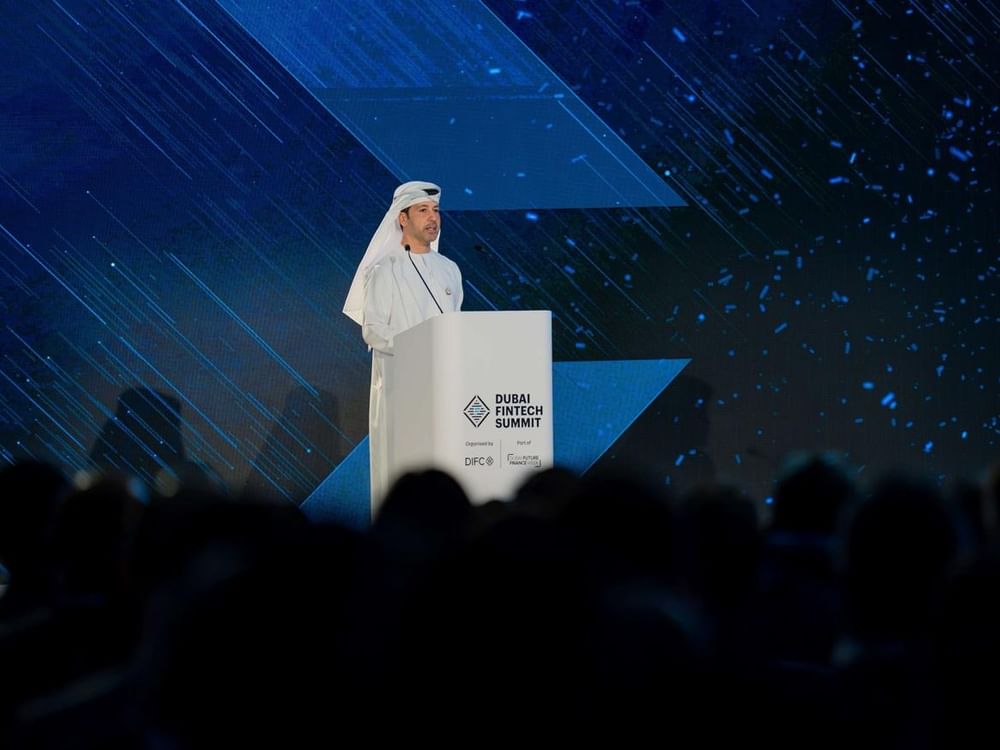
DUBAI, 3rd November, 2026 (WAM)-- Dubai International Financial Centre (DIFC) announced a new partnership providing up to 6,000 Japanese startups with direct access to its innovation ecosystem, opening new opportunities for collaboration, investment and international expansion.
The announcement came during the second day of the inaugural Dubai Future Finance Week, as DIFC also revealed that the number of artificial intelligence (AI), FinTech and innovation companies operating within its ecosystem had exceeded 2,000.
During the Dubai FinTech Summit, DIFC also unveiled plans to launch the Dubai FinTech Stack, an initiative designed to provide an integrated infrastructure supporting the establishment, growth and international expansion of emerging financial technology businesses.
The announcements coincided with the launch of the Digital Economy 2.0 report, which projects that the global FinTech market will reach US$1.5 trillion by 2030.
Dubai Future Finance Week is being held under the directives and patronage of H.H. Sheikh Maktoum bin Mohammed bin Rashid Al Maktoum, First Deputy Ruler of Dubai, Deputy Prime Minister and Minister of Finance, and President of DIFC.
Running until 6th November, the event supports the objectives of the Dubai Economic Agenda (D33), which aims to position Dubai among the world’s top four global financial centres.
Arif Amiri, Chief Executive Officer of DIFC Authority, said during his keynote address on the second day of the Dubai FinTech Summit that surpassing 2,000 companies specialising in AI, FinTech and innovation represents a significant milestone in the Centre’s development, achieved less than a decade after launching its vision to drive the future of finance.
He explained that DIFC established this vision in 2016, followed by the launch of its FinTech Accelerator in 2017 with just 11 startups.
Today, the Centre has developed into a comprehensive ecosystem bringing together innovative businesses, financial institutions, investors and specialised talent.
Amiri highlighted the transformative role of financial technology in reshaping financial services, business operations and access to economic opportunities, noting that artificial intelligence, digital assets and emerging technologies are creating new possibilities across the industry.
He stressed that DIFC’s ambition extends beyond attracting startups to providing the regulatory environment, infrastructure, capital and partnerships required for businesses to grow and compete internationally.
He added that the true measure of success lies in enabling companies to develop in Dubai and become global leaders in their respective sectors.
Amiri announced that the new partnership providing up to 6,000 Japanese startups with direct access to DIFC’s innovation ecosystem would strengthen connections between international markets while creating opportunities for investment, cooperation and knowledge exchange.
The initiative also supports DIFC’s efforts to establish new economic corridors connecting emerging markets and countries across the Global South.
He further revealed plans to launch the Dubai FinTech Stack, which will provide startups with essential capabilities covering customer onboarding, payments, risk management, financial security and artificial intelligence integration.
The initiative aims to simplify business operations, accelerate the development of innovative financial solutions and support their successful commercial expansion.
Amiri reaffirmed DIFC’s commitment to strengthening Dubai’s position as a leading global hub for financial innovation and technology.
The Summit also witnessed the launch of the Digital Economy 2.0 report, developed by DIFC in collaboration with its research partner, Asia House.
The report was presented by Michael Lawrence, Chief Executive Officer of Asia House, and highlighted the importance of capital, skilled talent and forward-looking regulatory frameworks in enabling the next phase of digital economic growth.
According to the report, global technology spending is expected to reach US$5.6 trillion in 2026, while artificial intelligence is projected to contribute US$22.3 trillion to the global economy by 2030.
The global FinTech market is also forecast to reach US$1.5 trillion by 2030, highlighting significant opportunities in digital finance, AI-powered financial services and advanced financial infrastructure.
The report emphasised Dubai’s innovation-driven digital ecosystem as a strong platform for developing, testing and scaling new financial technologies and expanding their international applications.
As part of the longstanding partnership between DIFC and Julius Baer Group, the Summit’s main session featured Noel Quinn, Chairman of Julius Baer.
Julius Baer was the first financial services institution to establish a presence in DIFC in 2004.
The second day brought together prominent financial and economic leaders, including H.E. Dr. Fatih Karahan, Governor of the Central Bank of Türkiye; H.E. Fahad Al Gergawi, Undersecretary of the UAE Ministry of Foreign Trade; Hamed Ali, Chief Executive Officer of Dubai Financial Market and Nasdaq Dubai; H.E. Dr. Tariq Bin Hendi, Chief Executive Officer and Board Member of Astra Tech; and Toon Gyssels, Chief Executive Officer of talabat.
Alongside the Dubai FinTech Summit, the Future Sustainability Forum convened under the theme “Building Greener Economies”, bringing together financial leaders, policymakers and industry experts to explore climate transition financing, climate adaptation capital, sustainable investment strategies and long-term economic value creation.
Discussions examined green finance, environmental, social and governance (ESG) integration, impact investing, climate technology venture capital, climate risk management and public-private partnerships, in alignment with the UAE Net Zero 2050 Strategy.
During the Forum, DIFC announced that the 29 founding partners of its One Million Learners initiative had collectively reached more than 130,000 learners in 2026.
Launched in May 2025 as part of DIFC’s Sustainable Finance Catalyst, the initiative aims to equip one million individuals with knowledge and skills in sustainability and sustainable finance by 2030.
DIFC also revealed that it is developing a Comprehensive Impact Framework in collaboration with a specialised B Corp-certified strategy and design consultancy.
The framework will assess the initiative’s economic, social, environmental and governance outcomes while establishing consistent indicators and practical tools for collecting data, evaluating impact and preparing reports.
The initiative will culminate in a report assessing its contribution to socioeconomic development and sustainability, providing a foundation for measuring its effectiveness as it continues to expand.
Alya Alzarouni, Chief Operating Officer of DIFC Authority, emphasised that sustainability has become a fundamental pillar of competitiveness and long-term success in financial services.
She noted that Dubai has translated its sustainability ambitions into practical initiatives that bring together financial institutions, investors, innovators and specialised talent.
Alzarouni added that reaching more than 130,000 learners demonstrates progress in building capabilities, while the next phase will focus on measuring tangible outcomes and the value created by the initiative.
In parallel, the Gulf Transition and Sustainable Finance Conference examined financing models, risk management frameworks and regulatory reporting requirements supporting climate transition across the Gulf region.
DIFC will also host a Gulf Cooperation Council ethical finance conference on Friday, organised by the Global Ethical Finance Initiative, focusing on resilience and sustainability within the financial sector.
In capital markets, the inaugural IPEM Future of Private Markets Dubai conference brought together leading private equity and private credit investors, institutional investors and fund managers to discuss long-term capital allocation and cooperation across alternative asset classes.
The event followed the success of a preliminary gathering held in Dubai last December, reflecting the emirate’s growing position as a regional and international centre for private markets and investment fund management.
The Capital Exchange GP-LP Programme also provided a dedicated platform for general partners and limited partners to align capital allocation priorities, discuss fund strategies and explore institutional co-investment models.
Meanwhile, InsurTech Middle East highlighted the transformation taking place across the insurance industry and the growing role of technological innovation in developing financial and insurance services.
The week’s programme also included the Middle East and North Africa Banking Excellence Awards, recognising outstanding performance in corporate and investment banking.
In the field of advanced technologies, DIFC Innovation Hub showcased progress made by the Space for Earth Labs platform, launched in collaboration with the Mohammed Bin Rashid Space Centre (MBRSC).
The initiative aims to harness space data and artificial intelligence to address challenges facing public and private sector organisations.
DIFC announced that the platform’s first programme, the Geo-Spatial Accelerator, implemented in partnership with Realm Insurance, attracted 73 applications from 24 countries.
The programme successfully connected international startups with five UAE-based public and private sector organisations.
These organisations include Buro Happold, Dubai Civil Defence, FADA, a company within EDGE Group, Liva Insurance, and the National Maritime Navigation Centre.
The participating organisations are developing pilot projects to assess the feasibility of proposed solutions in maritime safety, insurance, the built environment and public safety.
These solutions were showcased during the Dubai AI Festival in October.
The programme seeks to transform space-based innovations from research and development into commercially scalable applications, while strengthening cooperation between international startups and UAE institutions.
It also contributes to the objectives of the UAE National Space Strategy 2030 and Dubai Economic Agenda (D33).
Dubai Future Finance Week will continue until Friday, 6th November, bringing together global financial leaders, investors and industry experts.
Upcoming events will address banking excellence, Islamic finance, family wealth management, asset tokenisation and digital assets, further reinforcing Dubai’s position as a global centre for financial innovation, sustainable investment and economic competitiveness.