
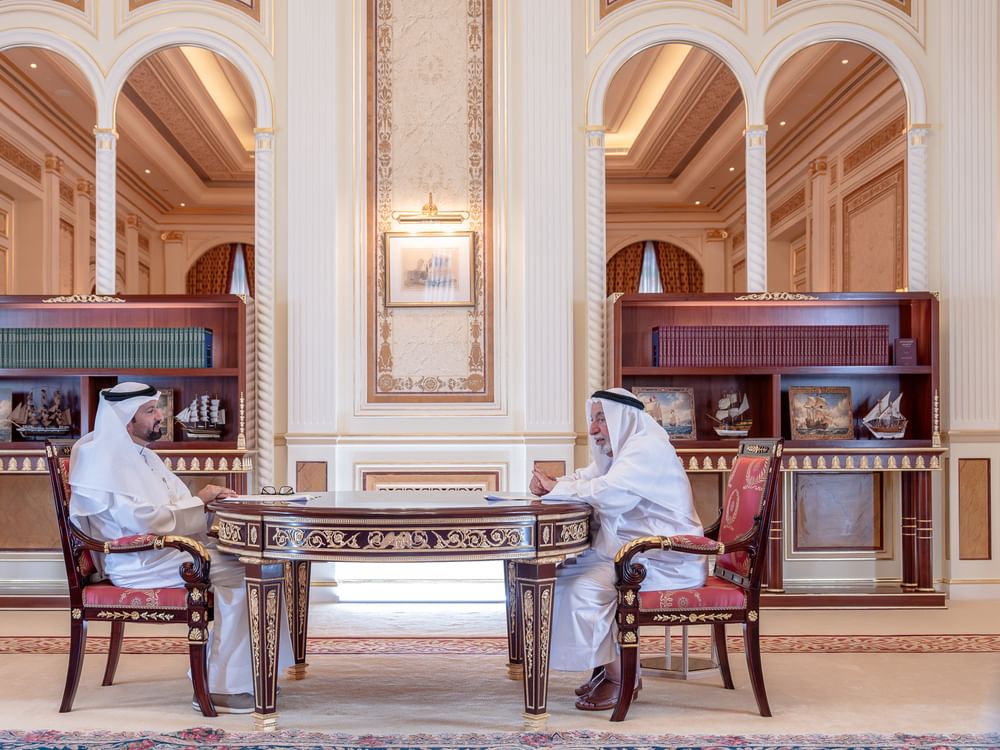
SHARJAH, 4th November, 2026 (WAM) -- His Highness Sheikh Dr Sultan bin Mohammed Al Qasimi, Supreme Council Member and Ruler of Sharjah, has unveiled his latest historical work: an encyclopedia titled "The Portuguese in the Indian Ocean: Annals of History from 1497 CE - 1750 CE," which consists of 61 volumes and is available in both Arabic and English.
In a recent interview on Sharjah TV, moderated by Mohammed Hassan Khalaf, the Director General of the Sharjah Broadcasting Authority, His Highness the Ruler discussed his new book titled 'The Portuguese in the Indian Ocean: Annals of History from 1497 CE - 1750 CE.' This work delves into the history of the Portuguese presence in the Indian Ocean, highlighting their control over trade routes linking India to Portugal, the various conflicts they faced in India, their gradual decline, and ultimately their transformation into a diminished power, primarily functioning as a trading entity in Goa, a state located on India's west coast.
His Highness began the interview by talking about the initiative he set up 37 years ago to collect, translate, and publish historical records. He had been a researcher at the British Library (then the India Office Records) and had spoken with the then Director, Mr Bloomfield, a very eminent scholar in British and Oriental studies with a vast amount of work to his name. His Lordship had a very keen interest in learning about the Portuguese in the Gulf. He went on to explain that the problems that had arisen were not just because Portuguese is not his native tongue, but also because of the sheer difficulty of tracking down the documents, collating them, and preparing them for publication. Previous attempts in that respect had all failed to achieve the desired result.
His Highness shared that Mr Bloomfield had offered his help by providing access to the library’s collection of books and documents translated from Portuguese to English, and noted that it took 5 years to transfer and translate these Portuguese documents for the British Library. This considerable undertaking was managed by an individual named Denver, with the assistance of five highly skilled aides who were fluent in both Portuguese and English.
His Highness observed that the efforts associated with the "India Office Library"—which aimed to gather information about the events and circumstances leading up to the British arrival in India—were largely centred around the British viewpoint. However, His Highness had a different goal in mind: he was determined to explore the history of the Portuguese presence in his own region. To do so, he enlisted the help of library staff, specifically Fiona Wilkie, who oversaw the Portuguese documents section and was approaching retirement. Fiona compiled Portuguese records and acted as liaison between His Highness and the scholar Denver, who was researching the documents. In 1989 there was a drive to establish a research centre to collect Portuguese material from both India and Portugal. Fiona was based in London and recruited several researchers to help.
His Highness the Ruler added that Fiona was tasked with procuring Portuguese documents held in various locations worldwide, including Portugal, Spain, and Goa, India. She recruited three individuals proficient in archaic Portuguese who could translate it into modern Portuguese, along with a 29-member team of researchers, transcribers, travellers, and logistics/support staff, all assembled to address the significant challenges associated with these documents. His Highness revealed that, at the time, he lacked the necessary funds to finance the project. However, His Highness had previously established the Sharjah Cement Factory; the shares he held in the company increased in value and later directed that they be sold through Invest Bank to cover the documentation project costs.
His Highness also worked at his office in Britain with a man called Mr 'Bridham' who was in charge of the administrative side of the office. They also worked together on the scholarly/research side. Meanwhile, Mr. "Michael Pinder" oversaw the financial affairs and office expenditures. Eight years later—specifically in 1997—His Highness received the first file in English. He and Bridham sat together to correct the terminology found within the translated documents and manuscripts. Examples include correcting the name "Khasab" (written as "Khasabo" by the Portuguese, who added a vowel to ensure the 'b' sound was pronounced) and the term "Al-Qadi" (rendered by them as "Cazi"). His Highness emphasised the need to ensure accurate pronunciation, explaining that he personally corrected such terms across Farsi, Hindi, and Arabic. He added that, given the documents' diversity and the work's complexity, it is no surprise the project spanned 37 years.
His Highness the Ruler of Sharjah reflected on the extensive effort that went into printing the documents and manuscripts, a process that took nine years—from 1997 until September 2006. His Highness recalled the project's final moments, including a phone call he missed while praying Maghrib. The next morning, a switchboard operator informed him that a woman named Fiona had arrived the evening before, intending to present the last set of documents and to congratulate him on the project's completion. She left behind two copies of the final file—one for His Highness and the other for Mr Bridem. When His Highness wanted to get in touch with her and thank her, he received the shocking news of her death. She had died that very evening, just after the last docs had been delivered.
His Highness noted that following Fiona's departure in December 2006, all the files and associated documentation were handed over (Mr Bridham, of course, kept his own copies). The British office was then wound up, and the staff were all released as the project came to an end. The research process ran from 2006 to 2025 and involved extensive research, investigation, and organisation to fill gaps, find what was missing, and clarify what was ambiguous. His Highness explained that he had consulted several very valuable texts written by people who had actually lived in Hormuz and India. These were people who had been there and had written down the events in great detail. He stressed that the works of the great historians Fernão de Castanheda, Diogo do Couto and João de Barros are historical records rather than simply literary works, as they were all first-hand accounts of the events which they described. His Highness also made it clear that the whole of that time was required in order to produce a worthwhile outcome, an outcome which would be of value to the wider field of history and would go well beyond the Portuguese period in the Indian Ocean.
His Highness the Ruler of Sharjah has chosen to cover the period from 1497 to 1750. That's when da Gama's fleet set off from Portugal, a voyage that took them a year and a half to reach India. They initially faced only local powers. As the period went on, they faced the English, the Dutch, and the Mughals. By the end of the period, they were down to just Goa in India, where they were simply traders. The book covers that period in full.
His Highness added: "The existing documents are the greatest source for recording this history. They do not merely recount events; they also detail what preceded them, describing both the events themselves and their underlying causes. For instance, we encountered the term 'NAVAT' in one document. Upon consulting English and Portuguese dictionaries, it became clear that this group consisted of Muslims who arrived in the mid-7th century AD, the early days of Islam. According to these sources, they lived in the Persian Gulf region, but the King of Persia expelled them and treated them harshly. Further examination of that era reveals that 'NAVAT' corresponds to 'Nabataean' (Nabat). Research on the Nabataeans shows they lived south of the Euphrates and in Ahvaz, a region once called 'al-Sawad al-A'zam' (the Great Expanse/the Vast Black Land). As Islam emerged, and before Persia fell, they staged an Islamic-inspired uprising. Feeling uneasy about the rise of Islam at the time, they engaged in conflict, which eventually forced them out of Ahvaz toward the coast. From there, they were driven away once more, leading them to migrate to India, where they settled in scattered groups. This is just one of the narratives uncovered through these manuscripts."
His Highness went on to provide another example of the significance of the information contained in these documents, stating: "When Islam reached Persia, the Arabs were not present, nor is there any mention of the 'great masses' “al-sawad al-a'zam” in Iraq. This corrects the historical record, contrary to the notion that the Arabs defeated the Persian army, and illustrates the value of these documents. For instance, when the Imam in Oman was replaced, his whereabouts were previously unknown; however, these documents reveal that he fled with his followers to escape the Portuguese, traveling as far as East Africa, specifically Mozambique. Portuguese records describe them as fair-skinned and distinct from the local African population. They were on the 4th island of the Comoros. The docs are very detailed, giving good insight not just into Portugal's history but into the history of the whole area.
As to the geographical scope of the venture, His Highness said: "It started with the acquisition of the Indian Ocean and the discovery of the sea route from India to Portugal. Before that, ships and cargo would go via the Gulf to Basra and then on to Aleppo and ultimately to Italy (Venice in particular). The situation was completely different when the Portuguese established themselves on the East African coast, extending their control from Mozambique to the north and into India to the east. They were able to intercept ships and cargo as they passed through that area and amassed enormous wealth as a result; that is one of the great mistakes in their history."
His Highness the Ruler of Sharjah said: "If you look at the sea route from India to Portugal, the Portuguese had a very difficult journey indeed, with all sorts of problems to contend with. The route via Hormuz, on the other hand, was far easier, with agents, caravan leaders, and ports in place. Consequently, goods on that route cost half as much as those on the other route, and the Portuguese therefore incurred massive losses. Their goods were effectively worth nothing."
His Highness went on to describe the King of Portugal, who sent forces via the Strait of Hormuz and the Red Sea to reach India. His Highness said the King appointed Afonso de Albuquerque, whose life story is the subject of my book “Al-Hiqd al-Dafin” (Deep-Seated Hatred), and who had previously fought the Muslims in Naples and across the Mediterranean. Albuquerque, driven by a quest for vengeance after losing a brother in battle in Morocco, arrived in our region harbouring deep animosity. The King had tasked him with blocking the Strait of Hormuz and the Red Sea to tilt trade advantages in favour of the Portuguese. Albuquerque took control of Hormuz and then set his sights on the Red Sea—a distinct body of water then under Muslim control. He reached the vicinity of Yanbu, a port serving Makkah and Madinah, where he even threatened to disturb the grave of the Prophet (peace be upon him) unless Jerusalem was handed over to him. However, fate got the better of him as a terrible storm drove him away from Yanbu toward Zeila in Somalia, scattered his fleet, and effectively got him out of the Red Sea. His ambition to control the route and impede the movement of goods was completely undermined. This was all part of a wider strategy to propagate a missionary agenda of Christianisation in Africa, specifically directed at the poor amongst the non-Muslims and the undecided.
His Highness the Ruler of Sharjah explained the distinction between the current publication, "The Portuguese in the Indian Ocean", and the previous one, "The Portuguese in the Sea of Oman", stating: "Had the events concerning Oman been left among these broader, major historical developments, they might have been lost. Instead, I've separated out the Oman events and the Gulf situation so that the researcher doesn't get lost in the records. Some information is duplicated, which is inevitable to some extent, so a researcher looking at both areas will see the same information, but those who want to go into it in more detail will find the detail they need in full."
His Highness cited several instances, noting: "For example, consider the stance of the Omanis, specifically the Ya'aruba, against the Portuguese. Historical documents indicate that the Portuguese never encountered resistance as fierce or formidable as that of the Ya'aruba, The Ya'aruba were the very essence of resistance, of willingness to die, of principle. The Portuguese authority simply broke down before them and was ended in Oman."
His Highness the Ruler of Sharjah added: "There was a centre called 'Bandar Kong' on the Persian coast, which housed offices for Portuguese commercial companies. The Ya'aruba dynasty fought them there, with the Al Qasimi tribe providing most of the leadership for the Ya'arubi army. They did not stop there; their campaigns extended to Bombay, the town of Salsette, near Bombay, and the island of Diu, a naval base. Mohammed bin Rashid Al Qasimi led these operations, which became a major epic. All those involved were Omanis, and their names are recorded in Portuguese documents; they are even mentioned in African records concerning East Africa."
As to the Portuguese expansion into the Indian Ocean area and their penetration beyond India, His Highness said: "The documents speak volumes in this respect. For instance, the transport of spices and goods didn't originate in India at all but in China. The route from China went via Malacca, then Malaya and then on to India. Trade in Ceylon was very active at the time, and the Portuguese were out there fighting for spices and goods. They got as far as Indonesia and the surrounding areas. You read the documents and feel as though you are there, seeing it all. It is such a complete record, such a good record of what happened, the way it is told, the way it is all explained in such detail."
His Highness spoke about the amount of work that went into getting his latest book completed: "The files were all ready by October 2025. Before we went to print, we had to do a full round of proofing and checking. From that point until October 2026, a full year, we worked on it non-stop. It was a case of starting at 3.00 a.m. every day and going through every single detail, checking every passage, every narrative to make sure it was all presented in the right way for the reader."
According to His Highness, the book is very readable and extremely accessible. If you come across a place name such as 'Julfar ', you'll find in parentheses the modern equivalent 'Ras Al Khaimah'; that name, of course, doesn't appear in the original. Any information in parentheses is not part of the original document. It's an addition by the editor, placed in the margin to distinguish it from the document text. Any additional characters added for clarity are also in parentheses. This is of the utmost importance to the researcher, as it prevents a major error from a misreading. It serves as a constant reminder to transcribe the document exactly as it stands, with no omissions and no additions.
His Highness encouraged researchers to stay true to the original manuscript texts, advising them to limit personal opinions or commentary to footnotes. His Highness stated, "This is my advice to researchers: I hope the current generation will engage with volumes that address history and primary documents, making the most of the information now available. Our goal is to promote rigorous scientific research that is rooted in documentation—rather than imagination or bias. I advise any researcher: if you feel your writing might bias your findings, then set the pen down; it is essential to strive for credibility."
His Highness spoke to the Omani researchers, saying that the Omanis had been in Africa for a long time and that nobody had written anything about them or done any research into their experience—despite the fact that there are literally hundreds of manuscripts which speak of them. "I have personally explored the history of this region, which stretches from the entrance of the Red Sea to Mozambique and deep into the interior—an area that was once under Omani influence. I urge the people of Oman to continue researching and writing, so that the true historical record and authentic documentation of our nation may come to light. Do not merely reference this information as coming from a book by Sultan Al-Qasimi; instead, attribute it to the original documents—the primary sources themselves. These documents are available for consultation at the Dr Sultan Al Qasimi Centre. This effort serves history and scientific research while honoring those who contributed to it—many of whom sacrificed their lives and were unjustly killed. They embarked on expeditions and never returned; this is a way to immortalize their names. We do not erect statues for them; rather, we preserve their memory by highlighting and documenting their deeds," His Highness Sheikh Dr Sultan bin Mohammed Al Qasimi said.
Regarding volume 61 of the "Portuguese in the Indian Ocean" series and its contents, His Highness stated: "The collection comprises 60 volumes, documenting a wide array of historical events. Researchers will find a 'document index' at the end of each volume. To avoid redundancy across the series, all explanatory notes have been consolidated into the final volume, volume 61. Any term that needs clarifying (e.g. Goa), together with all relevant detail, interpretation, and further research done on it, is in this final volume, complete with all footnotes."
His Highness the Ruler of Sharjah said: "As regards the rulers and the monarchs, there is a separate list for each category, a list of the monarchs themselves, a list of their deputies, with the duration of their rule and the fortresses and places to which they were attached. That is a very full and very rich set of information. I think Volume 61 is the key to the whole collection. It is the best guide to the rest of the volumes. All of it is intended to assist the researcher. If you wanted to know about a town on a river in 'Malacca ', you would certainly find it. There is a distinction to be made between 'Malacca ', which is on a river in Malaysia, and 'Málaga ', which is in Spain. Nothing has been left to chance, nothing to conjecture; everything has been carefully considered, and the intention is to save the researcher a great deal of effort. We wish them every success."
His Highness revealed that work has already begun on his next publication, stating: "In the very same week I finished this work, I embarked on a new and very significant project. When we look at the history of this region, the Portuguese were not the first to arrive; there were others before them, such as the Dutch and the English, and that is what I am working on now: the 'pre-Portuguese' era."
His Highness the Ruler of Sharjah added: "I've looked at the Portuguese in a more specific context (Oman and the Indian Ocean). In "The Compendium of the Histories" I also deal with the presence of the Dutch, the British and the Ottomans in the Gulf, all of which are recorded in the sources available to any researcher who cares to look. In "The Compendium of the Histories", it is noted that the English arrived initially as traders; in 1600, upon their arrival, they engaged the Portuguese and seized Hormuz, not for themselves, but rather ceding it to Shah Abbas, the King of Persia. They weren't there as colonists. I'll start with the arrival of John Malcolm, the man I associate with establishing a British presence. That was the genesis of British colonialism in 1806 (the first treaty with the Qawasim) and it continued right up until they left the area."
His Highness announced the anticipated date of release of the new publication (which is already in the pipeline), saying: "This is the historical record that people have been looking for. It is the record as it is, as it has been documented, interpreted and arranged. It will be available at the Sharjah International Book Fair in 2027. I have already started on it. I present the documents in the interest of historical integrity, not to glorify the Qawasim dynasty. I am absolutely neutral on the matter, with no intention of provoking anyone or going to war. I am simply presenting the facts as they appear in the documents, whether they concern the Qawasim or anyone else. History is a trust. To any researcher, I would say: don't let your pride or your bias lead you astray. You must stick to the documents and tell the story of the events as they appear in them. After that, you are free to interpret it in your own way, but you must never alter the truth. You must also always give your source, in this case the British Library and the manuscript reference number."
His Highness the Ruler of Sharjah went on to say that his most recent publication, "The Portuguese in the Indian Ocean" (60 volumes), took him an entire year to write. The one he is currently working on is expected to take the same length of time and will also be 60 volumes. He made the same appeal to researchers for resources to assist their work, pointing out that these are all available at no cost on His Highness’s website.