
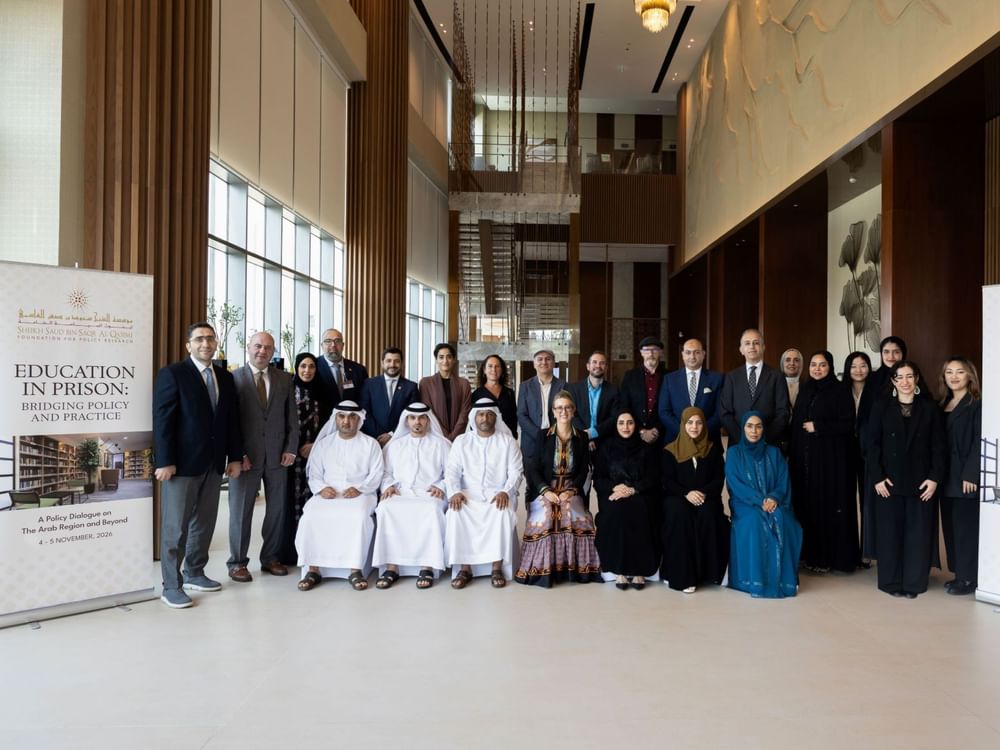
RAS AL KHAIMAH, 5th November, 2026 (WAM) -- Building on more than a decade of commitment to advancing education within correctional settings, the Sheikh Saud bin Saqr Al Qasimi Foundation for Policy Research convened “Education in Prison: Bridging Policy and Practice” on 4–5 November 2026, bringing together 25 regional and international stakeholders, including government officials, representatives of correctional and rehabilitation institutions, judicial authorities, and experts in education and rehabilitation.
Organised with the cooperation and technical advice of UNESCO and the UNESCO Institute for Lifelong Learning (UIL), the two-day policy dialogue explored the role of education in rehabilitation and successful reintegration into society, while examining opportunities to strengthen quality learning pathways within correctional settings across the Arab region and beyond.
Prison education in Ras Al Khaimah connects the right to learn with wider human rights principles, while creating opportunities for personal development, rehabilitation and reintegration into society. The dialogue built on the Foundation’s longstanding partnership with the Ras Al Khaimah Correctional Facility, including the development of a prison library housing 9,000 titles, recognized by UNESCO UIL for best practice in 2026. This initiative reflects the Foundation’s commitment to translating research and institutional partnerships into meaningful educational opportunities and lasting community impact.
Dr. Natasha Ridge, Executive Director of the Sheikh Saud bin Saqr Al Qasimi Foundation for Policy Research, said in her opening remarks:
“At the Al Qasimi Foundation, education is at the heart of everything we do. We believe in its power to transform lives, create opportunities, and build stronger, more inclusive communities. Since 2011, our partnership with the Ras Al Khaimah Correctional Facility has grown from establishing a prison library into a comprehensive educational initiative, delivering more than 150 courses to over 5,000 inmates. This reflects our longstanding commitment to ensuring that learning opportunities extend beyond traditional classrooms and that everyone has the opportunity to develop their potential. By bringing together regional and international expertise through this dialogue, we reaffirm our commitment to bridging research, policy, and practice, and advancing meaningful, lasting impact in Ras Al Khaimah and beyond.”
The two-day policy dialogue examined approaches to quality prison education across the Middle East and North Africa (MENA) region and beyond, with a focus on gender considerations, alternative learning pathways, and the policy and institutional frameworks needed to expand educational opportunities within correctional settings.
The program opened with remarks from the Al Qasimi Foundation and the UNESCO Institute for Lifelong Learning, followed by a keynote address titled “Education Not Incarceration: A Global Practice”, delivered by Dr. Baz Dreisinger of John Jay College of Criminal Justice/CUNY.
Since 2011, the Al Qasimi Foundation's partnership with the Ras Al Khaimah Correctional Facility has evolved from establishing a prison library into a comprehensive educational initiative, offering more than 150 courses to over 5,000 inmates. Today, the library houses more than 9,000 titles and has been recognised by the UNESCO Institute for Lifelong Learning for best practice in 2026, reflecting the Foundation's sustained commitment to expanding access to education and creating meaningful opportunities for personal development and rehabilitation.
Building on this experience, the dialogue featured a workshop titled “Building Prison Libraries into Learning Pathways,” led by Miguel Rivera Donoso, Coordinator of the Prison Libraries Plan at the National System of Public Libraries, Ministry of Culture, Arts and Heritage of Chile. Drawing on international experiences, the workshop explored how prison libraries can evolve into inclusive learning spaces that support education, personal development, and reintegration.
A roundtable facilitated by Dr. Matthias Eck of UNESCO further examined institutional, policy, and resource barriers to expanding prison education across the GCC, identifying opportunities for greater collaboration and practical improvements.
On the second day, discussions focused on translating policy into practice, with government representatives examining the role of public institutions in strengthening prison education and rehabilitation across Ras Al Khaimah and the wider UAE.
Reflecting on the dialogue, Miguel Rivera Donoso, Coordinator of the Prison Libraries Plan at the National System of Public Libraries, Ministry of Culture, Arts and Heritage, shared his reflections: "A prison library is much more than a place where people can find books to pass the time. In a context of confinement, an active library can become a key that opens doors within, connecting people, or reconnecting them, with hidden parts of themselves. In this way, people can discover or rediscover aspects of themselves that go beyond the identity of ‘offender’ imposed on them by the system, an identity they themselves may have come to accept as the single story of their lives. It is precisely this ability to rediscover and reshape one's identity that can broaden one's perspective, reshape one's values and mark a first step towards desistance from crime. Reading, writing and sharing experiences through literature can help make this process possible. I’ve witnessed the power of these processes firsthand over the years."
The dialogue highlighted the importance of sustained institutional collaboration, international knowledge exchange, and evidence-informed approaches to advancing prison education. Building on more than a decade of partnership with the Ras Al Khaimah Correctional Facility, the Al Qasimi Foundation continues to champion education as a pathway to opportunity, rehabilitation, and successful reintegration into society.
Organised by the Sheikh Saud bin Saqr Al Qasimi Foundation for Policy Research, with the cooperation and technical advice of UNESCO and the UNESCO Institute for Lifelong Learning (UIL), the dialogue reinforced the Foundation’s commitment to bridging research, policy, and practice, while identifying opportunities to strengthen prison education and create meaningful, lasting impact in Ras Al Khaimah, the wider Arab region, and beyond.