
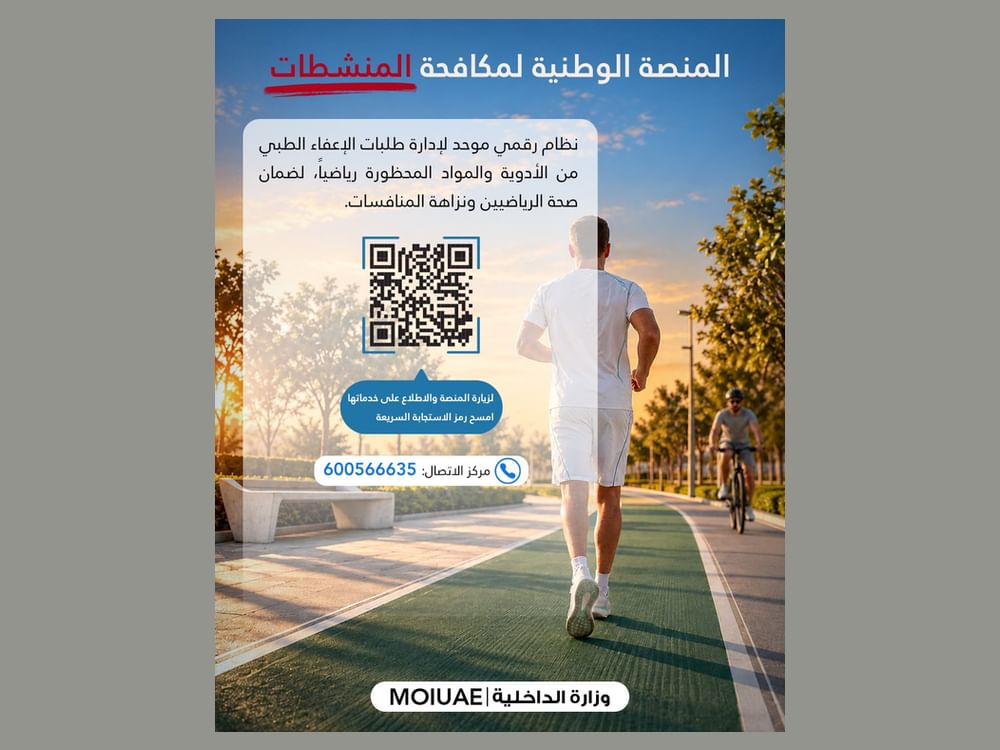
ABU DHABI, 8th November, 2026 (WAM) -- In collaboration with the Ministry of Sport and the National Anti-Doping Agency, the Ministry of Interior (MoI) has launched the National Anti-Doping Platform (NPAD), in line with the UAE’s vision for innovation and digital transformation and its efforts to establish a comprehensive national anti-doping framework to protect athletes.
The NPAD provides a unified digital system for managing Therapeutic Use Exemptions (TUEs), which allow athletes to use substances or medications prohibited in sport.
The platform enables applications to be submitted, reviewed, approved, and tracked electronically. It also sends automated notifications and verifies data and professional licenses through the relevant government authorities. In addition, it establishes a national database of athletes and healthcare practitioners, supporting data analysis, informed decision-making, preparedness for doping-related risks, operational efficiency, and the integrity of sports competitions.
The official launch follows approximately one year of operational use, during which the platform was tested and its procedures refined in coordination with various partners. This period helped automate key anti-doping processes, simplify the handling of TUE applications, and improve data exchange among the relevant entities.
Saeed bin Tuwair Al Suwaidi, Assistant Undersecretary for Security Affairs at the Ministry of Interior, said the platform highlights the role of technology in strengthening coordination among government, security, sports, and health entities. It aims to improve procedures and data exchange, protect athletes, and preserve the integrity of sports competitions in the UAE.
Dr. Mai Ahmed Sultan Al Jaber, Chairperson of the National Anti-Doping Agency, said the launch marks an important step in developing the technical and administrative procedures of the national anti-doping program. She noted that the platform provides a unified digital channel for managing TUE applications, allowing athletes and medical personnel to complete the required procedures more efficiently and with greater clarity.
She explained that the platform manages the entire application process electronically, from preparing applications and attaching medical reports to submission, review, status tracking, and completion in accordance with established regulations. This reduces reliance on paper forms and manual data entry, limits procedural errors, and improves the accuracy of submitted information.
Dr. Al Jaber added that the platform assists medical professionals in making decisions by providing access to information on substances prohibited in sport and enabling them to check permitted treatment alternatives. This helps prevent the inadvertent use of prohibited substances while ensuring that athletes retain access to the medical care and treatment they need.
She also highlighted the platform’s centralized national database of athletes, healthcare practitioners, and TUE applications. The database facilitates data analysis and reporting, enables faster and more accurate application tracking, and improves the efficiency of technical and administrative procedures.
The platform also enables data and professional licenses to be verified in coordination with the relevant government authorities. This helps ensure that medical personnel working with sports organizations meet the required licensing conditions and prevents athletes from receiving care from practitioners who do not hold the necessary professional qualifications.
Dr. Al Jaber noted that the platform’s first year of operation provided an opportunity to test and refine procedures in cooperation with key stakeholders. This helped automate processes, simplify medical exemption applications, and improve information exchange among the relevant entities. The experience also received positive feedback from medical personnel, improved procedural efficiency, and reduced errors associated with manually completed forms.
She emphasised that the platform is not limited to receiving applications online. It also serves as a preventive and regulatory tool that supports international anti-doping standards, improves coordination among athletes, physicians, and the relevant authorities, and encourages disclosure and verification before medications or medical products are used.
Dr. Al Jaber called on sports federations, clubs, organizations, and medical professionals to use the platform and join the system. Wider participation will help extend the use of digital services, raise awareness of the risks associated with prohibited substances, and strengthen commitment to clean sport.
Lamia Al Sabousi, Assistant Undersecretary for the Sports Regulation Sector at the Ministry of Sport, said the launch supports efforts to strengthen sports integrity by standardizing medical exemption procedures and providing digital services that simplify application tracking. These services also clarify regulatory requirements for athletes, medical personnel, and sports organisations.
The Ministry explained that the digital system improves procedural efficiency and data accuracy and speeds up information exchange among the relevant authorities. This helps sports organizations comply with established regulations and provide a safe environment that protects athletes’ health and the integrity of competitions.
The Ministry added that it supports policies and initiatives to develop the sports sector and strengthen institutional readiness in cooperation with the National Anti-Doping Agency and the relevant government and health authorities. It stressed that raising athletes’ awareness of the dangers of doping and promoting accountability among clubs and federations are essential to advancing clean sport.
The National Anti-Doping Platform's services are available at npad.ae and the call center can be reached at 600566635.