
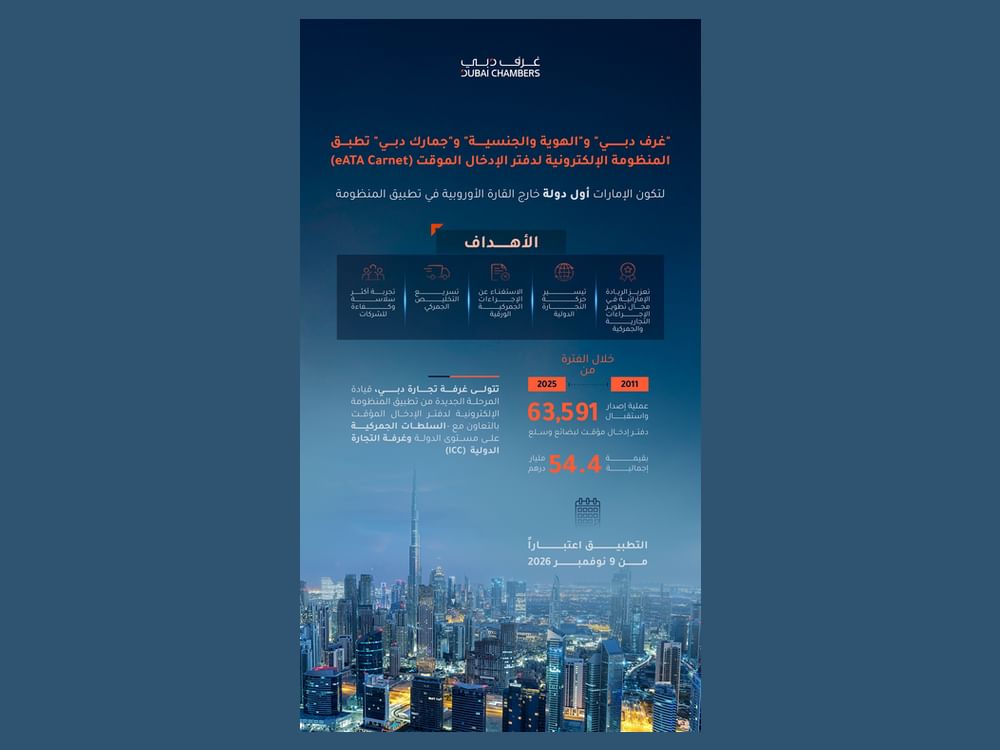
DUBAI, 9th November, 2026 (WAM) -- The United Arab Emirates commenced the rollout of the eATA Carnet system today, with the support of Dubai Chambers, becoming the first country outside Europe to implement a fully digital platform for issuing and processing ATA Carnets, reinforcing its leadership in advancing trade and customs procedures.
The transition to the eATA Carnet system represents another step forward in the UAE’s broader digital transformation roadmap. By eliminating paper-based customs procedures, the initiative accelerates border clearance, delivering a smoother and more efficient experience for businesses while further strengthening the country’s position as a global hub for international trade, major trade fairs, and world-class conferences.
Dubai Chamber of Commerce, one of the three chambers operating under the umbrella of Dubai Chambers, has been serving as the National Guaranteeing and Issuing Association for ATA Carnets in the UAE since 2011, when the UAE first joined the ATA Carnet system.
The chamber is leading the new phase and has been working closely with customs authorities and the International Chamber of Commerce (ICC) to deliver a seamless customs experience to businesses.
Dubai Chamber of Commerce is one of only 13 chambers around the world to implement the eATA Carnet out of 1,200 ICC-member chambers.
Ahead of the official launch of the eATA Carnet system, Dubai Chamber of Commerce executed a comprehensive readiness programme to prepare the national customs ecosystem for the implementation of eATA Carnets.
As part of this initiative, the chamber facilitated technical coordination meetings with UAE customs authorities, hosted online sessions connecting local customs officials directly with ICC experts, and conducted hands-on training workshops for customs representatives.
The chamber also led extensive pre-production testing to validate different scenarios. This helped ensure every stakeholder was aligned and technically ready to adopt the digital system.
Mohammad Ali Rashed Lootah, President and CEO of Dubai Chambers, said, “Dubai Chamber of Commerce has spearheaded the UAE’s ATA Carnet journey since 2010, driving the nation’s growth as a premier global hub for international trade, exhibitions, and major events. As the first chamber in the region to introduce the ATA Carnet system back in 2011, we are once again leading the way by championing the transition to eATA Carnet in close partnership with national customs authorities and the International Chamber of Commerce.
This milestone marks a major leap in trade facilitation, delivering a faster, more transparent, and highly secure digital experience that streamlines customs procedures. It reflects our commitment to offering smart, integrated services that empower companies to expand globally, while further cementing Dubai and the UAE’s status as a leading global centre for trade and events.”
A total of 63,591 ATA Carnets have been issued and received for goods and commodities worth AED54.4 billion since the launch of the ATA Carnet system in the UAE in 2011 until 2025.
Ahmed Abdullah bin Lahej Al Falasi, Acting Director General of Customs at the Federal Authority for Identity, Citizenship, Customs and Port Security, affirmed that the implementation of the eATA Carnet system reflects the UAE’s commitment to developing an agile and integrated trading environment that can respond to global developments and meet the evolving needs of the business community.
He noted that the initiative supports the leadership’s vision of building an integrated digital government ecosystem driven by innovation, technology, and international partnerships. It also strikes a balance between facilitating trade and protecting the national economy, strengthening the UAE’s competitiveness and reinforcing its position as a leading partner in shaping the future of global trade.
Al Falasi stated that the implementation of the system, in collaboration with strategic partners, represents an important step towards establishing a fully integrated digital customs and trade ecosystem for issuing and processing ATA Carnets. The system will enhance procedural efficiency, accelerate transactions, reduce reliance on paper documentation, and minimise the time, effort, and costs associated with the temporary admission of goods.