
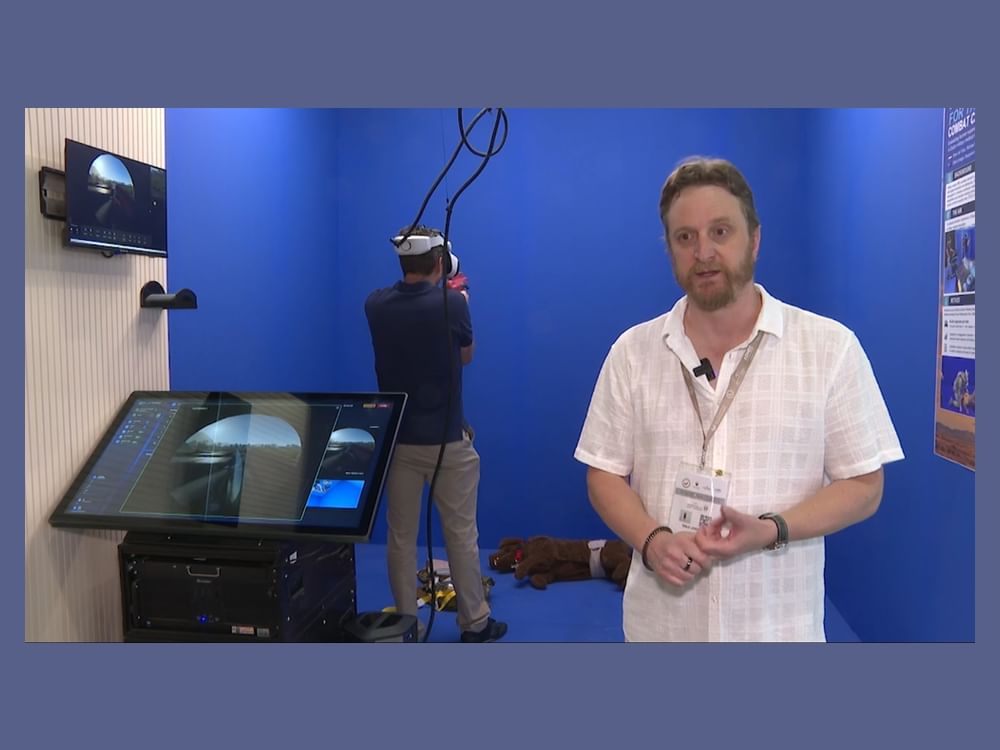
ABU DHABI, 10th November, 2026 (WAM) -- Australia's BlueRoom Simulations showcased a mixed reality simulator a the 46th ICMM World Congress of Military Medicine, designed to train medical and military personnel in medical procedures and emergency response within realistic digital environments that would otherwise be dangerous, expensive or difficult to access.
Dr. Dale Linegar, Chief Technology Officer at BlueRoom Simulations, told the Emirates News Agency (WAM) that the system supports tactical combat casualty care (TCCC) training and simulations aboard aircraft, helicopters and ambulances, as well as in urban, rural, highway and road vehicle environments.
He explained that mixed reality combines physical and virtual environments, allowing trainees to use their hands and real medical equipment rather than virtual reality controllers. This enables hands-on training in procedures such as cannulation, IV insertion, intubation, chest tube insertion and patient triage.
The system also allows military medics to practise providing security and applying tourniquets on the battlefield, while doctors can train in surgical interventions during medical evacuations aboard vehicles or aircraft.
Linegar said BlueRoom's Mission Control system enables facilitators to monitor and manage training in real time, including adjusting an offender's aggression, generating target vehicles, changing a patient's condition through a virtual patient monitor and triggering customised scenarios.
He added that the simulator can be reconfigured within minutes to switch between environments, incorporating real medical equipment, new procedures, uniforms and agency-specific equipment without custom development.
BlueRoom also works with Samsung to use wearable biometrics to monitor trainees' physiological responses, including stress levels, allowing instructors to adjust scenarios and feedback in real time.
The system provides performance assessment and debriefing tools, including two-way radio communication, video recordings and biometric monitoring. Results can be exported as PDFs for benchmarking by trainees and educational institutions or shared via xAPI.