
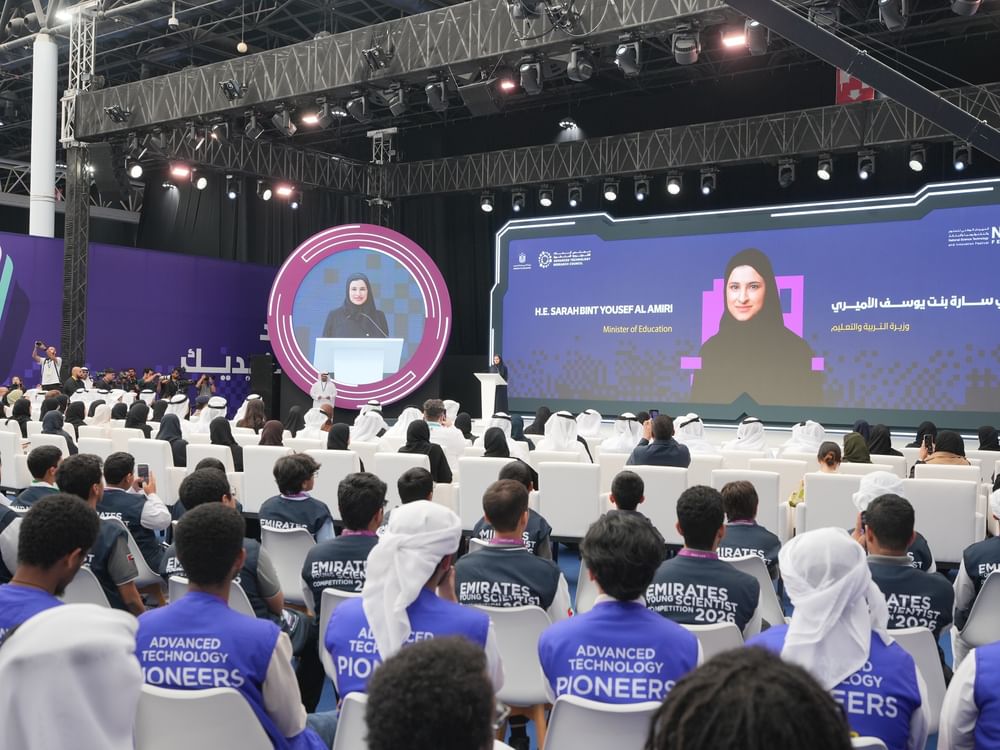
AL AIN, 10th November, 2026 (WAM) -- Under the patronage of H.H. Sheikh Hazza bin Zayed Al Nahyan, Ruler's Representative in Al Ain Region, the 8th National Science, Technology and Innovation Festival began today.
Organised by the Ministry of Education (MoE) in collaboration with the Advanced Technology Research Council (ATRC), the Festival – which coincides with the UAE’s Innovation Month, ‘UAE Innovates’ – runs until 13 November 2026 at ADNEC Centre, Al Ain. This year’s edition of the Festival sees the participation of 615 students, with 158 research and applied projects presenting innovative solutions to challenges across science and technology.
The opening ceremony was attended by Sarah bint Yousef Al Amiri, Minister of Education; Dr. Sultan Al Neyadi, Minister of State for Youth Affairs; Eng Mohammed Al Qasim, Undersecretary of the Ministry of Education; and representatives of several federal and local government entities, as well as a number of Ministry of Education officials.
In her speech at the opening ceremony, Sarah bint Yousef Al Amiri, Minister of Education, expressed her sincere appreciation to H.H. Sheikh Hazza bin Zayed Al Nahyan for his generous patronage of the festival and his continued support for UAE students. She affirmed that this patronage reflects the confidence placed in what the nation’s young people can achieve, motivates them to pursue their ambitions and strengthens their sense of responsibility towards contributing to the UAE’s progress.
The minister added that the UAE has adopted a development model based on the belief that building the future begins with investing in people, and that education represents the most important investment in the nation’s capabilities and potential. She explained that the ministry draws on this approach to prepare generations equipped with the ability to adapt to change and make responsible use of educational outcomes, and that these capabilities enable students to contribute to the acquisition of knowledge and develop solutions that address society’s needs and support national development priorities.
She noted that the partnership with the Advanced Technology Research Council reflects a shared national responsibility to prepare the talent that will lead vital sectors in the future. She emphasised that ambition extends beyond success in competitions to helping students make considered decisions about their education and future careers and understand how they can contribute to the UAE’s development. She stressed that equipping generations with the tools of science and technology is essential to strengthening the country’s ability to guide change and create opportunities, while building a scientific foundation that contributes to economic diversification and reinforces the UAE’s competitiveness.
The Festival brings together students from public, private and applied technology schools, from kindergarten to Grade 12, as well as university students and recent graduates. Participants have the opportunity to showcase their scientific projects and take part in competitions that develop their skills and connect classroom learning with real-world applications. The partnership with the Advanced Technology Research Council adds a distinctive dimension to this edition by supporting the development of competition content and the participant experience, while strengthening its connection to priority fields in science, technology and innovation.
The Festival comprises five components: the Advanced Technology Pioneers Competition for university students and graduates; the Emirates Young Scientist Competition; the Junior Innovators Challenge; a scientific conference; and a family festival. Together, these components broaden participation and connect school-level talent with university innovation and specialised expertise.
The Emirates Young Scientist Competition, the Festival’s flagship science competition, received 2,651 registrations from students in Grades 5 to 12. A total of 100 research projects were selected for the final stage across four scientific categories: Technology; Biological and Ecological Sciences; Chemical, Physical and Mathematical Sciences; and Behavioural and Social Sciences.
Students compete across two levels – the intermediate level for Grades 5 to 8 and the advanced level for Grades 9 to 12 – and present their projects to judging panels and Festival visitors. The competition provides participants with opportunities to develop their research skills, while its final-stage evaluation criteria are aligned with those of the Regeneron International Science and Engineering Fair (Regeneron ISEF), supporting students in preparing for international science competitions. The winners will be announced during the closing ceremony.
The Advanced Technology Pioneers Competition attracted 707 applications from university students and recent graduates, with 210 participants selected as part of 58 teams to develop prototypes and simulations for innovative solutions addressing challenges set by three national entities: the Department of Culture and Tourism – Abu Dhabi, EDGE Group and Emirates Nuclear Energy Corporation.
The Junior Innovators Challenge received 1,402 entries from students from kindergarten to Grade 4. A total of 150 students qualified for the final stage, with 50 students selected in each of the three categories: Kindergarten 1 and 2; Grades 1 and 2; and Grades 3 and 4.
Finalists will take part in individual and team-based competitions in science, technology, engineering and mathematics (STEM), where their creative thinking, problem-solving, communication, teamwork and adaptability skills will be assessed. A dedicated day will be allocated to the competitions for each category, with the winners recognised during the closing ceremony.
The Festival programme includes a scientific conference and a family festival featuring 80 sessions and workshops exploring the evolution of technologies through the centuries and the role of people in decision-making as the use of artificial intelligence continues to grow. The sessions will also highlight the rise of robotics and its applications, giving attendees an opportunity to explore technological progress and the associated implications for human life.
The festival will also include activities connecting cultural identity with sustainability, providing children and their families with shared opportunities for learning and discovery, in addition to dedicated areas for arts, food, education and entertainment, and providing Emirati and emerging entrepreneurs with opportunities to engage with the public.
Through the diversity of its competitions and activities, the Festival reflects the integration of educational, research and community efforts in nurturing talent and establishing innovation as a practice that extends beyond the event itself into schools, universities and families. It encourages younger generations to continue researching and experimenting and to use their knowledge to benefit society.