
DUBAI, 11th November, 2026 (WAM) -- The UAE-China Smart Transport Centre has been launched in Dubai as a year-round platform aimed at strengthening cooperation between the UAE and China in clean and smart mobility and turning industry discussions into tangible projects, investments and business opportunities.
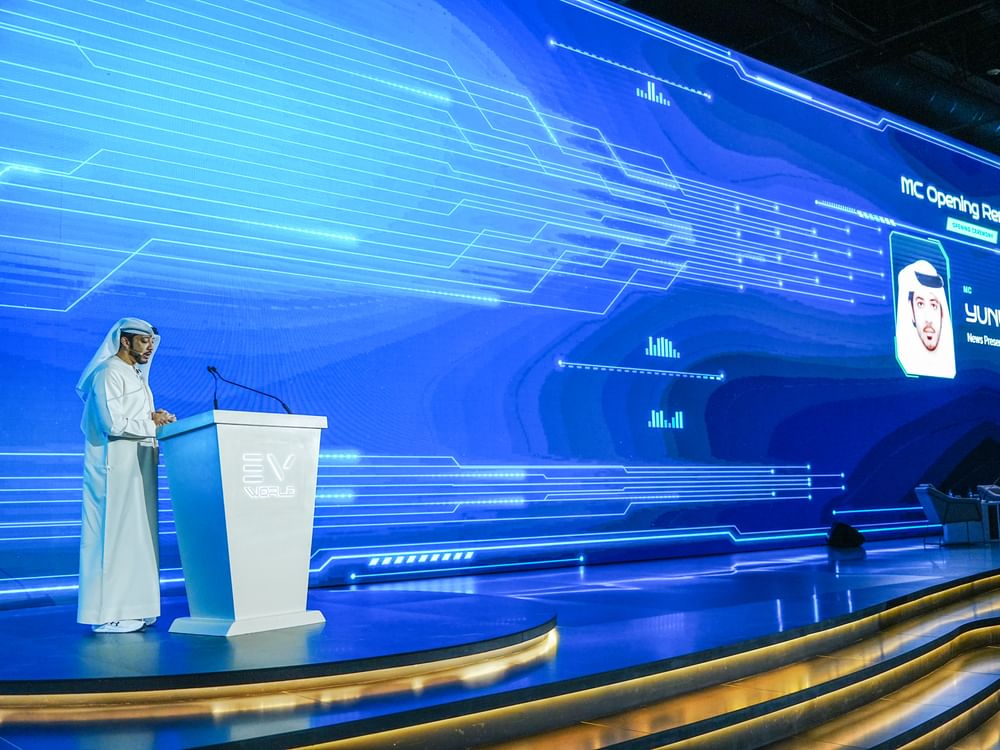
The announcement came during the UAE-China Industrial Cooperation Forum on green and smart mobility, held as part of the Dubai International Electric Vehicle Exhibition and Conference 2026 at Dubai World Trade Centre.
The forum brought together experts and representatives of international companies specialising in electric vehicles, energy and technology to explore opportunities for localising EV-related industries and strengthening investment and technological partnerships between the two countries.
Dawood Al Shezawi, President of the Dubai International Electric Vehicle Exhibition and Conference 2026, announced the launch of the centre during the forum.
He said the initiative would provide a permanent framework for UAE-China cooperation in clean and smart mobility and help translate partnerships and discussions initiated during the exhibition into practical projects and investment opportunities.
Al Shezawi said the centre was established in response to proposals made by representatives of government entities and Chinese companies during a meeting held on the sidelines of the exhibition's first day.
Participants highlighted the importance of providing clear pathways for licences and approvals, ensuring vehicle compatibility with local charging networks, identifying local partners for service provision and skills development, and maintaining engagement with decision-makers after the exhibition.
He said the centre would operate across three main tracks.
The first will provide a single point of access to help Chinese companies engage with relevant authorities and understand regulatory procedures and requirements, including licensing, vehicle certification, safety standards and electric charging requirements.
The second will connect Chinese vehicle and technology manufacturers with UAE fleet operators, charging-network providers, industrial partners and investors through regular meetings throughout the year, with the aim of developing cooperation and investment opportunities.
The third track will support pilot projects involving advanced technologies in areas including autonomous taxis, autonomous logistics, charging and energy.
This will allow companies to test their solutions, expand their deployment in the UAE and prepare for wider entry into regional markets.
Al Shezawi stressed that the centre would not operate as a conventional headquarters, but rather as an institutional framework to maintain cooperation throughout the year and turn discussions launched during the exhibition into practical outcomes.
Progress achieved through the centre will be reviewed during the next edition of the exhibition and conference, he added.
Al Shezawi said the UAE-China partnership is among the world's strongest, noting that non-oil trade between the two countries surpassed US$100 billion for the first time last year, growing 24.5 percent.
China is the UAE's largest trading partner, while the UAE is China's leading Arab trading partner in non-oil commodities.
He said the next phase of cooperation would move beyond trade indicators towards practical projects in transport, charging networks, ports and aviation.
The partnership, he added, can draw on China's leadership in new-energy vehicles, battery manufacturing, charging technologies, intelligent connected vehicles and autonomous driving, alongside the UAE's clear vision for clean and smart mobility, advanced infrastructure and strategic location connecting markets across Asia, the Middle East, Africa and Europe.
Al Shezawi said these complementary strengths could reinforce the UAE's position as a hub for testing Chinese mobility technologies, scaling their deployment and introducing them to regional markets.
He noted that this cooperation is already taking shape through the operation of autonomous taxis, the use of electric buses and the introduction of new vehicle models by Chinese manufacturers in the UAE market.
He also highlighted Dubai's ambitious mobility targets, including converting the emirate's entire taxi and limousine fleet to electric and hydrogen-powered vehicles by 2040.
The forum also explored opportunities to advance industrial and investment cooperation between the UAE and China, moving beyond traditional exchanges of goods and services towards broader partnerships in industrial and technology localisation and supply-chain development.
Participants discussed opportunities to benefit from China's expertise in electric vehicle manufacturing and charging infrastructure, while strengthening cooperation in research and development and the adoption of advanced technologies supporting the transition to sustainable transport.