
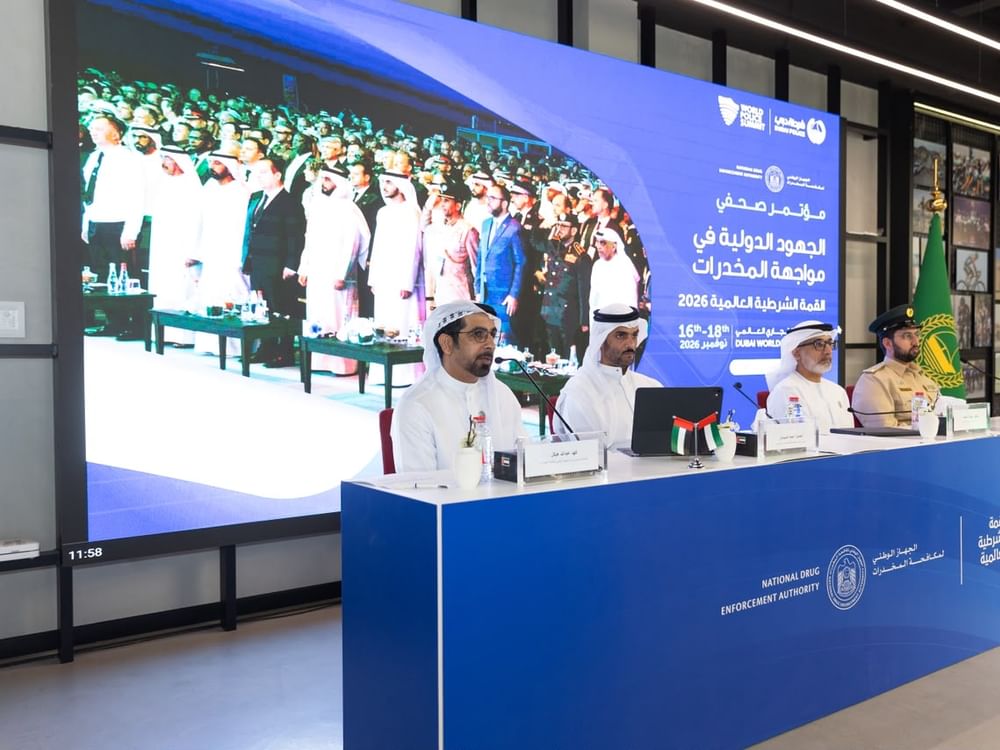
DUBAI, 12th November, 2026 (WAM) -- The National Drug Enforcement Authority (NDEA) and Dubai Police General Headquarters, represented by the General Department of Anti-Narcotics, in cooperation with the World Police Summit (WPS), have announced the details of the Anti-Narcotics Conference. It will take place on 17th November at Dubai World Trade Centre, as part of the Summit, which runs from 16th to 18th November.
The Conference will be held on the second day of the Summit. It will address drug-related issues from preventive, therapeutic, security, legislative and health perspectives. It brings together leading international and regional experts, specialists and researchers, with the participation of international organisations led by the United Nations Office on Drugs and Crime (UNODC) and the European Union Drugs Agency (EUDA).
Major Fahad Abdullah Haikal, Official Spokesperson for the National Drug Enforcement Authority, said the Authority’s participation in the Conference follows the directives of Sheikh Zayed bin Hamad bin Hamdan Al Nahyan, Chairman of the Authority, and his direct support for institutional representation in specialised international forums. He added that the Chairman believes tackling this cross-border threat can only succeed through effective international partnerships and the exchange of experience and proven practices.
He noted that the Authority was established under a Federal Decree-Law issued on 3rd August 2025, as an independent federal entity reporting to the Cabinet and the UAE’s principal authority for combating drugs. Its establishment supports delivery of the National Strategy for Combating Drugs 2024–2031. The Authority is responsible for developing drug-related policies and legislation, tracking and dismantling smuggling and trafficking networks, overseeing the treatment and rehabilitation of people with addiction, regulating chemical precursors, and strengthening cooperation with countries and international organisations.
The spokesperson commended the partnership with Dubai Police General Headquarters, describing it as a distinguished model of joint work that reflects a shared purpose and vision in protecting society and its children from this threat. He also praised the role of the media as a key partner in delivering the Authority’s strategy, and as the bridge through which its preventive messages reach every home and family.
Dr. Abdullah Al Khayat, Adviser at the National Drug Enforcement Authority, said trafficking and promotion networks no longer rely on traditional methods. They now use digital spaces, social media platforms, encrypted applications and electronic payment methods to reach young people, alongside the emergence of synthetic psychoactive substances sold in misleading forms that hide their danger.
Dr. Al Khayat added that prevention is no longer a complementary option but the first line of defence. He explained that it rests on strengthening digital awareness among children and young people, enabling families to follow up and talk with their children, embedding prevention programmes in educational, sports and community institutions, encouraging early reporting through approved channels, and using modern technology and data analysis to detect and anticipate new methods of promotion.
He stressed that confronting drugs is a shared national responsibility, in which the efforts of security, health, educational, social and media institutions come together with the role of the family. He said the Authority hopes the Conference will produce high-quality, practical recommendations that support the nation’s path towards a safe, drug-free society.
Dr. Mohammed Jamal Al Tamimi, Head of Programming, World Police Summit, stated, “Drug networks do not recognise borders, so no one can confront them alone. The Anti-Narcotics Conference brings security, health, legislative and academic bodies together with international organisations on one platform, to exchange experience and turn dialogue into practical partnerships.”
He added, “We are proud of our cooperation with the National Drug Enforcement Authority and Dubai Police’s General Department of Anti-Narcotics. Protecting future generations from this threat is a shared national responsibility, and it takes the combined efforts of institutions and members of society. The response to the Anti-Narcotics Excellence Award, with more than 39 entries from around the world, also shows the level of international interest in this issue.”
Brigadier Ahmed Al Suwaidi, Deputy Director of the General Department of Anti-Narcotics at Dubai Police General Headquarters, spoke about the Conference programme, which covers five key themes. The first is the international theme, “The Scale and Spread of the Global Drug Problem”. It is delivered by UNODC and highlights rising drug use worldwide, according to the latest reports and statistics, despite awareness and enforcement efforts.
The second theme, on treatment and rehabilitation, is titled “Moving from Criminalisation to Therapeutic Approaches”. It reviews the latest international trends in shifting from criminalisation to treatment programmes in drug use cases.
The international cooperation theme is titled “Cross-Border Interdiction: Dismantling Global Drug Networks”. It addresses joint action to pursue trafficking networks from countries of origin to destination countries.
The health theme is titled “How Global Bodies Are Addressing the Health Impact of Drugs”. It features experts from EUDA and examines the effects of drugs on mental and physical health.
The fifth theme, on artificial intelligence, is titled “The Future Role of AI in Combating Criminal Networks”. It looks at how smart technologies can contribute to confronting the drug threat.
The Conference includes two panel discussions. The first is titled “Dismantling Global Drug Networks: Tracking Illicit Flows Across Regional Corridors”. The second is titled “The Rising Threat of Synthetic Drugs: Global Impact, Law Enforcement Efforts and Regulatory Challenges”, and it discusses the growing circulation of chemical precursors and the importance of regulating them to prevent misuse. A fireside session, “Disrupting Drug Trafficking: Lessons from Australia and Colombia”, will also be held.
On the sidelines of the Conference, two workshops will cover manufactured substitutes for natural drugs and the analysis of drug cases using artificial intelligence. There will also be two brainstorming sessions, “Towards an Integrated Model for Drug Case Risk Management” and “Institutional Practices and Their Role in Developing Training Curricula Across Operational Entities and the Criminal Investigation Sector”.
Brigadier Al Suwaidi said that the Anti-Narcotics Excellence Award, launched by the World Police Summit for specialised institutions, researchers and other stakeholders, received more than 39 entries this year from around the world. Entries covered field and information-led work, precursor control, treatment and rehabilitation, and awareness and prevention. The winners will be announced during the Summit.
The Conference targets national institutions and professional groups working in this field. They include the Ministries of Health and Prevention, Justice, Education, Community Empowerment, Culture and Family, and the Federal Authority for Identity, Citizenship, Customs and Port Security. They also include local anti-narcotics bodies, treatment and rehabilitation entities (Erada Center, the National Rehabilitation Centre and Al Amal Hospital), judicial bodies (the Public Prosecution and Dubai Courts), the Knowledge and Human Development Authority, the Dubai Health Authority, the Community Development Authority and the Dubai Sports Council.
International partners taking part in the Conference are the UNODC Regional Office, the International Narcotics Control Board, the National Crime Agency (United Kingdom), the Fund for Combating and Treating Addiction (Egypt), the Criminal Information Centre for Combating Drugs (Qatar), the Arab Bureau for Narcotics Affairs (Jordan), and the National Association of School Resource Officers (United States).