
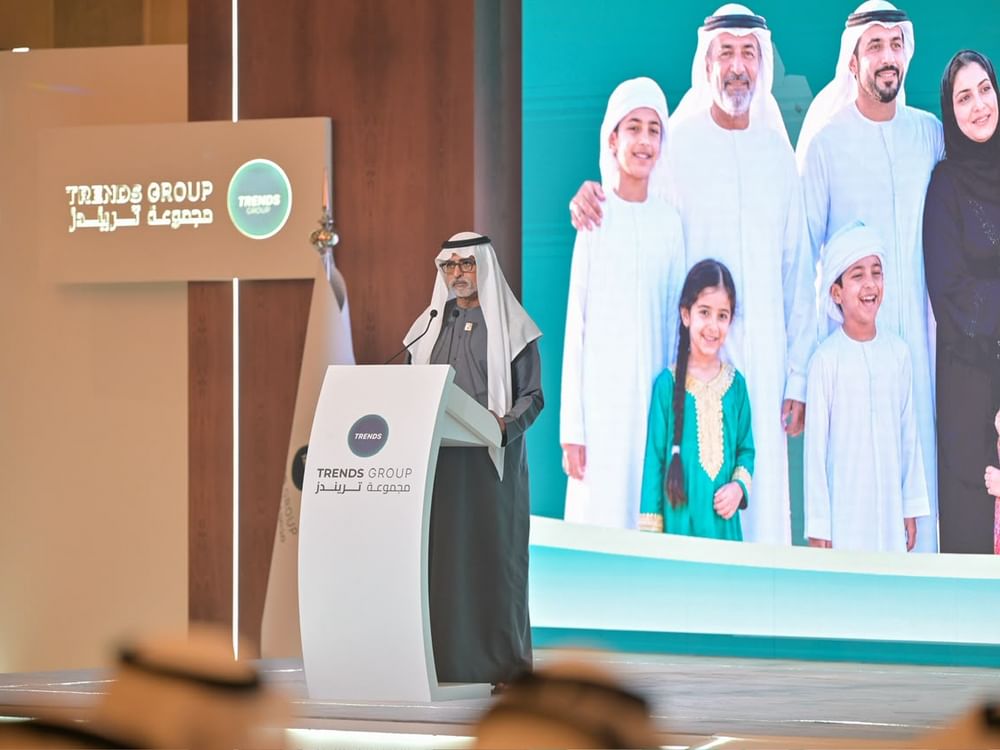
ABU DHABI, 12th November, 2026 (WAM) -- Sheikh Nahyan bin Mubarak Al Nahyan, Minister of Tolerance and Coexistence, inaugurated the TRENDS Observatory’s first annual Conference, held under the theme ''The Family in the Era of Social Transformation'', in Abu Dhabi on Thursday.
The opening ceremony was attended byAbdullah Sultan bin Awad Al Nuaimi, UAE Minister of Justice; Dr. Maitha bint Salem Al Shamsi, Minister of State; Dr. Omar Habtoor Al Darei, Chairman of the General Authority of Islamic Affairs, Endowments and Zakat; and a distinguished gathering of senior officials and representatives of institutions concerned with family affairs and community development.
Sheikh Nahyan, accompanied by ministers and conference guests, toured the exhibition held alongside the conference, exploring its digital platforms and various sections showcasing the knowledge products and services of the five companies within TRENDS Group. These include advisory and training services, surveys and social research, and more than 570 scholarly publications covering economic, technological, political, and futures studies topics. The exhibition also features interactive sessions and youth workshops held across its various platforms.
In his opening address, Sheikh Nahyan bin Mubarak Al Nahyan, Minister of Tolerance and Coexistence, welcomed the conference participants and expressed his pleasure at attending the event. He said that the theme chosen by TRENDS Group, The Family in the Era of Social Transformation, addresses one of the most vital issues closely linked to the nation’s development.
Sheikh Nahyan emphasised that, under the leadership of President His Highness Sheikh Mohamed bin Zayed Al Nahyan, the country is committed to providing families with every opportunity to contribute and achieve. He noted that His Highness the UAE President consistently stresses that comprehensive societal development requires the active and meaningful participation of every individual, men and women alike.
He explained that His Highness the UAE President continually emphasises the importance of ensuring that families contribute effectively to national progress in ways that reflect society’s circumstances, respond to ongoing changes and developments, and take account of the UAE’s position in global progress. This requires empowering all family members to understand the forces driving change and the rapid developments taking place at home and abroad. It also calls for constant readiness to respond wisely and intelligently to remarkable technological advances, the unprecedented growth of information and knowledge, and the significant challenges these developments pose to individuals, families, and society as a whole.
Sheikh Nahyan expressed his deep appreciation for the President’s wise directives and enlightened efforts, conveying his profound gratitude and respect for His Highness’s commitment to ensuring that the UAE remains a successful society that places people and families at the heart of every endeavor. He praised the President’s efforts to empower individuals and families to navigate rapid changes at home and abroad with awareness and sound judgment, while translating their love of the nation, sense of belonging, and loyalty to the state and its leadership into thought and action.
He also expressed his profound gratitude and appreciation to H.H. Sheikha Fatima bint Mubarak, the Mother of the Nation, Chairwoman of the General Women's Union, Supreme Chairwoman of the Family Development Foundation and President of the Supreme Council for Motherhood and Childhood.
He praised her unwavering support for meaningful initiatives and efforts to advance family development in the UAE and around the world, equip family members to respond successfully to contemporary challenges, and contribute to building a more cohesive society founded on love, coexistence, and the pursuit of collective well-being. Such a society, he noted, brings people together within an integrated framework to achieve stability, success, and prosperity.
Sheikh Nahyan added that the Mother of the Nation’s commitment to successful family development strengthens loyalty to the nation, self-confidence, happiness, and the capacity for achievement, while fostering optimism about the future among Emirati men and women. These qualities, he explained, enhance the UAE’s ability to sustain its progress and development and reinforce its prominent position internationally. He expressed pride in the Mother of the Nation’s far-sighted vision, which recognizes family development as a fundamental pillar of the nation’s success, progress, and stability.
He noted that discussing the family’s role in a changing world highlights the bonds of love, kinship, and family ties, as well as the bonds of citizenship and coexistence that connect family members with others in their communities and around the world. Examining social transformations, he explained, requires considering the family’s role in providing material, spiritual, and moral support; strengthening national identity; celebrating noble human values and principles; teaching children essential life skills; developing their capacity for responsible citizenship; and instilling moderation in their words and actions.
He added that families must prepare children to build strong, positive relationships with others in society, based on fraternity, a shared destiny, and a commitment to cooperation and collective action. They must also instill the conviction that ethical conduct helps build a society characterized by tolerance and coexistence, where everyone can enjoy peace, stability, and prosperity.
Sheikh Nahyan affirmed that families in the UAE are working diligently and with dedication to fulfill these aspirations, guided by the President’s directives and supported by the Mother of the Nation’s initiatives and efforts. He emphasised that the family is the foundation of Emirati society and a central pillar of its development. Emirati families take pride in the nation’s leaders, achievements, symbols, and heritage, uphold the teachings of Islam, and fulfill their responsibility to raise future generations.
They, he added, also embody the aspirations of the leadership and the people by protecting children from destructive ideological and behavioral influences, remaining committed to national goals and aspirations, and promoting positive engagement with people everywhere.
He explained that, in addition to highlighting the efforts of families in the UAE, the conference offers an opportunity to gain a comprehensive understanding of their role in sustainable national development and explore ways to strengthen it through clear, carefully considered plans.
Sheikh Nahyan stressed that successful family development is a responsibility shared by society as a whole, and that everyone has a duty to empower families to fulfill their roles effectively and competently. This includes providing family members with opportunities to gain experience, pursue lifelong learning, and consult one another on important matters affecting their lives. It also requires encouraging responsible use of modern technologies and removing obstacles that might prevent families from contributing fully to the nation’s continued progress and prosperity.
He explained that the conference’s success in achieving these objectives depends on the efforts and contributions of its participants. He called for prioritizing strategies that command broad support, strengthen the family’s standing in society, overcome the obstacles it faces, and provide the opportunities and choices needed to fulfill its role in a rapidly changing world. He added that the conference should aspire to go beyond discussion and dialogue by producing outcomes and recommendations grounded in the realities of society and capable of enhancing the vitality and effectiveness of institutions working in this field.
Concluding his address, Sheikh Nahyan renewed his welcome to the participants and wished them success in examining and discussing these vital issues affecting society’s development. He thanked TRENDS Group for organizing the conference and prayed for the success of all sincere efforts undertaken for the benefit of the UAE.
In his keynote address, Abdullah Sultan bin Awad Al Nuaimi, UAE Minister of Justice, emphasised the profound significance and timeliness of the conference theme, "The Family in the Era of Social Transformation." He noted that speaking of the family means speaking not merely of a social institution, but of the place where every human story begins, the first school of values, and the roots that give society its strength, the nation its stability, and generations their identity.
He pointed out that, since its founding, the UAE has recognised that building the nation begins with developing its people, and that the family is their first nurturing environment. Protecting the family has therefore been a constitutional commitment, a moral responsibility, and a long-term development priority. Article 15 of the UAE Constitution establishes that the family is the foundation of society, rooted in religion, morality, and patriotism, and that the law safeguards its existence and protects it from deviation.
Al Nuaimi added that, throughout the UAE’s development, this vision has evolved into an integrated framework of institutions, legislation, and policies, including designating 2026 as the Year of Family under the theme Growing in Unity.
Addressing current transformations, the Minister of Justice explained that artificial intelligence can bring family members closer together rather than drive them apart. It can give families more time and greater opportunities to learn, help parents understand and respond to their children’s needs and nurture their talents, and enhance the independence of older people. He stressed the importance of combining innovation with awareness, protecting family privacy and personal data, and strengthening children’s online safety. Technology, he noted, provides the tools, but families give them meaning.
He reviewed the results achieved by family reconciliation and guidance centers at federal courts. In 2025, these centers handled 2,457 family disputes, with a reconciliation rate of 56.8 percent. In the first half of 2026, they received 877 disputes, with a reconciliation rate of 47.2%, underscoring the importance of amicable settlements.
He also highlighted the Ministry’s launch of the Emirati Family Data Package initiative in 2026, designed to facilitate proactive updates to marriage and divorce records through digital integration.
He emphasised that the future of the family is a shared national responsibility requiring coordinated efforts by government, schools, universities, community institutions, and the private sector. This entails moving beyond addressing challenges after they arise toward building a system better equipped for prevention and foresight. Al-Nuaimi concluded his address by stressing that the family lies at the heart of development and is its ultimate purpose.
A nation’s greatest investment, he said, is not in smart cities or advanced economies, but in strong families capable of raising generations who uphold the values of the past while possessing the tools of the future. He called for an approach that embraces modernity without abandoning authenticity, pursues progress without compromising values, and ensures that technology serves humanity rather than replacing what makes us human.
In his keynote address, Dr. Omar Habtoor Al Darei, Chairman of the General Authority of Islamic Affairs, Endowments and Zakat, remarked that the family should be at the heart of social transformation, not social transformation at the heart of the family. He welcomed the use of the term "transformation" rather than "change" in the conference theme, emphasizing that the family is a stronghold from which society draws its intellectual, social, and moral resilience. He expressed confidence that Emirati families continue to possess strong social and moral resilience.
Al Darei stressed that safeguarding national identity within the family and among its members is essential to strengthening the UAE’s national identity. He also emphasized the need to cultivate awareness and sound judgment among family members, enabling them to distinguish beneficial content from harmful influences and resist extremist ideologies that may reach them, particularly younger generations, through digital platforms.
He underscored the importance of preserving religious and family values and passing them from one generation to the next, including modesty, tolerance, moderation, balance, and solidarity. The family, he noted, plays a central role in sustaining these values.
He then addressed a key priority for the General Authority of Islamic Affairs, Endowments and Zakat: protecting minds, particularly amid digital transformation, and countering attempts to manipulate people's thinking and expose young people to extremist ideologies in virtual environments. He emphasised that active family engagement is the first line of defense against harmful content on digital platforms.
Al Darei noted that the Emirati family's strong values enable it to adapt to and navigate the profound transformations of the digital world. He explained that sound judgment and wisdom in designing initiatives for Emirati families are just as important as the initiatives themselves. He stressed that enlightened awareness is essential to building intellectual resilience among family members, while warm, open dialogue within the family is the primary means of fostering that resilience.
He called on institutions to engage digital influencers in promoting the core values of Emirati identity. He also urged young people to appreciate the importance of the family and its deeply rooted traditional values, encouraging them to avoid unnecessary luxuries.
In her keynote address, Dr. Maitha bint Salem Al Shamsi, Minister of State, emphasised that the family is not merely a social unit affected by global transformations. Rather, it stands at the heart of these transformations, interacting with them, reshaping its roles, and helping determine their direction. As the first nurturing environment for individuals, the family is a fundamental pillar of society and its continued development, as well as the first line of defense in safeguarding the nation's culture, identity, and deeply rooted values. Investing in families, she stressed, is therefore a long-term investment in stability and sustainable development, rather than a short-term response to changing needs.
Al Shamsi structured her address around four key themes. The first was family empowerment, which begins with early socialization and rests on responsible parenting, an understanding of the respective roles of men and women, and a commitment to fulfilling their duties and responsibilities. It also involves equipping parents with appropriate parenting methods and improving their knowledge of nutrition, health, care, and psychological support. These efforts must be supported by flexible legislation and policies that keep pace with technological advances, changing lifestyles, and economic pressures while balancing openness to the world with the preservation of cultural identity.
Addressing her second theme, Raising Children and Building Character, she explained that the family is the primary source through which values and principles are passed down, including honesty, integrity, respect, and generosity. It shapes identity through customs and traditions, provides emotional support, love, and a sense of belonging, and develops social skills such as communication and cooperation. Although the family's influence is no longer absolute, given the growing role of schools, media, and social media in shaping children, it remains the primary foundation of individual character.
Her third theme focused on the importance of parental presence, particularly as women have become essential contributors to economic activity and the time available for direct family interaction has declined. She stressed the need to better balance work and family life, strengthen the roles of both fathers and mothers, reduce reliance on nannies, improve early childhood services, and encourage dialogue that lets children express themselves freely.
Turning to the challenges facing families, Al Shamsi highlighted economic pressures, weakening family cohesion, some parents' withdrawal from their parenting responsibilities in favor of providing financial support alone, growing indifference, declining empathy and solidarity, and excessive technology use.
She further highlighted the digital era's impact on identity through cultural domination and alienation, the tension between traditional and modern values, and the rise of individualism.
Concluding her address, Al Shamsi emphasized that the UAE leadership has established the Ministry of Family and Community Institutions to protect and support families. She expressed confidence that Emirati families would remain secure, stable, and committed to preserving the legacy of the late Sheikh Zayed bin Sultan Al Nahyan.
In his welcome address, Dr. Mohamed Abdulla Al Ali, Chairman of TRENDS Group, emphasised that we live in a world marked by accelerating technological, economic, and cultural transformations that are reshaping lifestyles, work patterns, communication, and human relationships. Amid these changes, the family remains the primary institution in which individuals develop their character, acquire values, and form their sense of identity and belonging. It also provides the foundation for social cohesion. The question, therefore, is no longer how to protect families from change, but how to empower them to adapt without losing their identity, essential functions, and deeply rooted values.
Dr. Al Ali explained that TRENDS Group believes family-related issues cannot be addressed solely through traditional social approaches. Instead, they require an integrated strategic vision that brings together scientific research, data analysis, foresight, and public policymaking. Effective family policies, he stressed, must be grounded not in assumptions or impressions, but in reliable knowledge, a clear understanding of demographic and behavioral transformations, and an appreciation of the needs of present and future generations.
He added that investing in families is not merely an investment in the present, but also in people, social capital, societal security, and the capacity for development and progress. Strong societies, he noted, are measured not only by their economic growth or technological advancement, but also by the cohesion of their families, the strength and quality of their human relationships, and their ability to raise generations equipped with awareness, a strong sense of identity, and responsibility.