
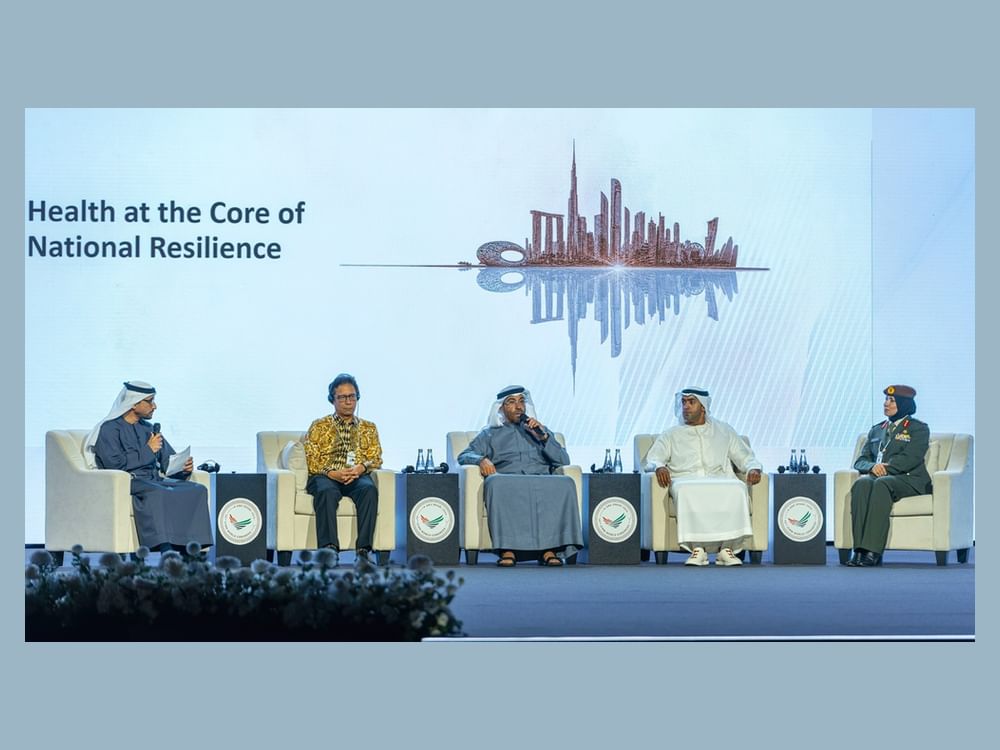
ABU DHABI, 12th November, 2026 (WAM) -- Ahmed Ali Al Sayegh, Minister of Health and Prevention, has affirmed that health security is a cornerstone of national security, stressing that major health challenges affecting people's lives and the continuity of essential services require a coordinated, whole-of-government response.
He said sustainable preparedness means maintaining essential healthcare services during emergencies while being ready to respond to new challenges as soon as they arise, safeguarding the health and safety of the community.
Al Sayegh made the remarks during a panel discussion titled Health at the Core of National Resilience, held as part of the 46th ICMM World Congress of Military Medicine – Abu Dhabi 2026.
The session brought together Budi Gunadi Sadikin, Minister of Health of the Republic of Indonesia; Mansoor Ibrahim Al Mansoori, Chairman of the Department of Health – Abu Dhabi; and Major General Staff Dr. Ayesha Sultan Al Dhaheri, Executive Director of the Military Health Executive Directorate at the Ministry of Defence and President of the International Committee of Military Medicine (ICMM), alongside senior military and civilian healthcare leaders.
Discussions focused on preparing for emerging challenges, improving coordination between civilian and military sectors, and maintaining essential healthcare services during crises. The session also highlighted the importance of international knowledge exchange in building health systems better equipped to withstand emergencies.
Al Sayegh explained that health security means protecting communities while ensuring they continue to have access to essential services. Hospitals, medical supply chains and health information systems, he noted, constitute vital national infrastructure.
He warned that a cyberattack on a hospital is both a security incident and a threat to patient safety. Losing access to medical records or essential systems can delay treatment, making the protection of digital health infrastructure an integral part of protecting people.
The Minister highlighted the UAE's multi-sector national response plans covering infectious disease outbreaks, mass-casualty incidents and chemical, biological, radiological and nuclear emergencies. The National Emergency Crisis and Disaster Management Authority (NCEMA) coordinates their implementation.
He noted that health emergency teams responded immediately when the regional crisis began on 28 February. Healthcare providers across the public and private sectors maintained urgent, critical and routine care, while mental health services were rapidly activated.
Al Sayegh also recalled how, in May, while responding to the regional situation, UAE health authorities assessed the potential risk of imported cases of Hantavirus and Ebola following outbreaks outside the country.
This involved assessing potential risks, reviewing preparedness at points of entry and coordinating with relevant authorities. No confirmed cases were recorded in the UAE.
The Minister attributed this outcome to an efficient, integrated healthcare system and a coordinated government approach that anticipates health risks before they develop into challenges affecting the community.
Al Sayegh stressed that the first decision in any crisis must be to identify the services that cannot be allowed to stop, particularly dialysis, maternity care and access to essential medicines.
He commended the Emirates Drug Establishment and its partners for maintaining medicine supplies despite pressure on supply chains. He also praised healthcare professionals for adapting quickly to changing circumstances and continuing to care for patients with dedication.
The Minister emphasised the importance of integrating virtual healthcare into routine services so that patients can continue receiving follow-up care when travel is disrupted or impractical.
Reflecting on the UAE's experience, Al Sayegh said the most important lesson is the need to establish strong working relationships between relevant organisations and test them in practice before a crisis occurs.
He described the community as the most important partner in overcoming emergencies, highlighting the delivery of early-warning alerts to mobile phones, including those of visitors, and the sharing of practical guidance to support families' mental health.
The Minister called for lessons learned to be incorporated into emergency plans, responsibilities to be clearly defined and preparedness to be tested through joint exercises to ensure that the intended improvements are achieved.
Al Sayegh said that, under the guidance of its wise leadership, the UAE continues to establish health as a cornerstone of national resilience through an integrated system in which civilian and military healthcare authorities and the private sector share responsibility.
Their complementary roles in planning, response and recovery, he explained, help protect people and safeguard national achievements in all circumstances. They also reinforce public confidence in the healthcare system's ability to respond effectively to challenges while ensuring uninterrupted care for everyone.
"The UAE's experience in crisis management shows that preparedness is measured not only by the speed of response, but also by the system's ability to learn and evolve after every challenge," Al Sayegh said.
He added that the UAE is committed to turning lessons learned into practical policies and procedures, while investing in healthcare professionals, partnerships and modern technologies.
The Minister also described the congress as a global platform for exchanging expertise and advancing international cooperation to build health systems better equipped to respond to change, protect communities and prepare for future challenges.
The Ministry of Health and Prevention (MoHAP) and Emirates Health Services (EHS) are participating in the congress through a joint platform showcasing six national projects and initiatives.
The platform reflects an integrated approach that connects policymaking with service delivery, bringing regulatory responsibilities and medical expertise together within a unified framework.
It also highlights the UAE's vision for a healthcare system centred on prevention, preparedness and modern technologies, in line with the congress’s focus on readiness, innovation and the responsible use of data and emerging technologies to advance medical practice.
Dr. Yousif Mohamed Al Serkal, Director General of Emirates Health Services (EHS), affirmed that EHS's participation in the 46th ICMM World Congress of Military Medicine underscores the importance of integrating national efforts and specialised expertise to build a more prepared and resilient healthcare system. He noted that the international event provides an important platform for exchanging knowledge and showcasing innovations that strengthen health systems' capacity to respond to various challenges.
He added: “The future of healthcare depends not only on advancing diagnostic and treatment capabilities, but also on the ability of health systems to anticipate risks, make informed decisions at the right time, and ensure continuity of care under all circumstances. In this context, the projects showcased by EHS reflect an integrated approach to leveraging artificial intelligence and data to advance clinical practices, enhance early detection, and improve the efficiency of emergency and crisis management.
The true value of these innovations lies in strengthening the links between prevention, care and institutional preparedness, supporting the development of a more proactive national healthcare system capable of adapting to change and translating innovation into tangible, sustainable health outcomes that enhance the quality of care and community health.”
MoHAP is showcasing the Health Policies and Legislation Smart Platform, which enables community members and experts to participate in developing and evaluating health policies and legislation.
The Ministry is also presenting Baseera, the AI-powered Behavioral Insights Platform, which develops predictive models by analysing health behaviour patterns, measuring the factors influencing health behaviour and linking population indicators with healthcare service data.
These capabilities support evidence-based governance and help shape health programmes that better reflect community needs and are more likely to achieve their intended impact.
EHS, meanwhile, is showcasing Ghiath, its digital emergency, crisis and disaster management system, which provides centralised data and real-time indicators on healthcare facility readiness and the availability of critical resources.
It is also presenting the Itmenan Programme, a comprehensive periodic health screening initiative that supports the early detection of chronic diseases.
EHS is also showcasing its Smart Physician Assistant Agent, which conducts medical interviews with patients before their consultations and prepares structured clinical summaries for physicians.
The platform also features the AI in Diagnostic Imaging project, completing a portfolio of six projects that reflects the breadth of institutional innovation.