
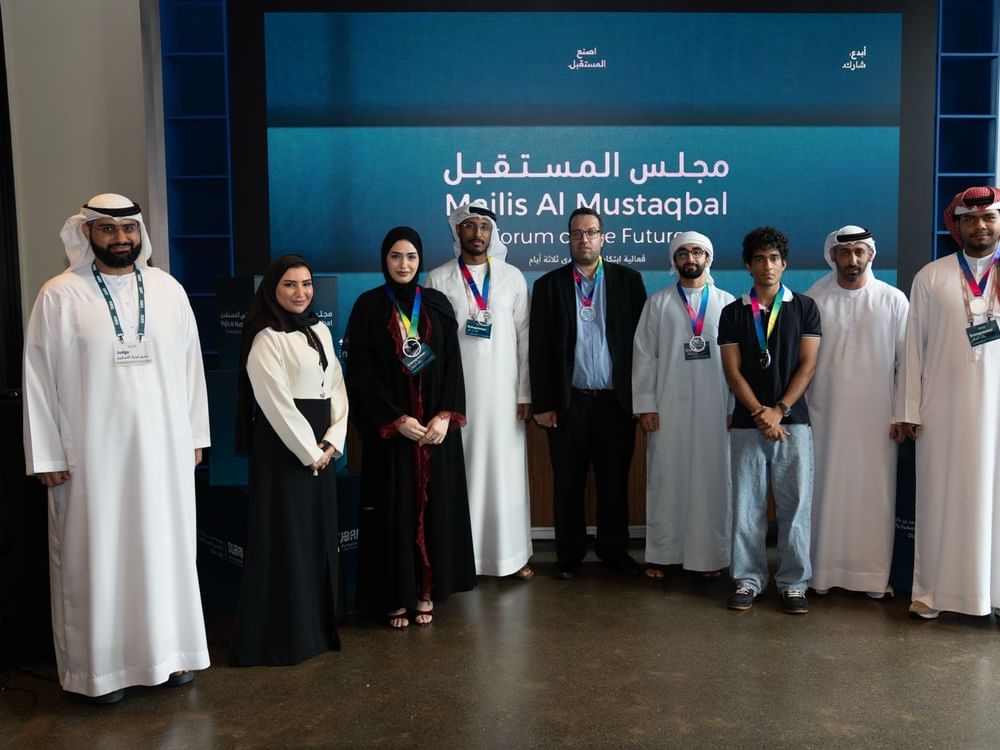
DUBAI, 14th November, 2026 (WAM) – The three winning teams of the second edition of the Future Council, organised by the Mohammed Bin Rashid Establishment for Small and Medium Enterprises Development (Dubai SME), part of the Dubai Department of Economy and Tourism (DET), showcased innovative projects leveraging artificial intelligence and space data to address real-world economic, government and societal challenges.
The projects highlighted the initiative’s role in transforming creative ideas into promising business opportunities.
In statements to the Emirates News Agency (WAM), members of the winning teams emphasised the importance of the initiative in providing an interactive environment that brings together individuals from diverse professional and academic backgrounds, enabling them to develop practical solutions and strengthening the role of young talent in supporting the national economy and harnessing advanced technologies to serve society.
The D100 team, representing Commercial Bank of Dubai, secured first place with a project to develop an AI-powered digital platform designed to help entrepreneurs overcome challenges during the first 100 days of business operations.
The proposed platform provides a comprehensive roadmap for managing operational, financial and administrative requirements following the issuance of a trade licence.
Team representatives explained that the idea emerged in response to a challenge presented by Commercial Bank of Dubai concerning the difficulties faced by newly established businesses, some of which struggle to remain operational and eventually close their bank accounts due to financial and administrative challenges.
They noted that the platform aims to guide entrepreneurs step by step after obtaining their trade licences, helping them transition from the establishment phase to actual business operations.
The proposed platform uses business data, including revenues, expenses, cash flows and capital burn rates, to generate indicators that help entrepreneurs assess their financial positions and identify potential risks at an early stage.
It also provides daily notifications regarding government, banking and tax procedures, deadlines and regulatory requirements.
The team explained that the project seeks to build an integrated ecosystem in cooperation with banks, universities, government entities and free zones, enabling entrepreneurs to access personalised services.
The platform could also facilitate access to financing by providing documented records of startups’ financial and operational performance.
Team members said winning first place provided strong motivation to continue developing the prototype created during the programme and transform it into a practical product.
They stressed that their goal extends beyond generating commercial returns to supporting the sustainability of small and medium-sized enterprises, strengthening their growth prospects and contributing to job creation.
The D100 team comprised Maryam, Ousha Mohammed Al Mazrouei, Mohammed Obaid bin Jarash, Ahmed Shahin Khalisdar, Mohammed Ashraf and Lucija Coga.
The Polaris team, representing the Mohammed Bin Rashid Space Centre (MBRSC), secured second place with a project aimed at maximising the value of satellite data generated by the centre and utilising it to meet the diverse needs of government entities and private sector organisations.
The project focuses on making better use of the extensive space data available through MBRSC and transforming it into relevant information tailored to the requirements and operational needs of individual organisations.
This approach would enable government and private sector entities to leverage satellite data according to their specific objectives, supporting their activities and facilitating data-driven decision-making.
The project seeks to expand the practical applications of satellite-generated data, transforming it into valuable information for various sectors.
It also aims to enhance the utilisation of the UAE’s advanced space and technological capabilities while opening new opportunities to support economic and institutional development.
The Polaris team comprised Vibhank Mehra, Raed Al Oqouli, Saif Mubarak, Sheikha Naji Al Zaabi, Hassan Khalid, Khalid Al Sabahi and Khalifa Masoud Al Otaiba.
Third place went to the Azwa team, representing Dubai Courts, which presented a project to develop a smart digital platform designed to facilitate access to government services for People of Determination (PoD) and senior citizens.
The proposed platform aims to enhance their ability to complete transactions independently by leveraging artificial intelligence and providing interactive tools tailored to their individual needs.
Speaking to WAM, Engineer Amal Ibrahim Al Marzouqi, a member of the Azwa team, said the project was inspired by the challenges faced by People of Determination and senior citizens when using digital applications and understanding legal and government procedures.
She explained that the project initially focuses on challenges associated with Dubai Courts services, with plans to expand its scope to cover other government entities in the future.
Al Marzouqi said the proposed platform includes four innovative initiatives: an AI-powered Smart Lawyer, a Smart Legal Advisor, a Smart Translator capable of translating languages and local dialects into written text in different languages, and a feature that uses artificial intelligence to convert sign language into Arabic text.
These features are designed to facilitate communication with People of Determination and accelerate the completion of government transactions.
She added that the platform takes into consideration the needs of users who experience difficulties interacting with digital applications.
It proposes voice-enabled features that allow users to ask questions and receive guidance without typing, while also helping senior citizens follow up on notifications related to legal cases and financial obligations.
Al Marzouqi noted that one of the team’s main challenges was identifying the varying needs of People of Determination and senior citizens across different government entities and developing solutions tailored to those requirements.
She emphasised that the team aims to further develop the project and expand its application across the UAE, with future ambitions to reach regional and international markets.
The initiative, she said, reflects the UAE’s leadership in harnessing technology to serve humanity.
She stressed that Azwa’s core mission is to empower People of Determination and senior citizens to live independently and participate fully in Emirati society by making essential services more accessible and user-friendly.
The Azwa team comprised Alyaa Essa Ali Bolehyool, Fatma Nasser Al Baloushi, Engineer Amal Ibrahim Al Marzouqi and Mahra Rashed Al Shamsi.
Participants affirmed that the Future Council provided an opportunity to work in multidisciplinary teams, benefit from the expertise of mentors and representatives of government and private sector organisations, and transform real-world challenges into innovative business concepts.
They highlighted the programme’s contribution to fostering teamwork, entrepreneurship and innovation.
The second edition of the initiative, held from 10th to 12th November at the Dubai Entrepreneurs Hub, attracted 50 participants working across nine teams.
The participants presented innovative solutions before a specialised judging panel, with the three winning teams receiving cash prizes.
The initiative forms part of Dubai SME’s ongoing efforts to empower entrepreneurial talent, strengthen Dubai’s innovation ecosystem and support the objectives of the Dubai Economic Agenda D33.