
ABU DHABI, 16th November, 2026 (WAM) -- The two finalists in the Mohamed bin Zayed Water Initiative’s “Al Miyah Challenge for Agriculture”, have achieved promising results in developing innovative technologies designed to improve soil water retention and strengthen roots’ ability to support crop growth under drought, heat and salinity.
EF Polymer and M4Life, among the six finalists in the Al Miyah Challenge for Agriculture launched by the Initiative, offer two complementary approaches. The first uses fruit waste to produce a material that retains water in the soil, while the second employs microbes to improve interactions between soil and roots, supporting water-use efficiency and agricultural productivity.
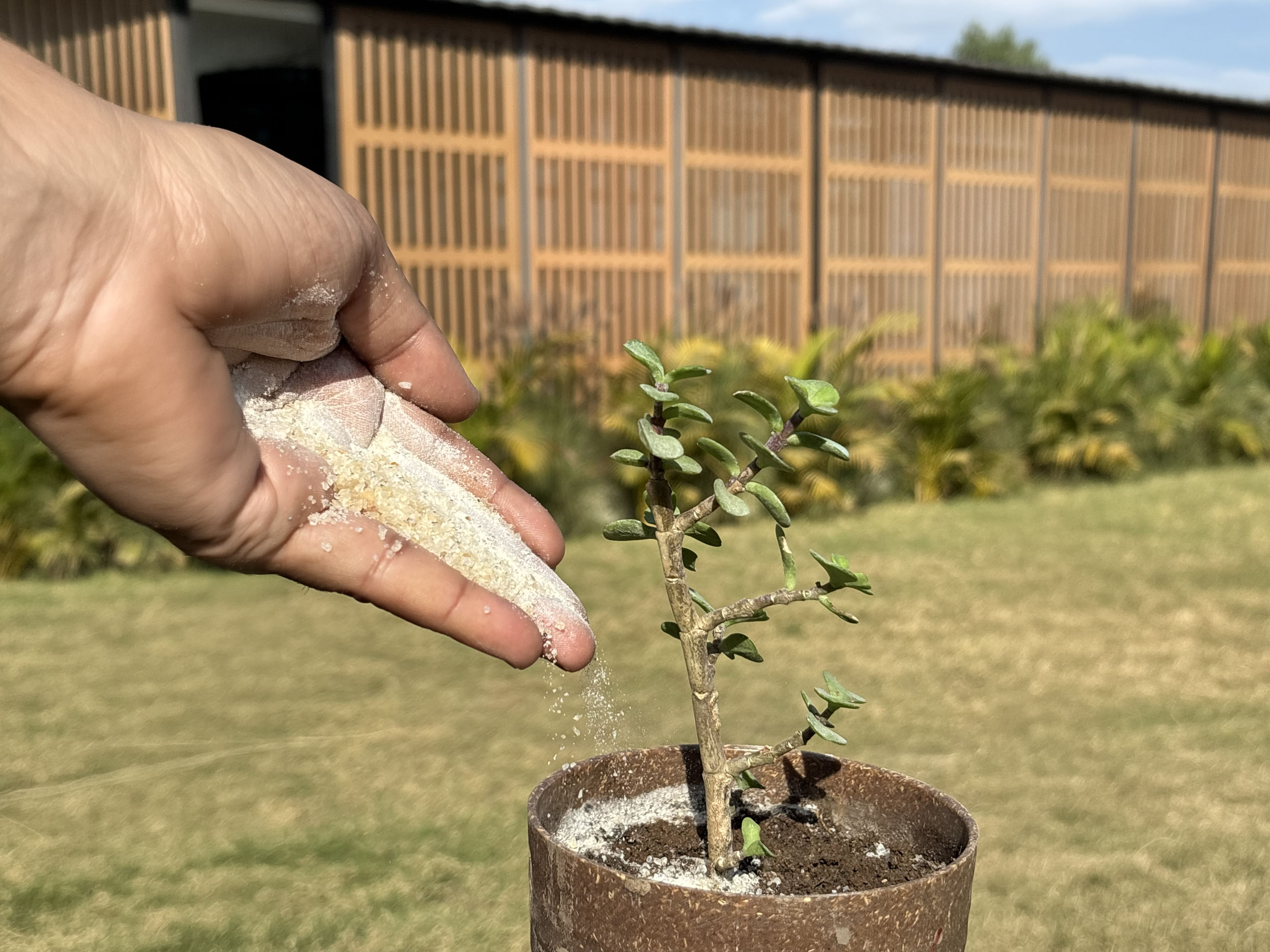
With the winner expected to be announced during the 2026 UN Water Conference, which Abu Dhabi will host this December, EF Polymer explained that its product is a superabsorbent polymer derived entirely from inedible fruit residues, such as orange peels, that improves soil water retention.
The company said the material can absorb up to 50 times its own weight in water, improving soil moisture retention. Field trials have demonstrated irrigation reductions of up to 40% and fertiliser savings of 20%.
It added that the product is fully biodegradable and described it as environmentally safe, noting its inclusion in the Organic JAS Materials List and registration with OMRI and ECOCERT INPUT in Europe and the United States.
Regarding performance under heat and salinity, the company cited trials in India’s arid Jaisalmer region, characterised by sandy soils and highly saline irrigation water. These demonstrated water savings reaching approximately 20–25% and average yield increases reaching approximately 15–20%.
The company explained that the material improved moisture availability in deeper soil layers, helping crops maintain physiological activity even under severe drought stress. However, its responses did not specify the temperatures or salinity levels at which these results were obtained.
Application costs vary according to the method used, the company said. Broadcasting costs range from US$16 to US$18 per hectare per application, depending on local labour rates. Application using a seed drill costs between US$45 and US$60 per hour of land preparation, covering equipment rental, the operator and consumables.
The company recommended integrating product application with routine land preparation, explaining that the material remains effective in the soil for approximately six months before beginning to biodegrade into organic matter.
M4Life, meanwhile, explained that it develops biological solutions to help crops withstand drought, heat and salinity, using beneficial microbes originally isolated from extreme environments and enhanced through a proprietary process called BioTraining.
This process improves the microbes’ ability to survive under stress, respond to root exudates and interact with roots. The technology targets the soil–root interface to promote root growth, improve nutrient availability, and enhance soil structure and water retention.
The company added that its products, BIO.R and BIO.C, are liquid formulations that can be applied through seed treatment, soil application or irrigation systems, without additional infrastructure.
According to the company, the microbes work through mechanisms including plant hormone production, phosphate solubilisation and the production of iron-binding compounds. They can also form protective biofilms that help create a more favourable environment for roots.
Stimulating root development and microbial activity also promotes soil particle aggregation, improving soil structure, water infiltration and moisture retention. This is particularly important in sandy soils with limited water-holding capacity.
According to M4Life, the technology has undergone more than 100 field trials in Argentina across different crops and agricultural regions, including trials during the severe 2022–2023 drought. Yield increases generally ranged from 8% to 20%, averaging approximately 15%.
Evaluations were conducted by independent organisations, including contract research organisations, public institutions and academic teams. Treated crops were compared with controls receiving the same standard agricultural management practices.
In a sweet-corn trial at Silal Innovation Oasis in the UAE, the treatment recorded an 11% reduction in irrigation water compared with the untreated control, while treated plants remained greener.
The company noted preliminary indications of improved productivity, but final quantitative yield data are still being processed by Silal and the Challenge team to determine whether the water savings were achieved while maintaining or increasing yield.
Starting approximately 40 days after sowing, and becoming more evident at harvest, observations showed stronger root development, greater aggregation of sandy soil particles around the roots, and darker, more cohesive soil.
The company believes these observations indicate potential improvements in soil water retention and microbial activity, with benefits potentially extending beyond a single growing season, helping farmers produce more food with less water while improving the soil’s capacity to support growth.