
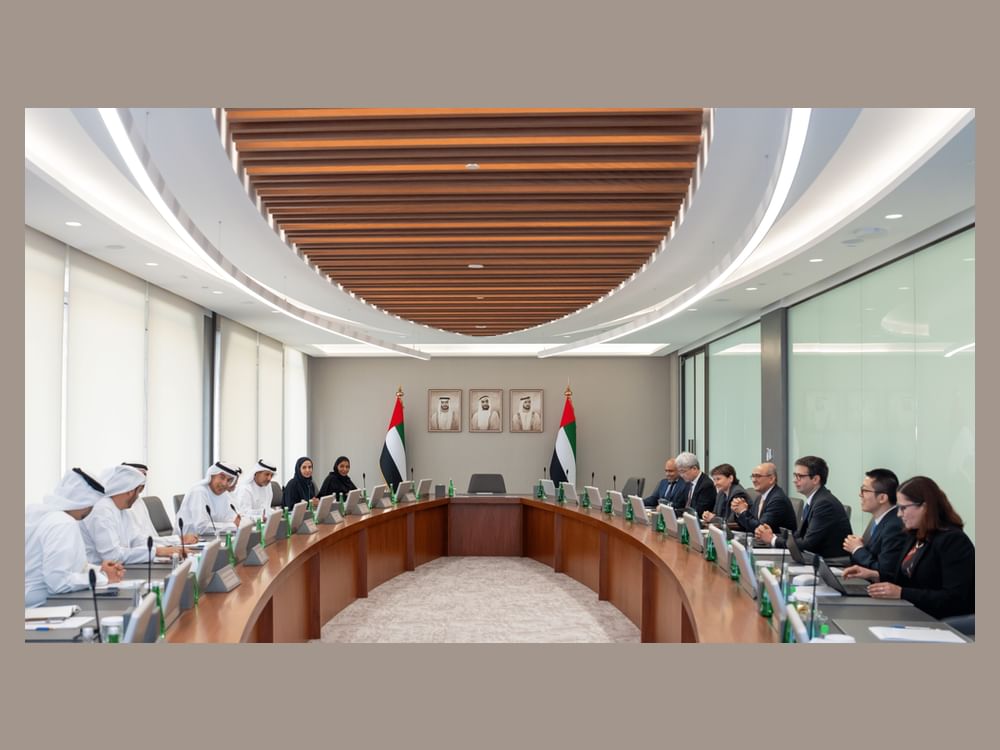
ABU DHABI, 18th November, 2026 (WAM) -- The International Monetary Fund (IMF) mission has concluded its official visit to the United Arab Emirates as part of the 2026 Article IV Mission, held from 3rd to 17th November. The Mission was led by the Central Bank of the UAE (CBUAE) in national coordination with federal and local government entities and the private sector.
Discussions focused on recent economic and financial developments and growth prospects amid regional and global shifts, alongside monetary and prudential policies aimed at reinforcing financial stability, enhancing banking sector resilience, and advancing the Dirham Monetary Framework and financial infrastructure.
Khaled Mohamed Balama, Governor of the CBUAE and Governor for the UAE at the IMF, chaired the mission’s concluding meeting at the CBUAE headquarters in Abu Dhabi.
He stated, “The resilience of the UAE economy and its high capacity to adapt to global developments and sustain growth embody the wise vision of our leadership and the effectiveness of the country’s proactive policies, which have reinforced the pillars of financial and monetary stability and solidified the UAE’s standing as a leading global economic and financial centre.”
Balama affirmed that the Central Bank continues to strengthen its proactive approach in developing monetary and supervisory policies, noting that the UAE’s financial sector continues to deliver strong performance, underpinned by growth in credit and deposits and sustained improvement in asset quality.
Total banking assets surpassed AED5.815 trillion by the end of Q3 2026, reflecting the strength, soundness, and high resilience of the banking system in supporting sustainable economic development.
He emphasised, “Our continuous and close cooperation with the IMF reflects our commitment to keeping pace with international best practices and standards by advancing monetary and supervisory policy frameworks and enhancing the efficiency of the financial system and its ability to navigate global developments. We continue to develop our financial infrastructure to support the competitiveness of the national economy and cement its position on the global financial stage.”
Said Bakhache, IMF Mission Chief for the UAE Article IV Mission, commended the strength and resilience of the UAE economy in a statement issued by the Fund today, saying, “The UAE economy has demonstrated resilience and strength in facing regional disruptions, supported by agile and targeted government policy responses, fiscal buffers, robust infrastructure, and a well-capitalised banking system.”
He explained that economic activity in the UAE has begun to regain momentum, particularly in the oil, trade, aviation, and tourism sectors, projecting real GDP growth to accelerate to 7.3 percent in 2027, driven by a 5.4 percent expansion in the non-oil sector, while inflation is expected to moderate and stabilise at 2 percent over the medium term.
Bakhache affirmed that public finances and external positions will remain strong, with international reserves remaining ample. He added that the financial system maintains its soundness thanks to substantial capital and liquidity buffers and continued improvements in asset quality.
He also highlighted the importance of the proactive initiatives and policies adopted by the CBUAE to bolster the resilience of financial institutions, entrench financial sector stability, and support national economic growth.
He noted that the comprehensive proactive support package in 2026, backed by other government initiatives, represents an appropriate approach to addressing the nature of developments affecting supply chains, underpinned by the country’s substantial fiscal buffers.
At the same time, he praised the UAE’s efforts to expand Comprehensive Economic Partnership Agreements (CEPAs) and develop alternative trade corridors to enhance supply chain resilience, commending the notable progress in the quality of economic and financial data and the close cooperation of various UAE authorities with the Fund.
The IMF mission team welcomed the significant efforts and notable progress achieved by relevant UAE authorities in improving the compilation of balance of payments and GDP data, alongside continued improvements in Government Finance Statistics.
In this context, the CBUAE led the national task force for the 2026 Article IV Mission and managed strategic coordination with relevant federal and local government entities and the private sector.
It also held a series of intensive technical meetings bringing together the IMF mission and these entities to consult on the UAE’s economic developments and review the effectiveness of macroeconomic policies, as well as the regulatory, legislative, and supervisory measures adopted to boost the competitiveness of the national economy.