
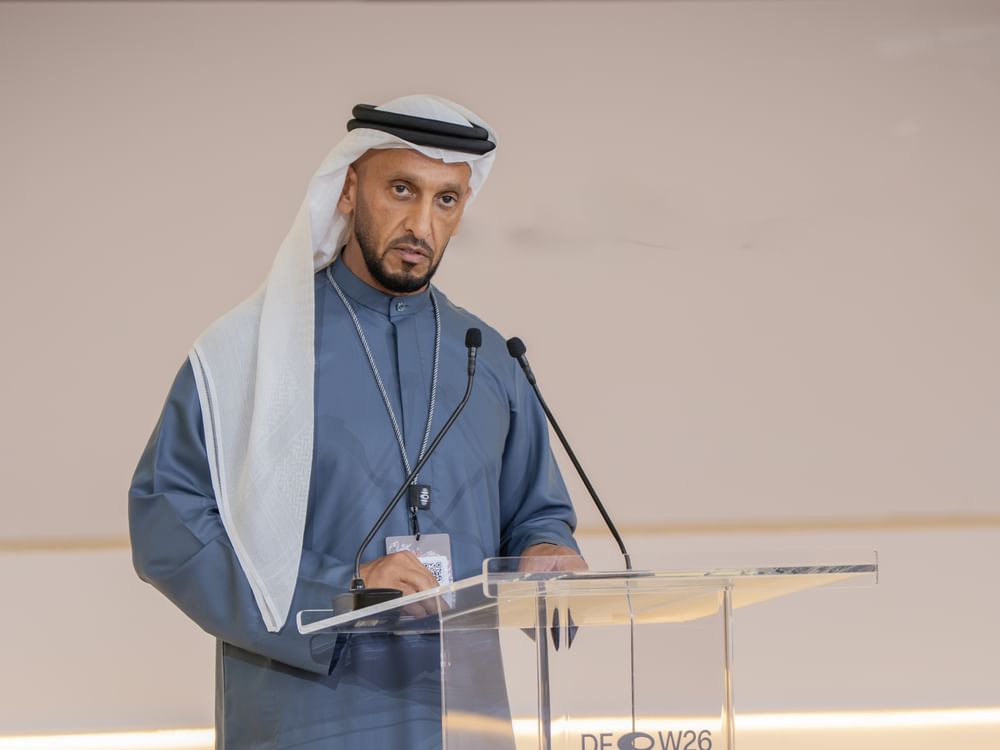
DUBAI, 19th November, 2026 (WAM) -- Abdulla bin Mohammed bin Butti Al Hamed, Chairman of the National Media Authority, emphasised that safeguarding the future of media requires shared responsibility across the entire media ecosystem and a fundamental rethink of the economic incentives shaping content creation and distribution.
He called for a shift towards rewarding content that builds trust, advances knowledge and prioritises human wellbeing, warning that current digital business models can encourage the spread of misleading information at the expense of individuals and societies.
Speaking during a keynote session titled ‘Bermuda Triangle of Media’ at Dubai Future Week 2026, organised by Dubai Future Foundation (DFF) under the theme ‘For the Human of the Future’, Al Hamed identified three interconnected challenges reshaping the global media landscape: the ease of producing misleading content, the growing difficulty of distinguishing truth from falsehood, and the commercialisation of public attention.
Al Hamed stressed that fabricated content is not always motivated by political or ideological objectives. In today's digital environment, misleading narratives can also be produced for commercial gain, with controversy, fear and provocation generating engagement and financial returns.
To illustrate this, he cited an investigation by the Institute for Strategic Dialogue (ISD), in collaboration with the Bureau of Investigative Journalism, which uncovered a network of 128 Facebook accounts and groups reaching a combined audience of more than 1.6 million people.
Al Hamed explained that the greatest danger lies in the interaction between the three forces, creating a system that rewards content according to its ability to attract attention, regardless of its accuracy or consequences.
Addressing the first challenge, Al Hamed highlighted the profound transformation artificial intelligence has brought to content creation.
AI technologies now enable individuals to generate highly realistic footage, recreate locations and produce convincing human performances without filming actual events. While these capabilities open new creative possibilities, they have also significantly lowered the barriers to producing fabricated material and accelerated its dissemination.
He stressed that this places greater responsibility on media organisations to verify information, authenticate sources and uphold professional standards.
The second challenge, he explained, is the increasingly blurred boundary between truth and misconception in an environment where conflicting narratives can emerge around the same event.
The central difficulty is no longer simply accessing information, but distinguishing between what actually happened and what people have been led to believe happened.
Al Hamed identified the attention economy as the third challenge, explaining that it has fundamentally altered the relationship between content, audiences and revenue.
A single piece of content can now cross borders, reach millions of people and generate substantial financial returns for its creator. However, when success is measured primarily through views, clicks and engagement, without sufficient regard for accuracy, quality or social impact, the system can reward content designed to provoke fear, anger and outrage.
He noted that the UAE has made a deliberate choice to place responsibility at the centre of media regulation and professional practice, recognising that a trusted media environment can only be built through cooperation among all stakeholders.
Al Hamed noted that discussions about the future of media at Dubai Future Week extend beyond technological advances and changes in professional practice to address a more fundamental responsibility: shaping the information environment that will influence the awareness, choices and decisions of future generations.
He explained that future generations will possess unprecedented capabilities for creativity and innovation, making it equally important to equip them with the ability to distinguish fact from disinformation and access reliable information to guide their lives and decisions.
Concluding his keynote, Al Hamed emphasised that the future of media will be determined by the choices made today and the values and incentives governing how information is produced, distributed and consumed.
Held at Emirates Towers and the Museum of the Future from 18 to 21 November, Dubai Future Week 2026 features a comprehensive programme of keynote speeches, panel discussions, workshops, debates, challenges and competitions, startup pitches, exhibitions, immersive future experiences, closed-door meetings and offstage activations.