
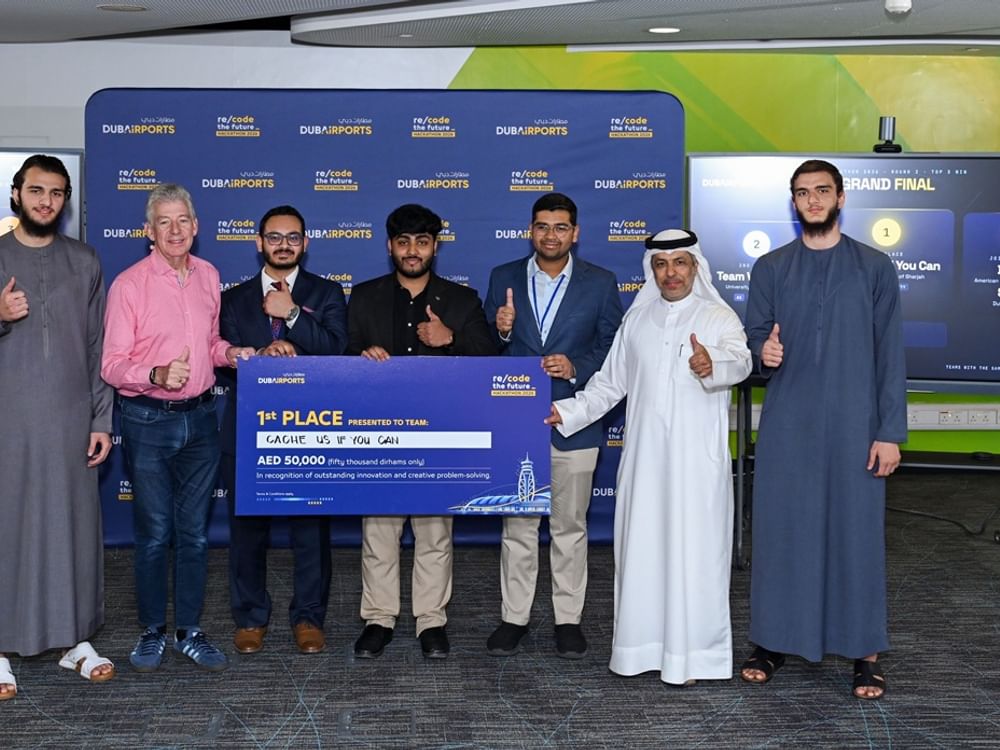
DUBAI, 20th November, 2026 (WAM) -- The Dubai Airports Hackathon 2026, held under the theme "Re-code the Future", brought together 50 school and university students to develop artificial intelligence (AI) solutions addressing real operational challenges at the airport.
Participants developed prototypes aimed at improving operational efficiency and the passenger experience, focusing on early detection of technical faults to prevent flight delays, better decision-making during fog-related low visibility, and helping passengers reach their connecting gates.
Held from 13th to 15th November at the Dubai Airports Learning & Development Centre, the three-day event coincided with UAE Innovation Month, celebrated nationwide through UAE Innovates.
The 50 participants, aged 16 to 22, formed 10 teams of five and developed their prototypes under the guidance of Dubai Airports specialists.
Finalists presented their projects to a judging panel of Dubai Airports executives, including Omar Binadai, Chief Technology & Infrastructure Officer; Ersin Inankul, Senior Vice President – Business Technology; and Ahmad Al Bastaki, Vice President – Technology Operations & Cyber Security.
Cache Us If You Can, from the American University of Sharjah, won first place and AED50,000 for its project, *Basira*, which uses AI to detect technical issues with gate equipment and prioritise responses according to their potential impact on passengers and gate capacity.
The system can recommend measures such as assigning alternative gates or scheduling preventive maintenance, while a digital model helps technical teams identify components requiring attention.
Team Visionary, from the University of Birmingham, secured second place and AED30,000 for *Marsad*, a unified dashboard integrating flight, passenger and operational data to support coordination between airport teams and airlines during disruptions.
Through a simulated fog-related low-visibility scenario, the team demonstrated how the system could prioritise flights and allocate gates while considering tight passenger connections and the operational impact of delays.
Third place was shared by Dubai-It, from the American University in the Emirates, and Spectre, comprising students from different schools. Dubai-It developed *DXB One*, an AI-powered web application helping passengers navigate airport terminals and access facilities and services. Spectre created an operational dashboard enabling airport teams to monitor aircraft disruptions, track communications with relevant parties and confirm receipt of intervention requests.
Each third-place team received AED20,000, bringing the total prize pool to AED120,000.
Omar Binadai, Chief Technology & Infrastructure Officer at Dubai Airports, said AI had made answers easier to obtain, but the more valuable skill was knowing which questions to ask.
He added, "What impressed me about these teams was how willing they were to challenge assumptions that come with working in an airport every day. Their ideas showed why we should involve young people early, when we’re still deciding which problems are worth solving and what a better outcome could look like."
The hackathon provided students with practical experience in developing and presenting AI prototypes while offering Dubai Airports fresh perspectives on everyday operational challenges.
The winning projects demonstrated AI's potential to improve airport operations through early fault detection, better coordination during disruptions and easier passenger navigation.
The copy follows the Arabic's paragraph order and retains the established English names, project titles and executive designations from the supplied English source. The figures are consistent: 50 participants, 10 teams, and AED120,000 in total prizes.