
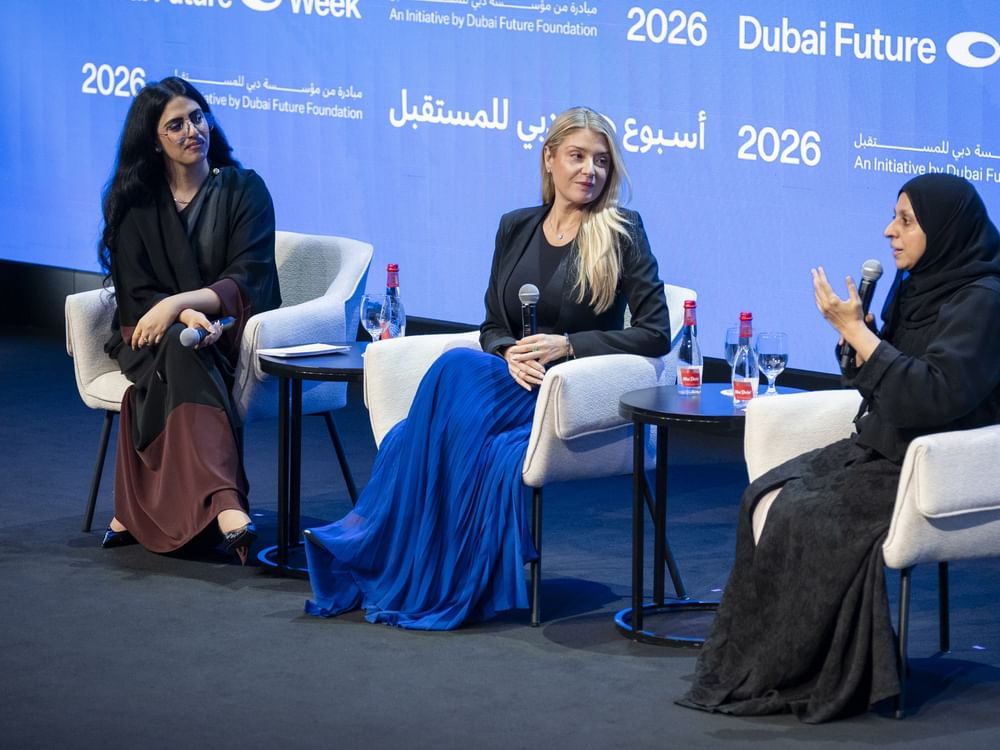
DUBAI, 21st November, 2026 (WAM) -- A panel discussion addressed the question ‘What Are We Not Measuring About Our Bodies?’ at Dubai Future Week 2026, organised by Dubai Future Foundation (DFF) under the theme ‘For the Human of the Future’ from 18 to 21 November.
Keara Sauber, CEO at Incora Health, and Muna Tahlak, CMO & Vice Provost at Dubai Health, joined the conversation with moderator Zahara Sadiq, Founder of Impact Gate Global.
The panel considered women’s health as a powerful dataset, continuous biometrics and differences between individual bodies as healthcare becomes more personalised, predictive and data-driven.
“Historically,” Tahlak said, “when we look at women in medicine and when we want to go back to the data that we have, especially when it comes to the dosing of medicine, it was always men’s data that was used. It was not until not too long ago that women were even considered in trials. That’s a big gap that the whole world is now working to correct.”
Tahlak highlighted evidence that continuous glucose monitoring among pregnant women with type 1 diabetes can improve blood sugar control and lead to better health outcomes for both mothers and babies. She emphasised that translating biometric data into effective clinical care requires accurate, validated measurements that can be meaningfully integrated into digital health records.
Raising a series of pertinent issues, Sauber said: “We have to ask a simple question: Why do you want to know these things? Are you not feeling well? Are you trying to optimise? Are you trying to biohack? Are you trying to conceive? We need to understand why, because you can get lost in this whole longevity and biohacking space. We have enough data right now. We need to understand how to place that data effectively and efficiently to then make decisions.”
Sauber shed light on the limitations of wearable technologies that rely on population-wide health benchmarks rather than individual biological patterns. Drawing on her experience developing continuous biometric monitoring technology, she cautioned against relying on AI-generated health interpretations without understanding the clinical research and datasets underpinning them.
Richer data and a deeper understanding of the body could reshape healthcare, creating a future of care that is truly designed around the individual, the speakers concluded.